
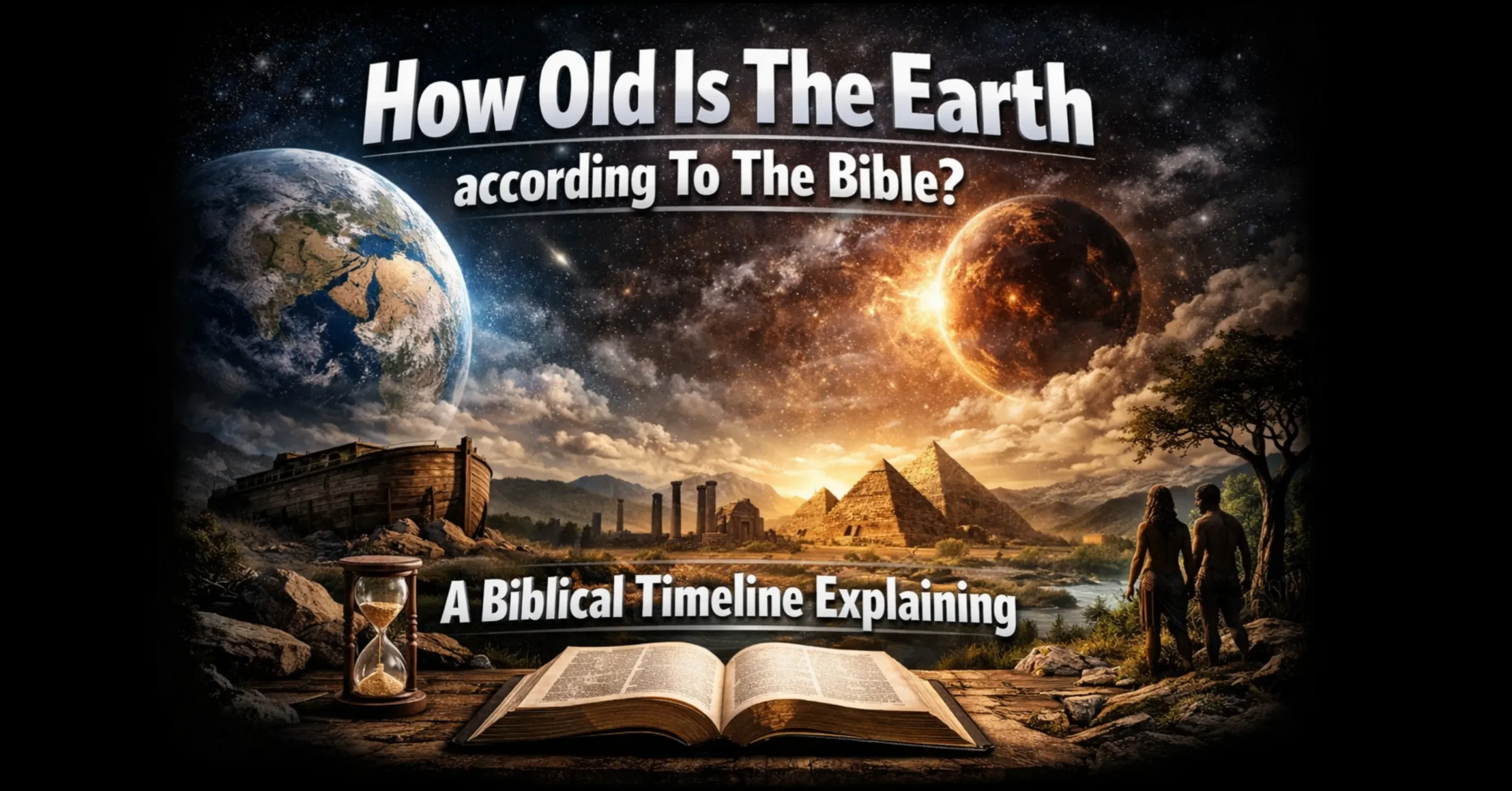
What Does the Bible Say About the Age of the Earth?
When people ask how old is the earth according to the Bible, they’re really asking: Does Scripture tell us when God created the earth, and how long ago that was? This question blends the hunger for spiritual truth with our wonder about God’s creation.
The Bible begins with a clear declaration: “In the beginning God created the heavens and the earth.” (Genesis 1:1, ESV). From this starting point, Scripture provides genealogies and historical markers that invite us to trace the timeline of human history under God’s sovereign revelation. As we follow the biblical record from Adam to Noah, from Abraham to Christ believers have sought to understand God’s timeline for history. This devotional article will explore what the Bible reveals about the age of the earth, how Christian scholars have interpreted it, and what it means for our faith today.
Here, we answer not just factually but spiritually, helping you grow in trust of God’s Word as you meditate on His handiwork and purposes.
Genesis: God’s Creation Week and the Biblical Timeline
The foundational text for understanding the age of the earth according to the Bible begins with the six‐day creation account in Genesis 1. Scripture describes God creating light, sky, land, plants, stars, animals, and finally humanity all within six days before resting on the seventh (Genesis 1:1–2:3).
Many faithful Bible teachers, especially within the young earth creationist tradition, read these days literally as six sequential 24‑hour periods because the Hebrew word yom is used with an ordinal number (“first day,” “second day,” etc.) and is qualified by evening and morning, terms consistently used elsewhere in Scripture to denote normal days.
When we accept a literal framework for Genesis, the six days of creation become our starting point for counting years forward from the creation of Adam. According to many biblical chronologists, Adam’s creation on the sixth day marks the first year of humanity so from Adam’s life onward we can trace decades and centuries recorded in Scripture. Genesis 5 and 11 give genealogies from Adam through Noah and beyond, allowing us to assemble a timeline from creation to later historical events.
This approach doesn’t make the Bible a science textbook; it simply trusts that what God says about beginnings is trustworthy and clear enough for those who read with reverence and diligence. The key question for believers is not just how many years but whether we honor God by trusting His Word as our ultimate authority on history.
“To understand the biblical timeline before the Flood, explore how long it took Noah to build the Ark and the faith behind God’s instructions.”
Estimating the Earth’s Age from Biblical Genealogies
So what happens when we add up the Bible’s timeline? The genealogies in Genesis 5 and 11 trace the lineage from Adam to Abraham. When these lifespans and events are counted and linked with later biblical history up to Christ and beyond, many careful chronologists estimate that the world has been in existence for roughly 6,000 to 7,000 years since creation.
Here’s the spiritual pattern:
- Adam to Noah: The years between Adam’s creation and the Flood provide our earliest figures.
- Noah to Abraham: The genealogies continue, connecting early history to the beginnings of Israel.
- Abraham to Christ: Biblical and secular history together give us a good sense of this period.
- Christ to today: Well‑documented history covers the last two millennia.
As Answers in Genesis explains, when the numbers from Genesis are laid out and connected with known historical markers (like kings and events that echo through Scripture and history), the total arrives at an age close to 6,000 years give or take a few decades depending on how genealogies are interpreted.
Importantly, Scripture itself does not provide a single verse that says, “The earth is exactly X years old.” Instead, it gives timelines that function like a birth certificate a starting point in time from which we read forward under God’s revelation.
From a devotional perspective, the significance isn’t just the number: it’s that God communicates truth about His creative work in His Word, and He invites us to trust Him with what we can discern.
Why Some Christians Believe in a Young Earth
Most Christian sources affirm that Scripture teaches a recent creation, based on its internal chronology and the meaning of the creation days in Genesis. Ministries like the Institute for Creation Research teach that, while the Bible doesn’t give an exact date, honest attempts to determine it using biblical data have consistently pointed to an earth only a few thousand years old most often around 6,000 years.
This view often emphasizes two biblical principles:
- Scripture interprets Scripture — The Bible’s own context and language define the meaning of creation days and genealogies.
- God’s Word is authoritative — We read creation history as genuine revelation, not as ancient myth.
For believers, this affirms that the same God who spoke the world into being (Genesis 1:3) also reveals Himself clearly enough that we can walk in confident obedience and worship, not confusion.
Addressing Common Questions and Misconceptions
Does the Bible directly state the age of the earth?
No verse in Scripture says, “The earth is X years old.” But Scripture gives us genealogical and historical data that function like a timeline from which age can be derived.
Why do some Christians believe in an old earth?
Some believers read Genesis in non‑literal ways (e.g., day‑age or poetic frameworks) and harmonize biblical creation with scientific theories that suggest billions of years. Others approach Genesis primarily as theological narrative rather than precise chronological history.
Is the age of the earth a salvation issue?
No our salvation rests on Christ (Ephesians 2:8–9). Whether one holds to a young earth or old earth view, what matters most is honoring Scripture and Christ as Lord.
In all discussions, Christians are called to humility, grace, and unity in essentials, charity in non‑essentials, and devotion in all things.
Conclusion: Eternal Truth Over Numbers
When we ask how old the earth is according to the Bible, we are really asking a deeper spiritual question: Can we trust God’s Word to guide us in understanding the world He made? Scripture provides a reliable framework that points to a history of thousands not billions of years, anchored in God’s revealed timeline.
Yet the true heart of this question isn’t a number it’s faith in the Creator who made time and existence itself. The Bible invites us to marvel at God’s handiwork, to read His Word attentively, and to live in awe of His eternal purposes.
As we meditate on creation and revelation, may we remember the words of Psalm 19:1:
“The heavens declare the glory of God, and the sky above proclaims his handiwork.”
Whether we focus on thousands of years or billions, the ultimate truth remains: God is the Creator, Sustainer, and Redeemer of all.

Hi, I’m Prashanta Kumbhar, a Christian blogger, faith writer, and the founder of Light and Gospel (LightandGospel.com), based in Odisha, India.
I regularly write Bible devotionals, prayers, Scripture reflections, and faith-based messages to encourage people in their daily walk with Jesus Christ and help them grow in hope, faith, and spiritual strength.
Along with blogging, I also create Christian content on my YouTube channel “The God Helps” and share faith, prayer, Bible study, and motivational messages across social media platforms like Facebook & Instagram. My mission is to make God’s Word simple, practical, & meaningful for everyday life.