
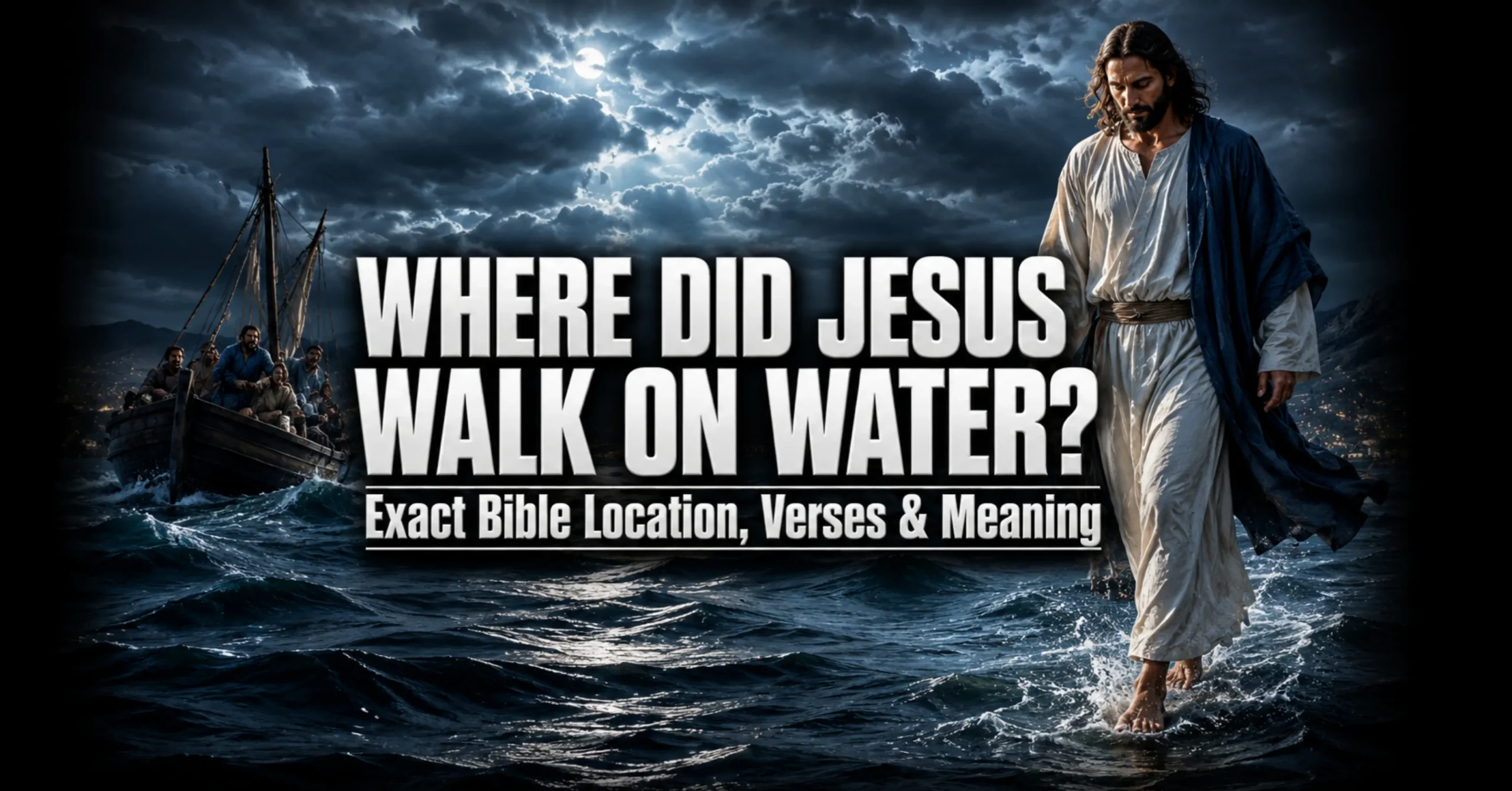
Have you ever wondered where did Jesus walk on water and why this miracle took place there? The Bible clearly records that Jesus walked on the Sea of Galilee, one of the most well-known locations in His earthly ministry. This remarkable event appears in the Gospels of Matthew, Mark, and John, with each account adding valuable details to the story.
Understanding the exact location and biblical context does more than answer a historical question. It helps us see why this miracle mattered to the disciples and what it revealed about Jesus’ authority over creation. In this guide, we’ll explore where the miracle happened, the Bible verses that describe it, what occurred before and after the event, and the lasting lessons believers can learn today.
Where Did Jesus Walk on Water?
The Exact Biblical Location
The simple answer is that Jesus walked on the Sea of Galilee, a freshwater lake in northern Israel that played a central role in His ministry. Many of Jesus’ miracles, teachings, and encounters with His disciples took place around its shores, making it one of the most significant locations in the New Testament.
According to the Gospel accounts, the disciples had left by boat after Jesus miraculously fed the five thousand. They were crossing the Sea of Galilee while Jesus stayed behind to pray alone on a mountainside. During the night, strong winds created rough conditions, and the disciples struggled against the waves. It was then that Jesus came to them, walking on the water.
Although the Bible does not provide exact coordinates, the journey appears to have taken place between Bethsaida and the area of Gennesaret, with Capernaum also mentioned in John’s account as the destination. These places all lie along the Sea of Galilee, helping readers understand the setting of this extraordinary miracle.
Rather than focusing on a precise spot on a map, Scripture emphasizes that Jesus met His disciples in the middle of a dangerous storm. The location highlights both the reality of the disciples’ fear and Jesus’ complete authority over nature.
Where the Disciples Were Traveling
After feeding the crowd, Jesus instructed His disciples to get into the boat and cross the Sea of Galilee ahead of Him. While they obeyed, a strong wind slowed their progress, leaving them far from shore during the night.
John’s Gospel notes that the disciples had rowed several miles before they saw Jesus approaching them on the water. This detail shows that they were well away from land when the miracle occurred, making the event even more remarkable.
The route across the Sea of Galilee was familiar to experienced fishermen like Peter, Andrew, James, and John. Yet even with their experience, they found themselves powerless against the storm until Jesus appeared.
Where Jesus Met Them on the Water
Jesus came to the disciples during the fourth watch of the night, walking across the sea toward their boat. At first, they were terrified and thought they were seeing a ghost. Jesus immediately reassured them by saying, “Take courage! It is I. Don’t be afraid.”
Matthew’s Gospel records that Peter stepped out of the boat and briefly walked on the water toward Jesus before fear caused him to sink. Jesus reached out, saved Peter, and together they entered the boat. As soon as they did, the wind ceased, leading the disciples to worship Him and declare, “Truly you are the Son of God.”
This miracle was not only about where Jesus walked on water but also about revealing His divine identity and strengthening the faith of those who followed Him.
Where in the Bible Did Jesus Walk on Water?
The miracle of Jesus walking on water is recorded in three Gospel accounts. Each writer shares the same event from a slightly different perspective, giving readers a fuller understanding of what happened without contradicting one another.
Matthew 14:22–33
Matthew provides the most detailed account of the miracle. After sending the disciples ahead by boat, Jesus went up a mountainside to pray alone. During the night, He walked across the Sea of Galilee toward the disciples as they struggled against strong winds.
This account also includes Peter stepping out of the boat. Peter walked on the water while keeping his eyes on Jesus, but he began to sink when fear replaced faith. Jesus immediately reached out, rescued him, and gently challenged his doubt. When they entered the boat, the wind stopped, and the disciples worshiped Jesus, recognizing Him as the Son of God.
Mark 6:45–52
Mark’s Gospel focuses on the disciples’ struggle during the storm and Jesus’ compassion for them. He explains that Jesus saw them straining at the oars before coming to them during the fourth watch of the night.
Mark also highlights that the disciples were amazed because they had not yet fully understood the significance of the earlier miracle of feeding the five thousand. This connection shows that Jesus’ miracles consistently revealed His divine power and identity.
John 6:16–21
John gives additional geographical details about the event. He explains that the disciples had rowed several miles across the Sea of Galilee when they saw Jesus walking toward the boat.
John also records an important detail not emphasized in the other Gospels: once Jesus entered the boat, they immediately reached the shore where they were heading. This highlights both the miracle itself and Jesus’ complete authority over the situation.
How the Three Gospel Accounts Work Together
Rather than telling different stories, Matthew, Mark, and John each emphasize unique details of the same miracle.
- Matthew focuses on Peter’s experience and the disciples’ growing faith.
- Mark highlights Jesus’ care for His disciples and their struggle to understand His miracles.
- John adds valuable geographical context and explains how the journey ended.
Together, these three accounts clearly answer where in the Bible did Jesus walk on water. The miracle is recorded in Matthew 14:22–33, Mark 6:45–52, and John 6:16–21, giving readers a complete biblical picture of one of Jesus’ most well-known miracles.
What Happened Before and After Jesus Walked on Water?
Understanding what happened before and after this miracle helps place it in its proper biblical context. The Gospel writers present these events as part of a continuous story, showing that Jesus was revealing His power and preparing His disciples for a deeper faith.
Before the Miracle: The Feeding of the Five Thousand
Before Jesus walked on water, He performed another well-known miracle by feeding more than five thousand people with five loaves of bread and two fish. After the crowd had eaten, Jesus instructed His disciples to get into the boat and cross the Sea of Galilee while He dismissed the people and went to pray alone.
This sequence is important because it shows that the miracle of walking on water did not happen in isolation. It followed a day in which Jesus had already demonstrated His compassion and divine power, preparing the disciples for another extraordinary sign.
After the Miracle: Arrival at Gennesaret
After Jesus entered the boat, the storm ended, and the disciples safely reached the other side of the Sea of Galilee. The Gospels identify this area as Gennesaret, while John’s account notes they arrived at the place they intended to reach.
Once they came ashore, people quickly recognized Jesus. News of His arrival spread throughout the surrounding region, and many brought those who were sick to Him. The Bible records that everyone who touched the edge of His cloak was healed.
These events show that the miracle was not simply about calming a storm or walking on water. It marked the beginning of another powerful moment in Jesus’ ministry, where His authority and compassion continued to be revealed through His teaching and healing.
Why Is This Miracle Important?
The miracle of Jesus walking on water is one of the clearest demonstrations of His divine authority in the Gospels. It was not performed merely to amaze the disciples but to strengthen their faith and reveal who He truly is.
What the Miracle Reveals About Jesus
By walking on the Sea of Galilee, Jesus showed that He has authority over the natural world. In Scripture, the sea often represents chaos and danger, yet Jesus crossed it without fear and brought peace to His followers.
The disciples had already witnessed many miracles, but this event deepened their understanding of His identity. After the storm stopped, they worshiped Him and declared, “Truly you are the Son of God.” Their response shows that the miracle pointed beyond the event itself to the person of Jesus.
Peter Walks on Water
Matthew’s Gospel includes Peter’s unique experience. When Peter asked to come to Jesus on the water, Jesus invited him to step out of the boat. As long as Peter focused on Jesus, he walked on the water. When he became distracted by the wind and waves, fear overcame him, and he began to sink.
Jesus immediately reached out and saved Peter, reminding him to trust instead of doubt. This moment offers an enduring lesson for believers: faith grows stronger when our attention remains on Christ, even during life’s most difficult storms.
Conclusion
The answer to where did Jesus walk on water is found in the Gospel accounts: Jesus walked on the Sea of Galilee as He came to His disciples during a storm. This miracle is recorded in Matthew 14:22–33, Mark 6:45–52, and John 6:16–21, each adding valuable details that deepen our understanding of the event.
More than identifying a location, this miracle reveals Jesus’ authority over creation, His care for His followers, and His power to bring peace in the midst of fear. Reading the complete Gospel accounts helps us appreciate both the historical setting and the lasting spiritual message of one of the Bible’s most remarkable miracles.

Hi, I’m Prashanta Kumbhar, a Christian blogger, faith writer, and the founder of Light and Gospel (LightandGospel.com), based in Odisha, India.
I regularly write Bible devotionals, prayers, Scripture reflections, and faith-based messages to encourage people in their daily walk with Jesus Christ and help them grow in hope, faith, and spiritual strength.
Along with blogging, I also create Christian content on my YouTube channel “The God Helps” and share faith, prayer, Bible study, and motivational messages across social media platforms like Facebook & Instagram. My mission is to make God’s Word simple, practical, & meaningful for everyday life.