
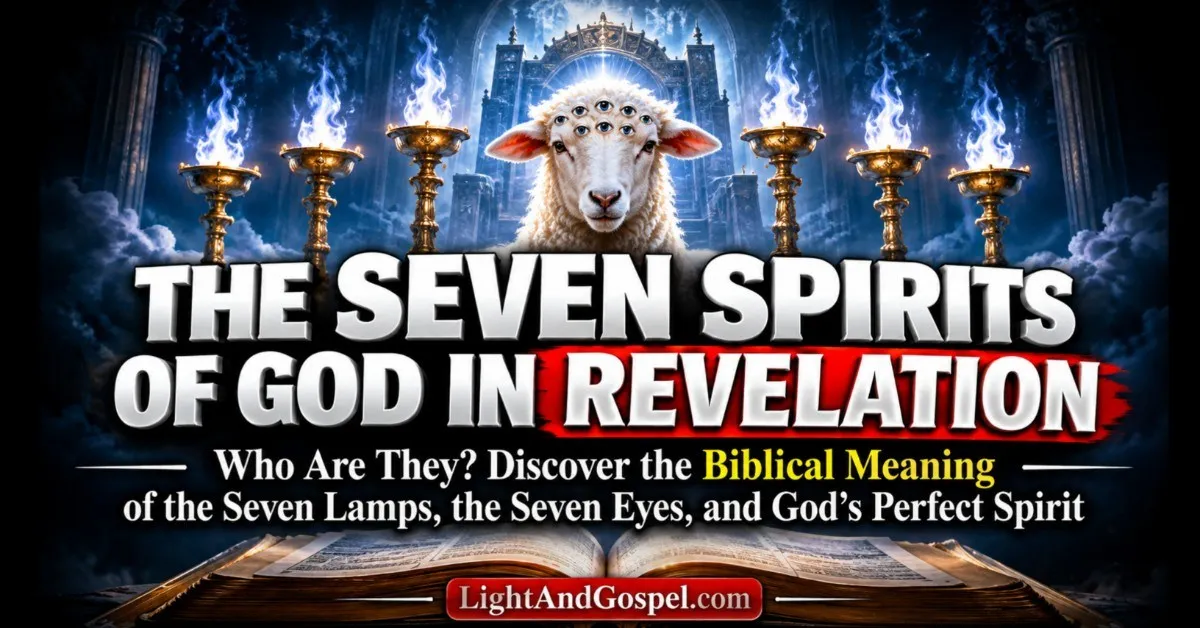
What are the seven Spirits of God in Revelation? Many Christians understand them as a symbolic description of the one Holy Spirit in His fullness and perfect work. Others believe they refer to seven heavenly beings or angels. The question remains debated because Revelation describes the seven Spirits but never directly explains their identity.
John mentions the seven Spirits in Revelation 1:4, 3:1, 4:5, and 5:6. He describes them in connection with God’s throne, Jesus Christ, seven burning lamps, and the seven eyes of the Lamb. Isaiah 11:2–3 is also important to this discussion because it describes the Spirit of the LORD resting upon the coming Messiah.
Where Are the Seven Spirits of God Mentioned in Revelation?
The seven Spirits of God are mentioned in four passages in Revelation. Each passage presents a different image or connection.
| Bible passage | Description |
|---|---|
| Revelation 1:4 | The seven Spirits before God’s throne |
| Revelation 3:1 | Christ has the seven Spirits of God and the seven stars |
| Revelation 4:5 | Seven burning lamps before God’s throne |
| Revelation 5:6 | The Lamb’s seven eyes, identified as the seven Spirits sent into all the earth |
Revelation 1:4 – The Seven Spirits Before God’s Throne
John opens Revelation with a greeting to the seven churches in Asia, extending grace and peace from God, the seven Spirits before His throne, and Jesus Christ (Revelation 1:4–5). The next verse describes Jesus as the faithful witness, the firstborn from the dead, and the ruler of the kings of the earth.
Many Christians understand the seven Spirits in this greeting as the Holy Spirit. Their place alongside God and Jesus is one reason for this view, though the verse does not directly identify them as the Holy Spirit.
The number seven appears throughout Revelation, including in the seven churches, seals, and trumpets. Many readers take it as a symbol of completeness or fullness. On that reading, the seven Spirits represent the fullness of the one Holy Spirit, rather than seven separate spirits. This is an interpretation of the symbolism, not an explanation John gives in the verse.
Revelation 3:1 – Christ and the Seven Spirits
In His message to the church in Sardis, Jesus identifies Himself as the One who has the seven Spirits of God and the seven stars (Revelation 3:1). The verse places the Spirits in connection with Christ but does not explain the precise meaning of this image.
Jesus warns Sardis that, despite its reputation for being alive, the church is dead. He calls it to wake up and strengthen what remains. This warning provides the immediate context for the reference to the seven Spirits and the seven stars.
Revelation 4:5 – The Seven Lamps of Fire
In John’s vision of God’s throne, seven burning lamps stand before it. Revelation 4:5 identifies these lamps as the seven Spirits of God.
The imagery recalls Zechariah 4, where the prophet sees a golden lampstand and hears that God’s work will be accomplished “by my Spirit,” not by might or power (Zechariah 4:6). This parallel is one reason readers connect Revelation’s lamps with the Holy Spirit. The two visions share imagery, but each passage must be understood in its own context.
Revelation 5:6 – The Seven Eyes of the Lamb
John sees a Lamb standing as though it had been slain, with seven horns and seven eyes. Revelation 5:6 identifies the seven eyes as the seven Spirits of God sent out into all the earth.
The image links the seven Spirits directly with the Lamb. The surrounding scene focuses on the slain Lamb, who is worthy to take the scroll and open its seals. The verse identifies the eyes with the seven Spirits but does not assign a separate meaning to each eye.
Zechariah 4:10 also speaks of the eyes of the LORD ranging throughout the earth. This may provide background for Revelation’s imagery, although Revelation 5:6 makes its own identification: the Lamb’s seven eyes are the seven Spirits of God.
Are the Seven Spirits of God the Holy Spirit?
Many Christians understand the seven Spirits of God as a symbolic description of the one Holy Spirit in His fullness. This interpretation draws on the way Revelation presents the Spirits alongside God and Jesus (Revelation 1:4), identifies them with the burning lamps before God’s throne (Revelation 4:5), and connects them with the Lamb’s seven eyes (Revelation 5:6). The repeated use of the number seven throughout Revelation also supports a symbolic reading of completeness.
The imagery in Zechariah 4, especially the declaration that God’s work is accomplished “by my Spirit” (Zechariah 4:6), is another reason some readers connect Revelation’s lamps with the Holy Spirit.
However, Revelation does not explicitly say that the seven Spirits are the Holy Spirit. This interpretation brings together several biblical images; it is not a direct definition given by John. The alternative view—that the seven Spirits are heavenly beings—is discussed in the next section.
For more on the Spirit’s work, see the work of the Holy Spirit.
What Does Isaiah 11:2 Have to Do With the Seven Spirits?
Isaiah 11:2–3 is an important passage in discussions about the seven Spirits of God in Revelation. Isaiah describes a shoot growing from the stump of Jesse, referring to a future ruler from David’s family. Christians understand this prophecy as pointing to the Messiah, Jesus Christ, upon whom the Spirit of the LORD would rest.
The passage describes the Spirit through qualities associated with the ruler’s wisdom, judgment, strength, and reverence for God. However, the Hebrew text and the ancient Greek translation known as the Septuagint present these qualities differently.
The Hebrew text names six attributes in three pairs: wisdom and understanding, counsel and might, and knowledge and the fear of the LORD. The Septuagint presents a sevenfold arrangement. It uses piety for the first reference to the fear of the LORD and includes the fear of God as a further description in Isaiah 11:3.
This difference helps explain why Isaiah 11 became important in the Christian understanding of the sevenfold Spirit. However, Isaiah does not directly identify these qualities with the seven Spirits in Revelation. That connection is an interpretation drawn from the biblical imagery, not an explicit statement in either passage.
The Sevenfold Description of the Spirit
In the traditional Christian sevenfold list based on the Greek text, the qualities are:
- Wisdom – Making sound judgments.
- Understanding – Recognizing what is right and true.
- Counsel – Giving or receiving wise guidance.
- Might – Strength to carry out what is right.
- Knowledge – Knowing and discerning God’s purposes.
- Piety – Living with reverence and devotion toward God.
- Fear of God – Honoring God with reverence and obedience.
These are descriptions of the Spirit’s work and the qualities associated with the coming ruler, not seven independent spirits. The central message of Isaiah 11 is that God’s Spirit equips the promised Davidic ruler to govern with wisdom, justice, and righteousness.
Are the Seven Spirits Seven Angels?
Some interpreters understand the seven Spirits of God as seven heavenly beings or angels who stand before God. They compare Revelation 1:4, which places the seven Spirits before God’s throne, with Revelation 8:2, where John sees seven angels standing before God and receiving seven trumpets.
However, Revelation 8:2 calls these beings angels, while the other passages use the phrase “seven Spirits of God.” John never directly says that the seven Spirits and the seven angels are the same group. The two descriptions may be related, but the text does not establish that they are identical.
The angel interpretation remains a debated possibility, not an explicit identification in Revelation.
What Does the Bible Clearly Say– and What Is Interpretation?
The Bible identifies the seven Spirits of God through several images, including the burning lamps before God’s throne (Revelation 4:5) and the seven eyes of the Lamb (Revelation 5:6). It also describes seven angels standing before God (Revelation 8:2), but does not directly identify them as the seven Spirits.
The connection between Isaiah 11:2–3 and Revelation’s seven Spirits is an interpretation based on the biblical descriptions of the Spirit resting upon the coming Messiah. Similarly, understanding the seven Spirits as the one Holy Spirit in His fullness or as heavenly beings involves interpreting Revelation’s symbolic language.
These distinctions matter. We can be confident about what the passages actually say while recognizing that the precise identity of the seven Spirits remains a matter of interpretation.
For a broader understanding of the relationship between God the Father, Jesus Christ, and the Holy Spirit, see what the Bible teaches about the Trinity.
Frequently Asked Questions
Are the Seven Spirits of God the Same as the Holy Spirit?
Many Christians understand the seven Spirits of God as a symbolic description of the one Holy Spirit in His fullness. They connect this interpretation with Revelation’s imagery and Isaiah 11:2–3. However, Revelation does not directly identify the seven Spirits as the Holy Spirit, and some interpreters understand them as heavenly beings or angels.
Does the Bible Give the Seven Names of the Holy Spirit?
No. The Bible does not provide a formal list of seven names of the Holy Spirit. Isaiah 11:2–3 describes the Spirit resting upon the coming Messiah and associates Him with wisdom, understanding, counsel, might, knowledge, and the fear of the LORD. The Septuagint, an ancient Greek translation of the Old Testament, presents a sevenfold arrangement by including piety as a separate description. These are qualities associated with the Spirit, not seven formal names.
What Are the Seven Powers of the Holy Spirit?
The expression “seven powers of the Holy Spirit” is not a formal biblical phrase. Some people use it to refer to the sevenfold description associated with Isaiah 11:2–3, including wisdom, understanding, counsel, might, knowledge, piety, and fear of the LORD. These describe the Spirit’s qualities and work rather than seven independent powers.
Conclusion
The seven Spirits of God in Revelation are commonly understood by Christians as a symbolic picture of the fullness of the one Holy Spirit. Isaiah 11:2–3 provides an important biblical connection for this interpretation by describing the Spirit resting upon the coming Messiah.
However, Revelation does not directly explain the identity of the seven Spirits. While many Christians understand them as the Holy Spirit, others interpret them as heavenly beings or angels.
The important thing is to distinguish what Scripture clearly says from what we conclude through interpretation. Studying these passages together helps us understand the biblical imagery while remaining careful not to claim more than the text reveals.

Hi, I’m Prashanta Kumbhar, a Christian blogger, faith writer, and the founder of Light and Gospel (LightandGospel.com), based in Odisha, India.
I regularly write Bible devotionals, prayers, Scripture reflections, and faith-based messages to encourage people in their daily walk with Jesus Christ and help them grow in hope, faith, and spiritual strength.
Along with blogging, I also create Christian content on my YouTube channel “The God Helps” and share faith, prayer, Bible study, and motivational messages across social media platforms like Facebook & Instagram. My mission is to make God’s Word simple, practical, & meaningful for everyday life.