
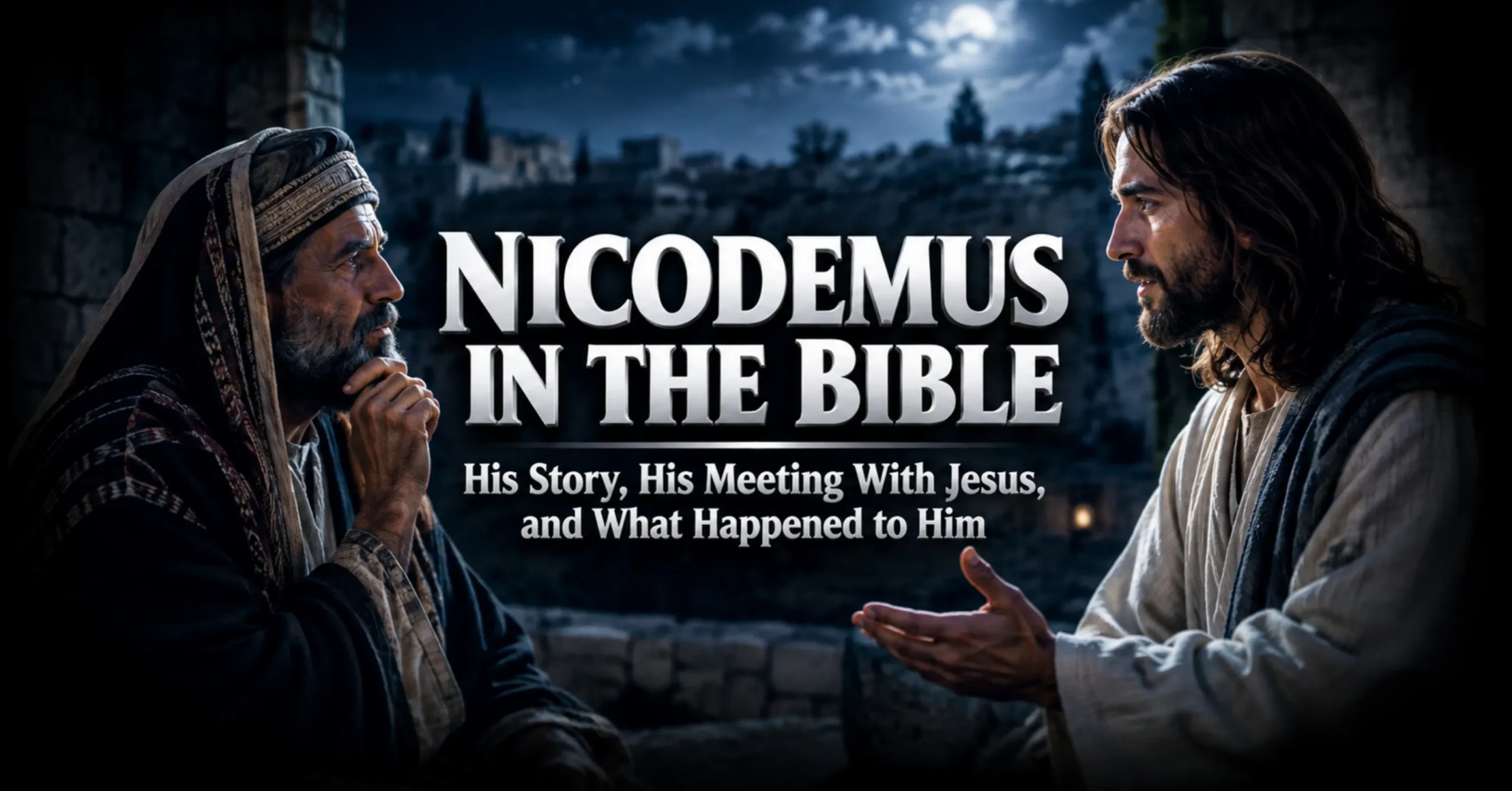
Nicodemus in the Bible is one of those figures readers keep coming back to. John 3:1 introduces him as a Pharisee and a ruler of the Jews, placing him among the religious leaders in Jerusalem. He appears three times in the Bible, all in John’s Gospel. He first came to Jesus at night, recognizing that God was at work through him (John 3:1–2). Later, he urged his fellow leaders to give Jesus a fair hearing (John 7:50–51), and after Jesus’ crucifixion, he helped prepare his body for burial (John 19:39–40).
His story, however, leaves an important question unanswered. Scripture never directly tells us whether Nicodemus came to believe in Jesus or was saved. We can see what he said and did in John’s Gospel, but we should be careful not to claim more than the Bible tells us.
Who Was Nicodemus?
John gives us a short but important description of Nicodemus. He was “a man of the Pharisees” and “a ruler of the Jews” (John 3:1). The Pharisees were a Jewish religious group known for their careful attention to the Law and religious traditions. Calling Nicodemus a “ruler of the Jews” places him among the Jewish leadership of his time.
Nicodemus appears again in John 7:50–51, when the chief priests and Pharisees are discussing what to do about Jesus. He reminds them that their own law requires a person to be heard before being judged. His role in that discussion strongly suggests that he was connected with the Jewish ruling council, often identified as the Sanhedrin, although John does not explicitly call Nicodemus a member of the Sanhedrin.
Jesus also calls him “the teacher of Israel” (John 3:10), which shows that Nicodemus held an important teaching role within Israel’s religious life.
So, who was Nicodemus? He was a Jewish religious leader, a Pharisee, and a teacher who came to Jesus with serious questions and continued to appear in key moments of Jesus’ story.
Nicodemus Meets Jesus at Night (John 3:1–21)
This is the conversation that introduces Nicodemus to us, and it is the most detailed account we have of his interaction with Jesus.
Why Did Nicodemus Come at Night?
John simply says that Nicodemus came to Jesus at night (John 3:2). He does not tell us why. That is an important detail to leave open rather than fill in with certainty.
Several explanations are possible. Nicodemus may have wanted a private conversation with Jesus. He may also have been cautious about being seen with him because Jesus had already attracted attention among the religious leaders. But the text does not tell us his reason, so we should treat these as possibilities, not facts.
John brings up the night visit again when Nicodemus speaks up in John 7:50 and when he appears at Jesus’ burial in John 19:39. The repeated reference connects these later moments with his first meeting with Jesus, even though John never explains what was happening in Nicodemus’s heart.
“You Must Be Born Again” (John 3:3)
Nicodemus acknowledges what he has seen. He tells Jesus that they know he is a teacher who has come from God because no one could perform these signs unless God were with him (John 3:2). Jesus responds with something Nicodemus was not expecting: unless a person is born again, he cannot see the kingdom of God (John 3:3).
The Greek word behind “born again” is anōthen, and it can mean “again” or “from above.” Both senses help us understand Jesus’ words. This is not a fresh start that a person produces simply by trying harder. It is a new work that comes from God and involves the Holy Spirit’s work in a person.
Nicodemus understands Jesus’ words in terms of physical birth and asks how a grown man could enter his mother’s womb a second time (John 3:4). His question shows that he has not yet understood what Jesus means. Jesus does not mock him. Instead, he continues explaining.
Born of Water and the Spirit (John 3:5)
Jesus restates the point: no one enters the kingdom of God without being born of water and the Spirit (John 3:5).
Christians have understood “water” in a few different ways. Some understand it as natural physical birth, set in contrast with spiritual birth. Some connect it to baptism. Others see an echo of Old Testament cleansing promises, especially Ezekiel 36:25–27, where God promises to cleanse his people and put his Spirit within them. If you want to look at that question more closely, we cover it in Can You Receive the Holy Spirit Without Being Baptized?
There is genuine disagreement over the meaning of “water,” so it is better not to claim more than the text allows. Whatever interpretation is taken, Jesus makes clear that entering God’s kingdom requires a birth that comes from God and involves the Spirit.
Why Nicodemus Struggled to Understand
Jesus compares the Spirit to the wind: you hear its sound, but you cannot tell where it comes from or where it goes (John 3:8). Nicodemus still asks how these things can be (John 3:9).
Jesus then asks how Nicodemus, “the teacher of Israel,” can fail to understand these things (John 3:10). The point is not that Nicodemus was unintelligent. Rather, Jesus is challenging him as a teacher of Israel to understand what God is revealing about the new birth.
The Heart of the Conversation: John 3:16
The passage does not stay in the realm of theory. Jesus points back to Moses lifting up the serpent in the wilderness and says the Son of Man must be lifted up in the same way, so that whoever believes in him may have eternal life (John 3:14–15).
The conversation then leads into one of the best-known verses in the Bible. John 3:16 says that God loved the world and gave his only Son, so that everyone who believes in him would not perish but have eternal life. The next verse adds that the Son was not sent to condemn the world but to save it (John 3:17).
The verse is often quoted on its own. It takes on added meaning when you remember the setting: a nighttime conversation with a religious leader who had just admitted that he did not understand what Jesus was saying.
Nicodemus Speaks Up for Jesus (John 7:45–52)
Some people ask why Nicodemus never did anything to help Jesus. The question overlooks something John records: Nicodemus did speak up for Jesus by calling for a fair hearing.
At the Feast of Booths, temple officers sent to arrest Jesus came back empty-handed, saying, “No one ever spoke the way this man does” (John 7:45–46). The Pharisees accused the officers of being deceived and said that the crowd did not know the law (John 7:47–49).
That is when Nicodemus speaks. He asks whether their own law condemns a man before hearing him and finding out what he has done (John 7:50–51). It is a legal point, not a confession of faith, but it is a real intervention in the discussion.
Their response does not directly address his point. They ask whether he is from Galilee too and tell him to search and see that no prophet comes from Galilee (John 7:52). They dismiss his objection rather than answering the legal question he raised.
We should not overstate this moment. Nicodemus did not declare Jesus to be the Messiah. He did, however, speak up when the other leaders were moving against Jesus without giving him a proper hearing.
Nicodemus Helps Bury Jesus (John 19:38–42)
The last time Nicodemus appears in John’s Gospel, Jesus has been crucified and is dead.
Joseph of Arimathea, whom John explicitly calls a disciple, though a secret one because of fear (John 19:38), asks Pilate for Jesus’ body. Nicodemus comes with him, and John reminds readers that this is the man who had first come to Jesus at night (John 19:39).
Nicodemus brings a mixture of myrrh and aloes. John gives the amount as about a hundred Roman litrai, which modern translations render as roughly seventy-five pounds or about thirty-four kilograms, depending on the conversion used. Whatever the precise figure, John is describing a very large quantity of burial spices.
Together they wrap Jesus’ body in linen with the spices, following Jewish burial custom, and lay him in a new tomb in the garden (John 19:40–42).
John does not tell us what Nicodemus was thinking or feeling. What we can see is the contrast with his first visit. That one happened at night. This time, Nicodemus is openly involved in caring for the body of a man who had just been executed. And John has already identified him as a ruler of the Jews (John 3:1).
Was Nicodemus Saved?
Scripture never tells us. That is the honest answer, and it is worth saying plainly before saying anything else.
John never explicitly says that Nicodemus believed in Jesus or became his disciple. Compare that with Joseph of Arimathea, whom John does identify as a disciple (John 19:38). That distinction is important.
At the same time, Nicodemus’s actions are worth considering. He came to Jesus with serious questions. He spoke up when the religious leaders were discussing how to deal with Jesus, calling for him to receive a proper hearing (John 7:50–51). Then, after Jesus’ death, he helped prepare his body for burial and brought a large quantity of spices (John 19:39–40). John never records Nicodemus turning against Jesus.
Some readers see these actions as evidence that Nicodemus was moving toward faith, while others are more cautious because John never tells us what he ultimately believed. We can say that his actions show increasing involvement in Jesus’ story, but we cannot turn that into a definite statement about his salvation.
So was Nicodemus saved? The Bible does not give us enough information to say for certain. His story leaves us with evidence worth considering, but not a clear statement of his final spiritual condition. The Bible tells us what God wanted us to know, not everything we happen to be curious about.
Did Nicodemus Follow Jesus?
This question overlaps with the last one, but it is not identical. Salvation concerns a person’s relationship with God, while being described as a disciple or follower points to a person’s relationship to Jesus as presented in the Gospel accounts.
By that measure, the biblical record about Nicodemus is limited. He is never listed among the Twelve, never described as traveling with Jesus, and never said to have left his position to follow him. John also never calls him a disciple, even though John uses that word for Joseph of Arimathea in John 19:38.
Nicodemus’s last recorded act is helping prepare Jesus’ body for burial. After that, John says nothing more about him.
So we can say that Nicodemus repeatedly appears in important moments involving Jesus, from his nighttime conversation in John 3 to his defense of a fair hearing in John 7 and his involvement in Jesus’ burial in John 19. But we cannot say that Scripture presents him as a follower or disciple in the same clear way it presents Peter, John, or Mary Magdalene.
What Happened to Nicodemus? How Did He Die?
The Bible does not tell us. Once the burial account ends, Nicodemus disappears from Scripture. There is no biblical account of his death, no recorded location, no cause of death, and no record of later ministry.
Later Christian tradition filled in some of that silence. Britannica notes that hagiographical traditions describe Nicodemus as being ostracized by the Pharisees because of his sympathy toward Jesus and say that he spent the rest of his life in the home of Gamaliel, another Jewish religious leader. These claims come from later tradition, not from the New Testament.
Catholic and Orthodox traditions venerate Nicodemus as a saint. Some Orthodox accounts say that he died after weeping over the grave of Stephen and was buried with Stephen, Gamaliel, and Abibus. These accounts are part of later Christian tradition, not the biblical record.
So, how did Nicodemus die? We do not know. The Bible gives us no account of his death, and later traditions cannot be treated as established historical fact. Anyone who states confidently exactly how Nicodemus died is going beyond what Scripture tells us.
The Meaning of the Name Nicodemus
The name comes from Greek, Nikódēmos, and is commonly understood as a combination of nikē (“victory”) and dēmos (“the people”), giving the meaning “victory of the people.”
A Greek name among a Jewish religious leader was not unusual in the first century. Greek language and culture had a significant presence in the Jewish world of that time. But it is probably a mistake to read a deeper theological meaning into Nicodemus’s name. His name tells us something about his cultural setting, not about his spiritual condition.
Is the “Gospel of Nicodemus” Part of the Bible?
No. The Gospel of Nicodemus is not part of the Bible or the biblical canon.
It is a later non-canonical Christian writing, also known as the Acts of Pilate. It is generally dated to the fourth or fifth century. The title “Gospel of Nicodemus” is also a later name for the work. The text expands on Jesus’ trial before Pilate and includes a well-known account of Christ’s descent to the dead.
The work was written long after the New Testament period, so it is not regarded as a writing by the Nicodemus described in John’s Gospel. Although it carries his name, there is no historical evidence that the biblical Nicodemus wrote it.
The Gospel of Nicodemus can be studied as a later Christian text that shows how Christians expanded and retold parts of the Gospel story. But it is not Scripture, not a first-century eyewitness account, and not a lost book of the Bible.
Nicodemus in “The Chosen”: What’s Biblical and What’s Added
The Chosen portrays Nicodemus as a fuller character than the Bible does, but the series is a dramatization rather than a verse-by-verse retelling of Scripture. Creator Dallas Jenkins has said that viewers should turn to the Bible for the biblical account and that the show should not replace Scripture.
A couple of examples make the difference clear. The series gives Nicodemus a wife named Zohara, a character who does not appear in Scripture, and in the Season 1 finale has him decide not to follow Jesus. The Bible does not record either of those details. These are additions made for the show’s dramatic storytelling.
That does not mean the series cannot be useful or meaningful to watch. It simply means we should keep the distinction clear. The Nicodemus we can know from Scripture is the man we meet in John 3, John 7, and John 19.
What Nicodemus Teaches Us Today
A few things stand out from the biblical record.
Honest questions are not a threat to faith. Nicodemus came to Jesus with questions, struggled to understand what Jesus was saying, and Jesus continued the conversation with him.
There is also a lesson in not forcing a conclusion where Scripture leaves one open. We do not know exactly what Nicodemus believed in the end, how his story continued, or how he died. We can look carefully at what he said and did without filling in the gaps with our own assumptions.
His story also reminds us that not every person’s journey is recorded in full. Nicodemus appears in three important moments in John’s Gospel, and then the record stops. Scripture does not tell us everything we might want to know. Taking that silence seriously is part of taking the Bible seriously.
Conclusion
Nicodemus enters the story as a man who came to Jesus at night with more questions than answers. He shows up again when he asks his colleagues to give Jesus a fair hearing. He appears one last time after Jesus’ death, bringing burial spices and helping prepare Jesus’ body for burial.
The Bible does not tell us how Nicodemus’s life ended or what he ultimately believed. We can trace what he said and did, while leaving the unanswered parts where Scripture leaves them. Sometimes, taking the Bible seriously means being willing to leave some questions unanswered.

Hi, I’m Prashanta Kumbhar, a Christian blogger, faith writer, and the founder of Light and Gospel (LightandGospel.com), based in Odisha, India.
I regularly write Bible devotionals, prayers, Scripture reflections, and faith-based messages to encourage people in their daily walk with Jesus Christ and help them grow in hope, faith, and spiritual strength.
Along with blogging, I also create Christian content on my YouTube channel “The God Helps” and share faith, prayer, Bible study, and motivational messages across social media platforms like Facebook & Instagram. My mission is to make God’s Word simple, practical, & meaningful for everyday life.