
When we read the Bible in English, the word “praise” feels simple. But in Hebrew, praise is rich, deep, and full of life. The Hebrew meaning of praise carries emotion, action, surrender, and joy. That is why many believers want to understand the 7 Hebrew Words of Praise and how they appear in Scripture.
The Hebrew words of praise in the Bible show us that worship is not just singing. It is lifting hands, bowing low, shouting with joy, and even offering thanks in hard times. Each Hebrew word of praise reveals a different way to honor God.
In this guide, you will clearly learn the 7 Hebrew Words of Praise, their biblical meaning, and how they shape true worship. You will also see how the Hebrew meaning of praise helps us grow closer to God in a real and personal way.
What Is the Hebrew Meaning of Praise?
To understand the 7 Hebrew Words of Praise, we must first understand the Hebrew meaning of praise itself. In English, praise usually means to say good things about someone. But the meaning of the word praise in Hebrew goes much deeper.
The definition of the word praise in Hebrew often comes from root words like halal (הָלַל) and yadah (יָדָה). These words are active. They describe shining, celebrating, lifting hands, and even expressing joy loudly. Praise in Hebrew is not quiet admiration. It is bold, visible, and heartfelt.
The Hebrew word of praise is often connected with movement hands raised, knees bent, voices lifted. This shows that biblical praise involves the whole person. The Hebrew meaning of praise is not only about words. It is about action, surrender, and love flowing toward God.
When we see how praise works in Hebrew, we begin to understand why worship in Scripture is so alive and expressive.
What Are the Seven Hebrew Words of Praise?
Many believers ask, what are the seven Hebrew words of praise found in Scripture? These are not random terms. They are powerful worship expressions used throughout the Psalms and other parts of the Old Testament.
The 7 Hebrew Words of Praise show us that worship is not one-dimensional. Instead, it includes thanksgiving, singing, kneeling, shouting, and joyful celebration. These 7 words of praise in Hebrew give us a fuller picture of how God’s people honored Him in the Bible.
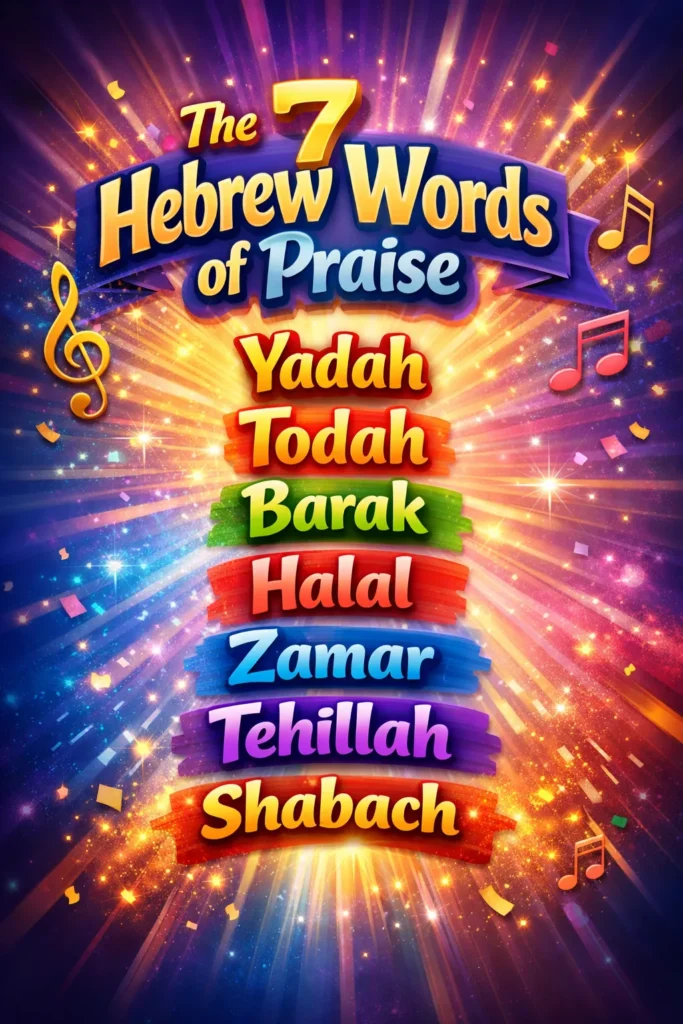
Here are the 7 Hebrew Words of Praise we will explore:
- Yadah
- Todah
- Barak
- Halal
- Zamar
- Tehillah
- Shabach
Each Hebrew word of praise reveals a unique way to glorify God. Together, they help us understand the beauty and depth of biblical worship.
Learn more about Hebrew praise words like “Amen” and their meaning in Scripture.
1. Yadah – The Hebrew Word of Praise Through Lifted Hands
Hebrew spelling: יָדָה (Yadah)
Literal meaning: To throw, to cast, or to extend the hands.
Worship meaning: To lift hands in gratitude, surrender, and open praise before God.
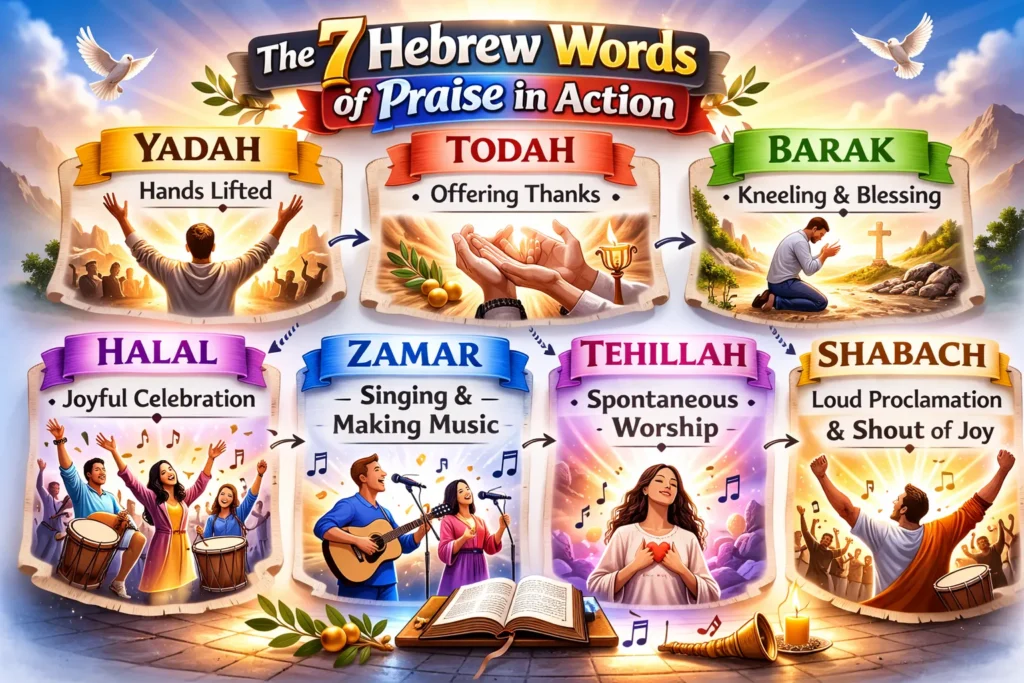
Yadah is one of the most beautiful expressions among the 7 Hebrew Words of Praise. It paints a picture of someone stretching out their hands toward heaven. In Scripture, this Hebrew word of praise often shows a heart that is thankful and fully dependent on God.
Psalm 63:4 says, “I will bless You as long as I live; I will lift up my hands in Your name.” This is Yadah in action. It is praise that reaches upward.
Among the Hebrew words of praise in the Bible, Yadah reminds us that worship is not passive. It involves our bodies and our hearts. When we lift our hands, we show trust and surrender.
In daily life, Yadah teaches us to thank God openly. Even in quiet prayer, lifting our hands can be a simple but powerful act of love toward Him.
2. Todah – The Hebrew Word for Offering of Praise
Hebrew spelling: תּוֹדָה (Todah)
Literal meaning: Thanksgiving; gratitude.
Worship meaning: A thankful praise given to God, even before the breakthrough comes.
Todah is a powerful expression within the 7 Hebrew Words of Praise. It is the Hebrew word for offering of praise that flows from trust. This kind of praise is not based on feelings. It is based on faith.
Psalm 100:4 says, “Enter His gates with thanksgiving.” The word for thanksgiving here reflects Todah. It also connects to the Hebrew word for sacrifice of praise. Todah is praise offered even when the answer has not yet arrived.
Among the Hebrew words of praise in the Bible, Todah shows bold faith. It is thanking God before you see the result.
In daily life, Todah means saying “Thank You, Lord” in the middle of waiting. It is quiet confidence that God is working.
3. Barak – To Kneel in Worship
Hebrew spelling: בָּרַךְ (Barak)
Literal meaning: To kneel, to bless, or to show reverence.
Worship meaning: Humble praise that acknowledges God’s greatness and our dependence on Him.
Barak is one of the 7 Hebrew Words of Praise that emphasizes humility. When we Barak, we bow low or kneel, recognizing God’s power and mercy. This Hebrew word of praise is about surrendering our pride and lifting God’s name.
Psalm 95:6 says, “Come, let us bow down in worship, let us kneel before the Lord our Maker.” Here, the act of kneeling reflects Barak. It is more than a posture; it is a heart attitude of honor and devotion.
Among the Hebrew words of praise in the Bible, Barak reminds us that true worship combines respect, awe, and gratitude. It is a gentle way to show God that we acknowledge His authority.
In daily life, Barak can be expressed in prayer, personal devotion, or church worship. A simple kneel can carry a deep message of love and surrender.
4. Halal – The Root of Hallelujah
Hebrew spelling: הָלַל (Halal)
Literal meaning: To shine, to boast, to rave; to celebrate loudly.
Worship meaning: Exalting God with joyful noise, clapping, and public declaration.
Halal is the Hebrew word that forms the basis of “Hallelujah,” meaning “Praise the Lord.” It is one of the most expressive among the 7 Hebrew Words of Praise. This word of praise calls for loud, enthusiastic worship that celebrates God’s goodness.
Psalm 150:1 says, “Praise the Lord. Praise God in His sanctuary; praise Him in His mighty heavens.” The word used here reflects Halal, encouraging believers to praise boldly and joyfully. Halal is energetic, vibrant, and overflowing with delight.
Among the Hebrew words of praise in the Bible, Halal teaches us that worship can be loud and visible. It reminds us that God enjoys the joy of His people expressed freely.
In daily life, Halal invites us to sing, clap, and rejoice openly. It reminds our hearts and others that God is worthy of high celebration.
5. Zamar – The Hebrew Word for Song of Praise
Hebrew spelling: זָמַר (Zamar)
Literal meaning: To make music, to play instruments, to sing.
Worship meaning: Praise God through songs and instruments, expressing joy and devotion.
Zamar is one of the 7 Hebrew Words of Praise that focuses on musical worship. This Hebrew word for song of praise emphasizes melody, rhythm, and heartfelt singing. It reminds us that music is a powerful way to connect with God.
Psalm 33:2 says, “Praise the Lord with the harp; make music to Him on the ten-stringed lyre.” The word for praise here reflects Zamar, showing how the Bible encourages instrumental worship alongside singing. Zamar combines creativity, skill, and devotion.
Among the Hebrew words of praise in the Bible, Zamar teaches that music can carry our hearts closer to God. It allows worship to flow in harmony, emotion, and joy.
In daily life, Zamar can be singing hymns, playing instruments, or joining a worship team. Music becomes a living expression of love and gratitude to God.
6. Tehillah – A Song of Spontaneous Praise
Hebrew spelling: תְּהִלָּה (Tehillah)
Literal meaning: A spontaneous song of praise; a hymn of exaltation.
Worship meaning: Offering heartfelt, natural praise to God, often inspired by His works or presence.
Tehillah is one of the 7 Hebrew Words of Praise that highlights personal, flowing worship. Unlike structured songs or ritual offerings, Tehillah is praise that arises naturally from the heart. It celebrates God in moments of joy, wonder, or gratitude.
Psalm 22:3 says, “You are holy, enthroned on the praises of Israel.” The word for praises here reflects Tehillah, showing that heartfelt, sincere praise honors God profoundly. Tehillah is about sincerity, not performance.
Among the Hebrew words of praise in the Bible, Tehillah reminds us that praise can be immediate and spontaneous. It reflects a living, breathing relationship with God.
In daily life, Tehillah encourages us to speak, sing, or silently rejoice whenever God moves our hearts. It is praise born from love and awareness of His goodness.
7. Shabach – Loud Praise to God
Hebrew spelling: שָׁבַח (Shabach)
Literal meaning: To shout, to acclaim, to give a loud, triumphant praise.
Worship meaning: Expressing victory and exaltation through loud, confident praise.
Shabach is one of the 7 Hebrew Words of Praise that celebrates God with boldness. This Hebrew word of praise often appears in the Psalms during moments of triumph, joy, or thanksgiving. It calls for voices lifted high in confidence and reverence.
Psalm 47:1 says, “Clap your hands, all you nations; shout to God with cries of joy.” The shout described here reflects Shabach. It is praise that is both public and victorious.
Among the Hebrew words of praise in the Bible, Shabach teaches us that praise can be powerful, energetic, and contagious. It declares God’s greatness loudly and joyfully.
In daily life, Shabach encourages believers to celebrate God openly. It can be a joyful shout, a lifted voice in church, or an enthusiastic declaration of God’s goodness in personal prayer.
Hebrew Words of Praise in the Bible (Quick Comparison)
Understanding the 7 Hebrew Words of Praise becomes easier when we see them side by side. This comparison highlights their meanings, actions, and Bible references.
| Hebrew Word | Meaning | Type of Praise | Bible Reference |
|---|---|---|---|
| Yadah | To lift hands | Gesture of gratitude | Psalm 63:4 |
| Todah | Thanksgiving | Offering of praise | Psalm 100:4 |
| Barak | To kneel | Humble worship | Psalm 95:6 |
| Halal | Celebrate loudly | Joyful, public praise | Psalm 150:1 |
| Zamar | Music & song | Instrumental worship | Psalm 33:2 |
| Tehillah | Spontaneous song | Heartfelt hymn | Psalm 22:3 |
| Shabach | Loud shout | Triumphant praise | Psalm 47:1 |
This table shows that the Hebrew words of praise in the Bible are diverse. Each word has its unique expression, yet all point toward glorifying God. Together, they help us understand the depth of worship in Scripture.
Hebrew Word for Sacrifice of Praise Explained
Hebrew spelling: תּוֹדָה (Todah)
Literal meaning: Thanksgiving offering; a praise given as a sacrifice.
Worship meaning: Giving God praise through intentional acts of devotion, even in difficult times.
The Hebrew word for sacrifice of praise appears when believers offer thanks to God as an act of faith. It is not only about spoken words but also about dedicating our actions and hearts to Him. This type of praise acknowledges God’s goodness even before seeing results.
Hebrews 13:15 says, “Through Jesus, therefore, let us continually offer to God a sacrifice of praise the fruit of lips that openly profess His name.” This verse directly connects Todah to the Hebrew word for sacrifice of praise. It reminds us that praise can be a spiritual offering, combining gratitude with obedience.
Among the Hebrew words of praise in the Bible, this word teaches us that worship can be intentional and sacrificial. It encourages believers to honor God actively, not just passively.
In daily life, offering a sacrifice of praise can mean speaking gratitude in challenges, singing joyfully despite struggles, or dedicating our time and service to God as a form of worship.
Why Understanding the 7 Hebrew Words of Praise Matters
Learning the 7 Hebrew Words of Praise helps us see worship from God’s perspective. Each word highlights a different way to honor Him through hands, music, humility, shouting, and thanksgiving. Together, they show that praise is both an action and a heart attitude.
The Hebrew words of praise in the Bible remind us that worship is full of life and expression. Understanding them deepens our prayer, strengthens our personal devotion, and enriches church worship. They teach us how to praise God in ways that are joyful, sincere, and complete.
In daily life, knowing these words can transform our approach to worship. We can lift hands like Yadah, give thanks like Todah, kneel like Barak, sing like Zamar, and shout like Shabach. Applying all seven words of praise helps us honor God more fully in every moment.