
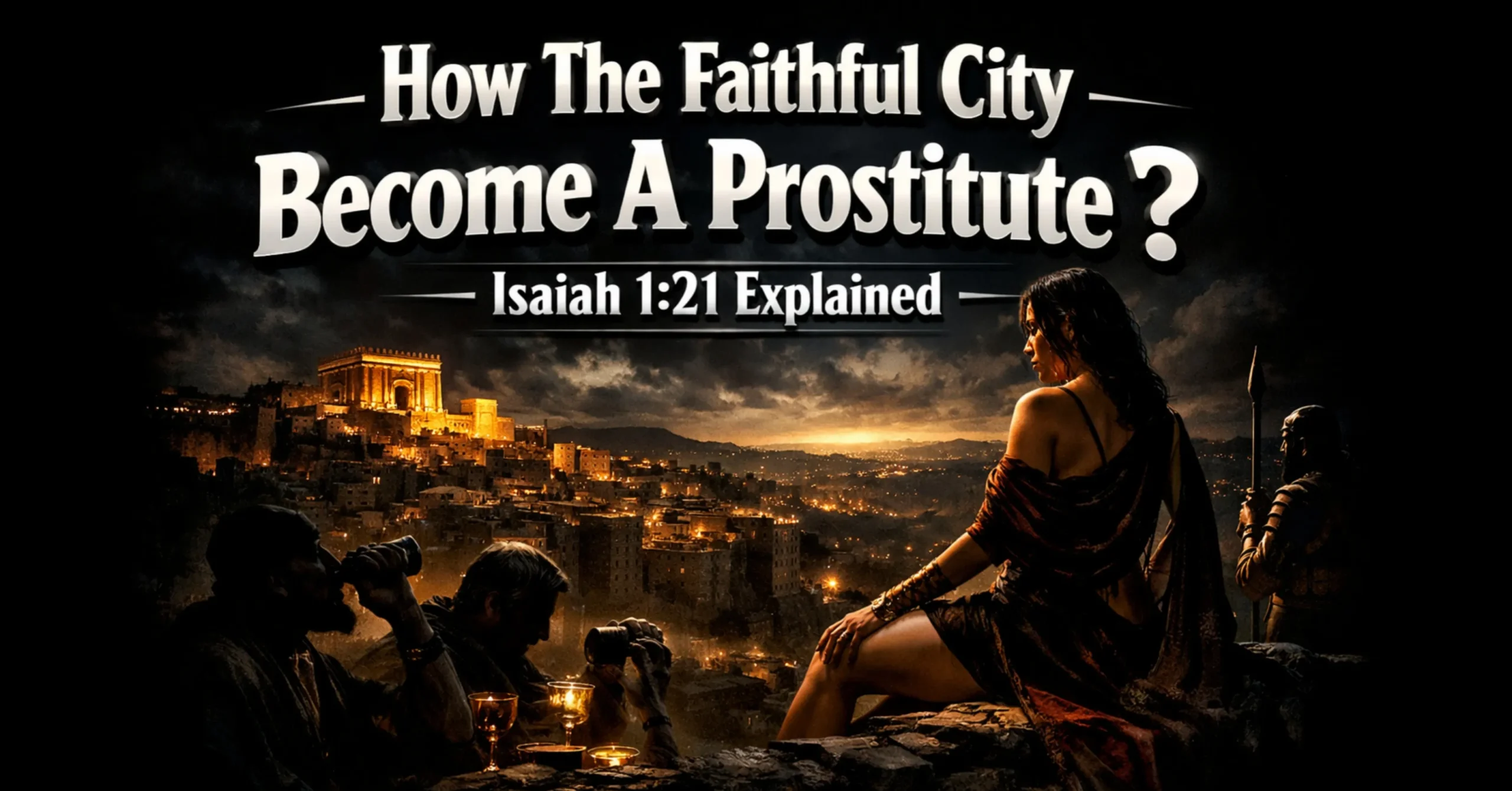
“How the faithful city has become a prostitute!” (Isaiah 1:21)
This verse shocks the reader. The words are strong and painful. God is not speaking calmly here; He is grieving. Isaiah 1:21 shows the deep sorrow of God over Jerusalem. This was a city that once walked closely with Him but later turned away.
The language is not meant to describe physical sin. It carries spiritual meaning. God uses strong words because the betrayal was serious. This verse still matters today because it warns how faith can slowly fade when justice and obedience are replaced by pride and compromise.
Isaiah 1:21 is not only about ancient Jerusalem. It speaks to every generation that claims to follow God.
Historical Context: Who Is the “Faithful City”?
The “faithful city” clearly refers to Jerusalem. It was the center of worship and the place God chose for His presence. At one time, Jerusalem stood for justice, righteousness, and obedience to God’s law.
God’s relationship with Israel was based on a covenant, similar to a marriage. God promised protection and blessing. In return, His people promised loyalty. When Jerusalem turned to idolatry and injustice, it was not just breaking rules. It was breaking trust.
This is why Isaiah describes the city’s fall as spiritual unfaithfulness. Jerusalem did not fall suddenly. It drifted away over time, slowly abandoning justice and righteousness.
What Does “Becoming a Prostitute” Mean?
Isaiah is not speaking about sexual sin. In the Bible, prostitution often symbolizes spiritual unfaithfulness. God compares His relationship with Israel to a marriage. He remained faithful, but the city turned elsewhere.
Jerusalem trusted idols, political alliances, and personal gain instead of God. This turning away is called spiritual adultery. The faithful city prostitute meaning becomes clear when we see it as covenant betrayal, not immoral language.
Other prophets used the same image. Hosea also described Israel as an unfaithful spouse. This shows God’s heart. Isaiah 1:21 is not only about judgment; it is a call to return to faithful love.
Literary Meaning of Isaiah 1:21
Isaiah uses sharp contrast to show loss. Jerusalem was once full of justice and righteousness. These values lived there. They belonged there.
Isaiah says justice once “lodged” in the city. It felt at home. Now the city is filled with violence and corruption. Truth has been pushed out.
This shows that the problem was not lack of religion. It was loss of faithfulness. Justice in biblical Jerusalem disappeared when the people turned away from God. Spiritual unfaithfulness always leads to social breakdown.
Moral Decline in Verses 22–23
Isaiah continues with clear images. Silver becomes dross. Wine is watered down. What was pure is now mixed and weak. These pictures describe moral decay.
He then speaks about corrupt leaders. They love bribes. They ignore widows and orphans. This shows how spiritual adultery is linked to injustice. When people turn away from God, compassion disappears.
Jerusalem’s problem was deep. It was not one sin but a complete moral collapse. Still, God’s words point toward correction and restoration.
Why Isaiah 1:21 Still Matters
Isaiah 1:21 reveals God’s heart. God desires justice, righteousness, and faithfulness. Jerusalem kept religious practices but rejected God’s ways.
This theme continues in the New Testament. Jesus spoke of an “adulterous generation,” describing people who honored God with words but not with their hearts. These Isaiah and Jesus parallels carry the same message. Covenant love requires obedience and truth.
This verse is not just history. It is a warning for every believer.
Modern Application for Believers
Isaiah’s message speaks to the church today. Spiritual unfaithfulness now may look different, but the heart issue is the same. It appears when success, comfort, or power replace trust in God.
For individuals, it begins quietly. Prayer fades. Obedience becomes selective. Compassion weakens. For churches, it shows when justice is ignored and truth is compromised.
Applying Isaiah 1 today means returning to humility, justice, and sincere devotion. God calls His people to live their faith, not just speak it.
Hope and Restoration in Isaiah
Isaiah 1 does not end with judgment. God always offers hope. Later in the chapter, He promises restoration if His people are willing to return.
The faithful city can be restored when righteousness returns. God does not abandon His covenant. He invites repentance and renewal.
This hope reminds believers that failure is not final. When hearts turn back to God, restoration follows.
Conclusion
Isaiah 1:21 is a mirror for every generation. Jerusalem became unfaithful through slow compromise, not sudden rebellion. Justice was ignored. Covenant love was forgotten.
This verse invites reflection. Are we walking in justice and righteousness, or has routine replaced true devotion? God’s call is clear: return with honest hearts.
If this message encouraged you, share your thoughts in the comments and pass it on to others. God still restores the faithful city when His people choose truth and obedience.
“Explore 25 powerful Bible verses about adultery and God’s forgiveness”

Hi, I’m Prashanta Kumbhar, a Christian blogger, faith writer, and the founder of Light and Gospel (LightandGospel.com), based in Odisha, India.
I regularly write Bible devotionals, prayers, Scripture reflections, and faith-based messages to encourage people in their daily walk with Jesus Christ and help them grow in hope, faith, and spiritual strength.
Along with blogging, I also create Christian content on my YouTube channel “The God Helps” and share faith, prayer, Bible study, and motivational messages across social media platforms like Facebook & Instagram. My mission is to make God’s Word simple, practical, & meaningful for everyday life.