
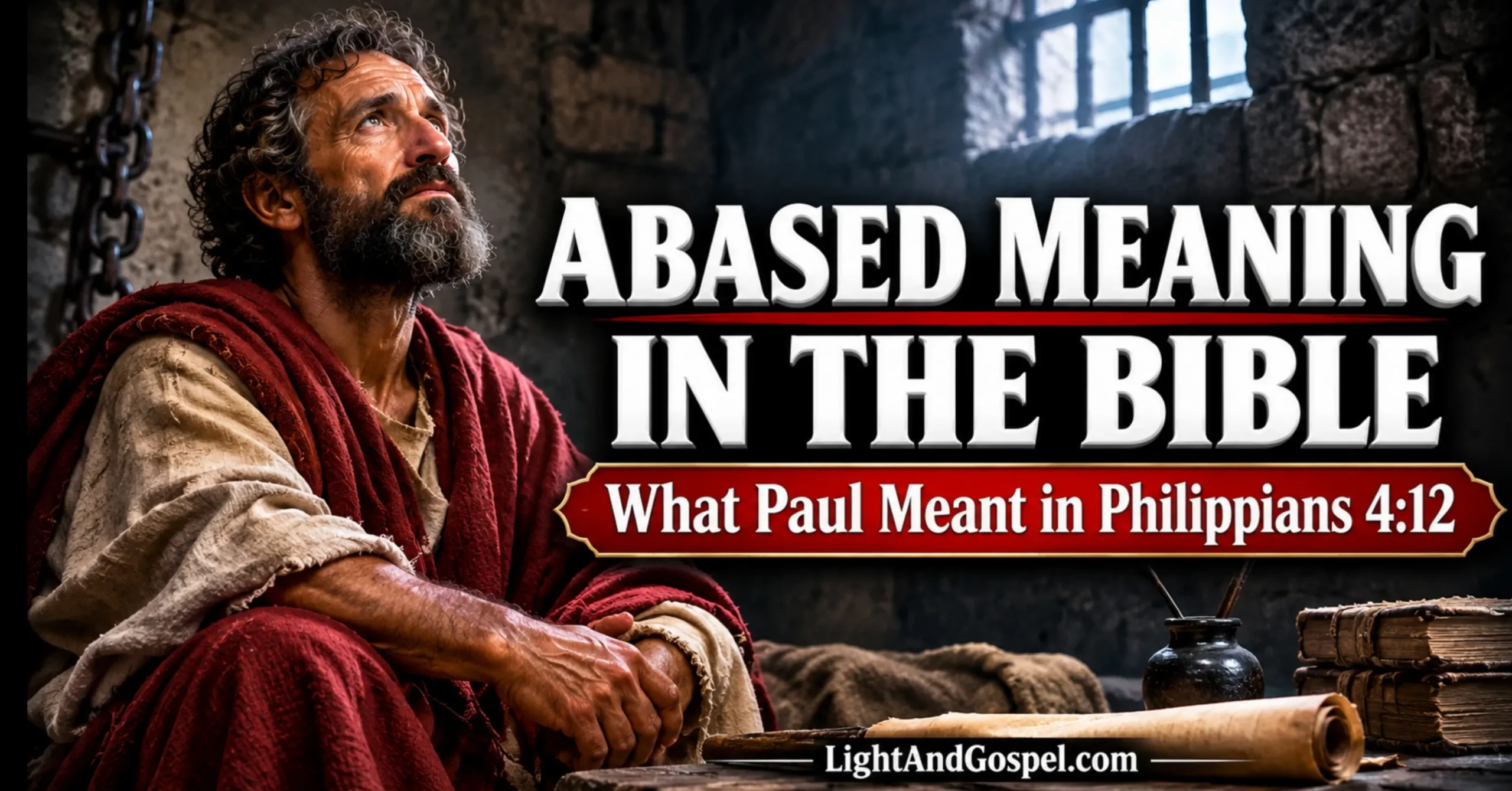
The abased meaning in the Bible is to be brought low, humbled, or placed in a low condition. The word appears in Philippians 4:12, where Paul writes about knowing how to be abased and how to abound. He is describing his experience of living through both times of need and times of plenty.
The word abased may sound unfamiliar because it is rarely used in everyday English today. In Philippians, Paul uses it to describe his circumstances, not to suggest that he felt worthless or deliberately sought humiliation. Understanding the surrounding verses helps clarify what he meant.
What Does Abased Mean in the Bible?
The word abased is a form of the verb abase, which means to bring someone or something low. It is found in older English Bible translations, including the King James Version (KJV) and the New King James Version (NKJV).
The word can describe different situations. Someone may be brought low in position or status, humbled because of pride, or placed in difficult circumstances. Its meaning depends on how it is used in the passage. It does not always refer to poverty.
Abase, abased, and abasing are different forms of the same verb. For example, Jesus used this idea when warning against self-exaltation in Matthew 23:12. In Philippians 4:12, Paul uses it to describe his experience of having little.
What Does Abased Mean in Philippians 4:12?
Paul writes in Philippians 4:12 (KJV):
“I know both how to be abased, and I know how to abound.”
The rest of the verse explains this contrast. Paul speaks of being full and hungry, having plenty and suffering need. He had experienced both having little and having enough.
The Greek verb translated as abased is tapeinoō (Strong’s G5013). The form used in this verse is tapeinousthai, which means to be brought low. The words that follow—full, hungry, abundance, and need—show that Paul is speaking about changing circumstances, including times when he lacked the necessities of life.
Paul had learned to remain content whether he had little or plenty. His circumstances changed, but his trust in Christ remained the same.
How Do Bible Translations Explain “Abased”?
Modern Bible translations often use more familiar wording to express the idea behind abased. Here is how several translations render Philippians 4:12.
| Bible translation | Wording used in Philippians 4:12 |
|---|---|
| KJV | How to be abased |
| NKJV | How to be abased |
| ESV | How to be brought low |
| NIV | What it is to be in need |
| NASB 2020 | Get along with little |
| NET | Times of need and times of abundance |
The KJV and NKJV retain the older word abased. The other translations use more familiar expressions to describe Paul’s experience. Although their wording differs, they all communicate the contrast between having little and having plenty.
What Do “Abased” and “Abound” Mean Together?
Paul uses abased and abound to describe two opposite sides of his experience. In Philippians 4:12, abased refers to being brought low or experiencing need, while abound means to have plenty. The meaning of abound in the Bible includes having an abundance or experiencing plenty.
The Greek verb translated as abound is perisseuō (Strong’s G4052). It carries the idea of having plenty or an abundance.
Paul had experienced both conditions. He was not saying that poverty is better than having plenty or that wealth makes someone spiritually strong. His point was that neither condition had to determine his contentment. He had learned to depend on Christ whether he had little or plenty.
What Is the Context of Philippians 4:10–14?
Paul’s words in Philippians 4:12 are part of his response to the support he received from the church at Philippi. In verse 10, he rejoices because the believers have renewed their concern for him. They had cared about him before, but had not had an opportunity to show it.
In verse 11, Paul explains that he has learned to be content whatever his circumstances. This contentment came through experience, not because his life was always easy.
Verse 12 describes the different conditions he had faced. Then, in verse 14, Paul acknowledges that the Philippians did well by sharing in his trouble. He appreciated their support.
This shows that contentment does not mean refusing help. Paul trusted Christ through difficult circumstances, but he was also grateful when other believers helped meet his needs.
For a related look at what Scripture teaches about wealth and contentment, read what the Bible says about being rich.
What Does Philippians 4:13 Mean in This Context?
Paul writes, “I can do all things through Christ which strengtheneth me” (Philippians 4:13, KJV).
In context, Paul is referring to the strength Christ gives him to face both need and abundance. He has learned that he can depend on Christ in either situation.
Paul is not promising that believers will achieve every goal they pursue or become wealthy through faith. He is explaining how Christ strengthens him to face changing circumstances.
Does Abased Have the Same Meaning in Every Bible Passage?
No. The idea of being brought low or humbled appears in different situations throughout the Bible. Some passages describe the humbling of the proud, while others call believers to humble themselves before God.
| Bible passage | What the passage describes |
|---|---|
| Matthew 23:12 | Jesus warns that those who exalt themselves will be humbled. |
| Luke 14:11 | Jesus teaches that those who exalt themselves will be humbled, while those who humble themselves will be exalted. |
| Luke 18:14 | Jesus describes the humble tax collector being justified rather than the self-righteous Pharisee. |
| 2 Corinthians 11:7 | Paul speaks of humbling himself by preaching the gospel to the Corinthians without charge. |
| James 4:10 | Believers are told to humble themselves before the Lord. |
| 1 Peter 5:6 | Believers are told to humble themselves under God’s mighty hand. |
These passages illustrate related ideas, but they do not all use the exact English word abased in every translation.
In Matthew and Luke, Jesus warns against pride and self-exaltation. In 2 Corinthians, Paul is talking about his decision to preach without charging the Corinthians. James and Peter encourage believers to humble themselves before God.
The shared idea is humility or being brought low, but the circumstances and message differ in each passage. That is why the meaning of abased should always be understood in its biblical context.
What Is Self-Abasement in the Bible?
Self-abasement in the Bible refers to lowering or humbling oneself. The expression appears in some Bible translations of Colossians 2:18 and 2:23. However, Paul’s warning in these verses is about more than humility itself.
The Greek noun used in these passages is tapeinophrosynē (Strong’s G5012). It is related to the Greek verb tapeinoō used in Philippians 4:12, but they are different words. Tapeinoō is a verb, while tapeinophrosynē is a noun associated with humility.
In Colossians 2:18, Paul warns believers about religious practices involving false humility, visions, and the worship of angels. In verse 23, he describes self-imposed worship, false humility, and harsh treatment of the body. Such practices may appear wise or religious, but Paul says they have no real power to restrain sinful desires.
This does not mean that humility itself is wrong. In Colossians 3:12, Paul uses the same Greek noun positively when he tells believers to put on humility, along with compassion, kindness, gentleness, and patience.
The difference is in the kind of humility being described. Paul warns against religious practices that appear humble but are rooted in human rules and self-made devotion. The humility he encourages in Colossians 3:12 should be seen in the way believers live and treat others.
Frequently Asked Questions About Abased
Does abased mean poor?
Not in every Bible passage. In Philippians 4:12, it describes Paul’s experience of having little or experiencing need. In Matthew 23:12, the idea is about those who exalt themselves being brought low. The meaning depends on the passage. Having little does not make someone less valuable to God.
What is the opposite of being abased?
In Philippians 4:12, abound provides the contrast. It describes having plenty rather than experiencing need. In Matthew 23:12, the contrast is being exalted or lifted up. These are contextual contrasts, not strict opposites in every Bible passage.
Conclusion
The abased meaning in the Bible depends on the passage. In Philippians 4:12, it describes being brought low or experiencing times of need. Paul had learned to face both need and abundance through Christ’s strength. His example reminds believers that contentment does not have to depend on how much they have.

Hi, I’m Prashanta Kumbhar, a Christian blogger, faith writer, and the founder of Light and Gospel (LightandGospel.com), based in Odisha, India.
I regularly write Bible devotionals, prayers, Scripture reflections, and faith-based messages to encourage people in their daily walk with Jesus Christ and help them grow in hope, faith, and spiritual strength.
Along with blogging, I also create Christian content on my YouTube channel “The God Helps” and share faith, prayer, Bible study, and motivational messages across social media platforms like Facebook & Instagram. My mission is to make God’s Word simple, practical, & meaningful for everyday life.