
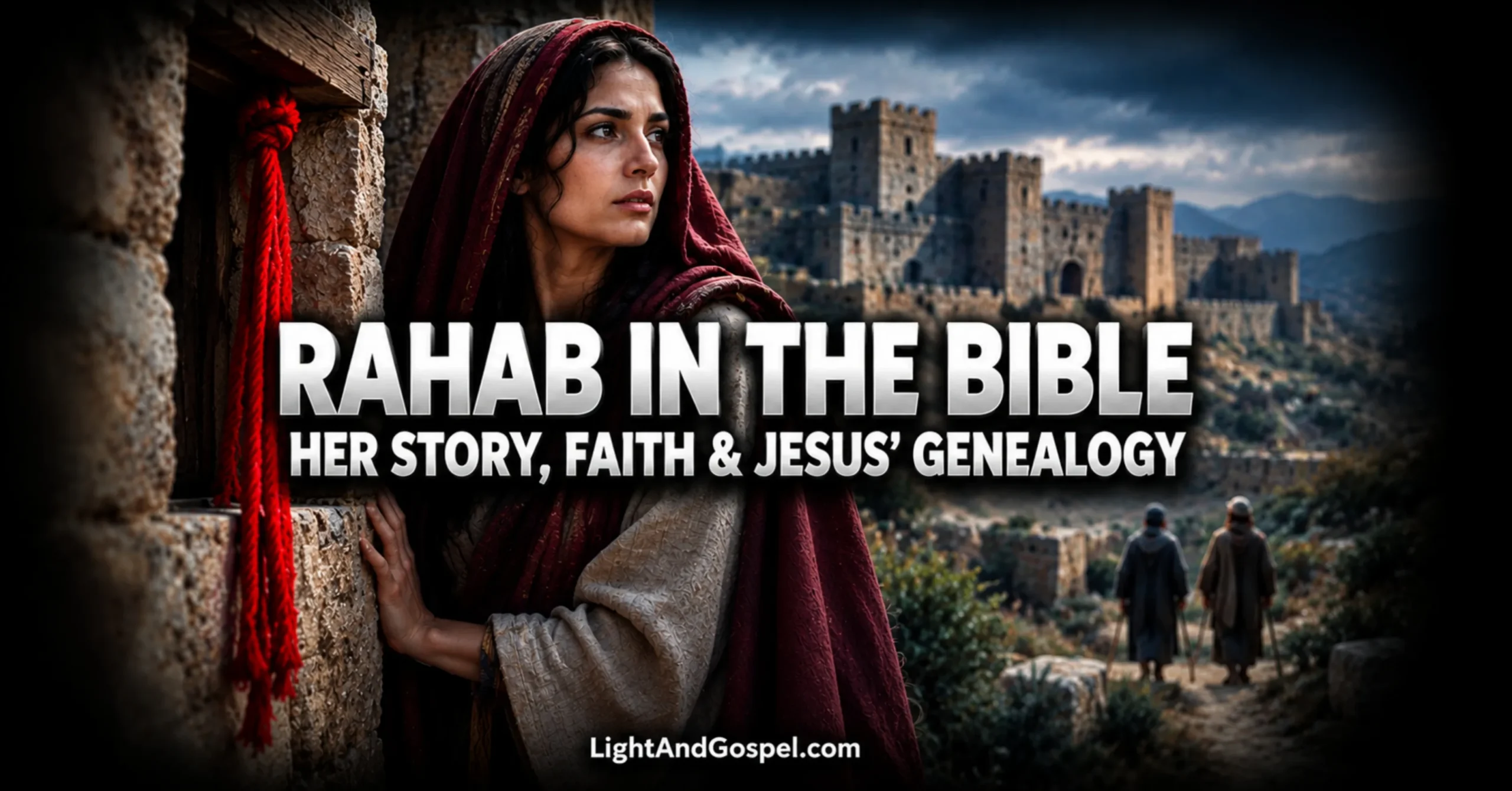
Rahab was a woman who lived in Jericho and helped two Israelite spies escape the king’s men. Before Jericho fell, she asked the spies to spare her family. They promised to protect her family if they stayed in her house and followed the agreed instructions. Her story is recorded in Joshua 2 and Joshua 6.
Rahab is also remembered in the New Testament. Hebrews 11:31 highlights her faith, James 2:25 refers to her actions, and Matthew 1:5 includes her in the family line leading to Jesus Christ.
Why did Rahab help the spies? How was her family saved? And why do the New Testament writers remember her centuries later?
Who Was Rahab in the Bible?
Rahab lived in Jericho, the city Joshua’s spies were sent to explore. After Moses’ death, Joshua led Israel and sent two men from Shittim to scout the land, especially Jericho. The spies entered Rahab’s house and stayed there (Joshua 2:1).
The Bible identifies Rahab as a prostitute. When the king of Jericho heard that Israelite spies had entered the city, he sent men to her and ordered her to bring them out. Instead, Rahab hid the spies and helped them escape.
Rahab explained that the people of Jericho had heard how the Lord had helped Israel. She acknowledged the Lord’s power and asked the spies to spare her family. When Jericho fell, Rahab and her family were rescued according to the agreement she had made with the spies (Joshua 2:8–21; 6:22–25).
Why Is Rahab Called a Prostitute in the Bible?
Many modern English Bible translations describe Rahab as a prostitute. The King James Version uses the older English word “harlot.” The same description appears in Joshua 2:1, Hebrews 11:31, and James 2:25.
Scripture does not give a detailed account of Rahab’s earlier life, so we should not assume details about her background or circumstances that the text does not provide.
Her occupation is part of the biblical account, but it is not the only detail Scripture preserves about her. Joshua describes how she protected the spies and sought safety for her family. Hebrews highlights her faith, while James points to her actions. Reading these passages together helps us understand why Rahab is remembered in the Bible beyond the label used to describe her.
Rahab and the Two Spies in Jericho
Bible reference: Joshua 2:1–7
Joshua sent two spies to Jericho to explore the land. When the king heard that Israelite men had entered the city, he sent word to Rahab and ordered her to hand them over.
Rahab had hidden the men on her roof beneath stalks of flax. When the king’s men questioned her, she admitted that the men had visited but claimed she did not know where they came from. She told the pursuers that the men had left and urged them to follow quickly.
The king’s men went out to search for the spies, and the city gate was shut after they left. Rahab had kept the men hidden from those who wanted to capture them (Joshua 2:2–7).
Rahab’s actions put her in a risky position because she was protecting men the king wanted to arrest. Joshua 2:1–7 describes what she did, while the following verses reveal more about her response to Israel’s God.
Rahab’s Faith and Her Request to Save Her Family
Bible reference: Joshua 2:8–14
Before the spies went to sleep, Rahab went up to them on the roof. She told them that the people of Jericho had heard how the Lord dried up the Red Sea when Israel came out of Egypt. They had also heard about Israel’s victories over Sihon and Og, two Amorite kings east of the Jordan.
These reports had filled the people of Jericho with fear. Rahab went further, saying that the Lord had given Israel the land and confessing that the Lord was God in heaven above and on earth below (Joshua 2:8–11).
Rahab then asked the spies to swear by the Lord that they would show kindness to her family, just as she had shown kindness to them. She asked them to spare her father, mother, brothers, sisters, and the rest of her family.
The spies agreed to protect her family, but Rahab had to keep their mission secret. Their promise applied to those who gathered in her house and followed the instructions the spies gave her. It was not a promise to save everyone in Jericho (Joshua 2:12–14).
Rahab’s words and actions are closely connected in this account. She acknowledged the Lord’s authority, protected the spies, and asked them to spare her family. Her faith is shown through what she said and did, rather than through words alone.
The Scarlet Cord and the Spies’ Escape
Bible reference: Joshua 2:15–24
Rahab’s house was built into Jericho’s city wall. She lowered the spies through a window by a rope and advised them to hide in the hill country for three days until their pursuers returned. The spies followed her advice and later made their way back to Joshua (Joshua 2:15–16, 22–24).
Before leaving, the spies told Rahab how she could protect her family when Israel attacked Jericho. She was to tie a scarlet cord in the same window through which she had lowered them. Her father, mother, brothers, sisters, and other family members were to gather inside her house.
The spies made the terms of their promise clear. Anyone who remained inside the house would be protected, but those who went outside would not be covered by the agreement. Rahab accepted these conditions and tied the scarlet cord in the window after the spies left (Joshua 2:17–21).
The scarlet cord served as a sign identifying Rahab’s house under the agreement. Some Christians interpret it as a picture of the blood of Jesus Christ, but Joshua 2 does not directly explain it that way. The passage focuses on the sign and the promise to protect Rahab’s household.
After hiding in the hills, the spies returned to Joshua and reported that the Lord had given the land into Israel’s hands (Joshua 2:22–24). Rahab’s promise would be fulfilled when Jericho fell.
How Rahab and Her Family Were Saved
Bible reference: Joshua 6:22–25
When Jericho fell, Joshua remembered the oath the spies had made to Rahab. He sent the two spies to her house and told them to bring her and her family out safely.
The men brought Rahab, her parents, her brothers and sisters, and the rest of her household out of the city. Joshua 6:25 records that Rahab was spared because she had hidden the spies. It also says that she lived among the Israelites.
This fulfilled the promise made in Joshua 2. Rahab had protected the spies, and they had pledged to protect her household. When Jericho fell, they kept their word.
Joshua gives little detail about Rahab’s life after her rescue. The account establishes that she and her household survived Jericho’s fall and that she lived among Israel. It does not describe her later experiences or explain how her life changed afterward.
Why Rahab Is Remembered for Her Faith and Actions
The New Testament refers to Rahab in Hebrews 11:31 and James 2:25. Both passages mention her welcome of the spies, but each highlights a different aspect of her response.
Rahab in Hebrews 11:31
Hebrews 11 describes people who demonstrated faith in God. Among them are Abel, Noah, Abraham, Moses, and Rahab.
Hebrews 11:31 says Rahab did not perish with those who disobeyed because she welcomed the spies. The writer presents her as an example of faith.
This connects with Rahab’s response in Joshua 2. After hearing what the Lord had done for Israel, she acknowledged His authority and helped the spies. Her faith was reflected in the decision she made when they came to Jericho.
Rahab in James 2:25
James mentions Rahab while explaining the relationship between faith and works. In this context, works are actions that demonstrate a person’s faith. James teaches that genuine faith should be reflected in how a person lives.
He points to Rahab because she welcomed the messengers and sent them away by another route (James 2:25). Her actions showed the seriousness of the belief she had expressed.
Hebrews emphasizes Rahab’s faith, while James highlights her actions as evidence of that faith. Together, these passages show why her story matters in Christian teaching: her belief was accompanied by action.
Rahab in Jesus’ Genealogy
Bible reference: Matthew 1:5–6
Rahab appears in Matthew’s genealogy of Jesus Christ. Matthew 1:5 names Salmon and Rahab as the parents of Boaz. The genealogy continues from Boaz to Obed, Jesse, and King David, tracing the family line that leads to Jesus (Matthew 1:5–6).
Was Rahab the mother of Boaz? According to Matthew’s genealogy, yes. The passage connects Rahab with Salmon and identifies Boaz as their son.
However, Matthew does not describe Rahab’s marriage to Salmon or explain when and where it took place. Joshua does not provide those details either. The genealogy establishes the family connection without recounting Rahab’s later life.
Her appearance in Matthew connects the story in Joshua with the family line leading to Christ. Joshua describes Rahab’s help to the spies and her rescue with her family, while Matthew records her place in Jesus’ genealogy.
For more background on Jesus’ life and message, read our guide to the gospel of Jesus Christ.
What Rahab’s Story Shows in the Biblical Narrative
Rahab’s story begins in Joshua 2, where she hides the spies, acknowledges the Lord’s authority, and asks for her family to be spared. In Joshua 6, she and her household are rescued as promised.
The New Testament highlights different aspects of her story. Hebrews 11:31 presents her as an example of faith, while James 2:25 points to her actions. Matthew 1:5–6 places her in Jesus’ genealogy.
Together, these passages show how Rahab’s faith, choices, and place in the biblical account are connected. Joshua describes her actions and rescue; Hebrews and James refer to her for their teachings on faith and works; and Matthew records her place in the family line leading to Jesus Christ.
Reading these passages in context gives a fuller picture of Rahab while leaving details the Bible does not provide unanswered.

Hi, I’m Prashanta Kumbhar, a Christian blogger, faith writer, and the founder of Light and Gospel (LightandGospel.com), based in Odisha, India.
I regularly write Bible devotionals, prayers, Scripture reflections, and faith-based messages to encourage people in their daily walk with Jesus Christ and help them grow in hope, faith, and spiritual strength.
Along with blogging, I also create Christian content on my YouTube channel “The God Helps” and share faith, prayer, Bible study, and motivational messages across social media platforms like Facebook & Instagram. My mission is to make God’s Word simple, practical, & meaningful for everyday life.