
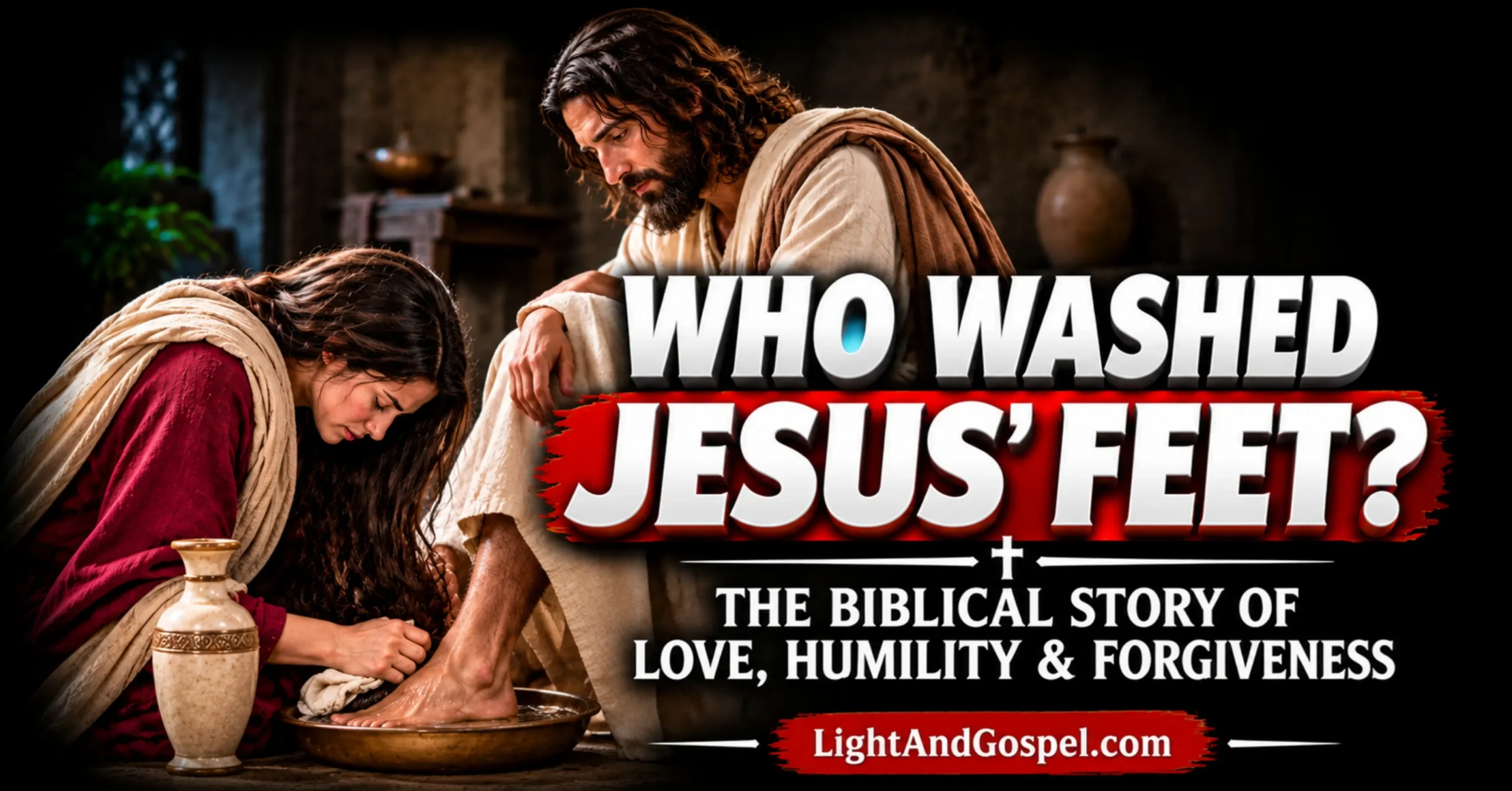
Who washed Jesus’ feet in the Bible? The Gospel of John identifies Mary of Bethany as the woman who anointed Jesus’ feet with expensive perfume and wiped them with her hair (John 12:1–8). Luke records another occasion when an unnamed woman wet Jesus’ feet with her tears, wiped them with her hair, and anointed them with perfume (Luke 7:36–50).
The Gospels also describe a separate event during the Last Supper, when Jesus washed His disciples’ feet and taught them to follow His example of humble service (John 13:1–17).
Who Was the Woman Who Anointed Jesus’ Feet?
John identifies the woman as Mary of Bethany, the sister of Martha and Lazarus (John 11:1–2; 12:1–3). Luke, however, does not name the woman in his account. He describes her actions at the home of Simon the Pharisee (Luke 7:36–50).
Although the accounts share some details, the Gospels do not identify the two women as the same person. Their identities and the settings of the events should be considered separately.
Mary of Bethany Anointed Jesus’ Feet (John 12:1–8)
Six days before the Passover, Jesus came to Bethany, where Lazarus lived. A dinner was held in His honor. Martha served the meal, and Lazarus was among those reclining at the table with Jesus (John 12:1–2).
Mary of Bethany is also seen sitting at Jesus’ feet and listening to His teaching in the Mary and Martha Bible story, recorded in Luke 10:38–42.
During the meal, Mary took a pound of expensive perfume made from pure nard. She anointed Jesus’ feet with it and wiped them with her hair. John adds that the fragrance filled the house (John 12:3).
Judas Iscariot objected. He questioned why the perfume had not been sold for three hundred denarii and the money given to the poor (John 12:4–5). John explains that Judas was not concerned about the poor. He was a thief who kept the money bag and took from it (John 12:6).
Jesus defended Mary and told Judas to leave her alone. He connected her act with His approaching burial (John 12:7). He also reminded those present that they would always have the poor among them, but they would not always have Him (John 12:8).
Why Did Mary Wipe Jesus’ Feet With Her Hair?
John does not explain why Mary chose to use her hair. He simply records that she anointed Jesus’ feet with perfume and wiped them with her hair (John 12:3). The Gospel presents this action as part of her anointing of Jesus, but it does not reveal her personal reason for doing it.
The Unnamed Woman Who Washed Jesus’ Feet With Her Tears (Luke 7:36–50)
Luke describes a woman who came to Jesus while He was eating at the home of a Pharisee named Simon.
The woman was known in the city as a sinner, but Luke does not explain what her sin was. She brought an alabaster flask of perfume and stood behind Jesus near His feet. Weeping, she wet His feet with her tears, wiped them with her hair, kissed them, and anointed them with perfume (Luke 7:37–38).
Simon watched what was happening and questioned whether Jesus could truly be a prophet. He thought that if Jesus knew what kind of woman was touching Him, He would not allow her to do so (Luke 7:39).
Jesus knew Simon’s thoughts and told him about two people who owed money to the same lender. One owed five hundred denarii and the other fifty. Neither could repay the debt, so the lender forgave them both. Jesus asked Simon which person would love the lender more. Simon answered that it would be the one who had been forgiven the larger debt (Luke 7:40–43).
Jesus then compared Simon’s treatment of Him with the woman’s actions. Simon had not provided water for His feet, but she had washed them with her tears and wiped them with her hair. Simon had not welcomed Him with a kiss, but she had continued kissing His feet. Simon had not anointed His head with oil, but she had anointed His feet with perfume (Luke 7:44–46).
Jesus explained that her many sins had been forgiven and that her great love showed it. He then told her, “Your faith has saved you; go in peace” (Luke 7:47–50). Her actions did not purchase forgiveness. They reflected the love that followed it.
Does the Bible Reveal Who This Woman Was?
Luke does not give the woman a name or explain what her sin was. He also does not identify her as Mary Magdalene or Mary of Bethany.
Later Christian interpretations sometimes connected these women, but Luke’s account does not make those identifications. The woman in Luke 7 remains unnamed.
Although we do not know her identity, Luke makes the purpose of the encounter clear. Jesus forgave her sins, affirmed her faith, and sent her away in peace.
The story of Rahab also offers an example of faith and God’s grace. Read more about Rahab’s story in the Bible.
Did the Woman Anoint Jesus’ Head or His Feet?
The Gospels describe anointing accounts in which perfume was poured on Jesus’ head or feet. Comparing these passages helps clarify what each writer records.
Matthew 26:6–13 and Mark 14:3–9 describe an unnamed woman pouring expensive perfume on Jesus’ head. Both accounts place the event in Bethany, at the home of Simon the leper.
John 12:1–8 also records an anointing in Bethany, but John identifies the woman as Mary of Bethany. She anoints Jesus’ feet and wipes them with her hair.
| Gospel passage | Woman identified? | Setting | What was anointed? |
|---|---|---|---|
| Matthew 26:6–13 | Unnamed woman | Bethany, house of Simon the leper | Jesus’ head |
| Mark 14:3–9 | Unnamed woman | Bethany, house of Simon the leper | Jesus’ head |
| John 12:1–8 | Mary of Bethany | Bethany, with Lazarus present at the meal | Jesus’ feet |
The accounts also differ in their narrative placement. John says the visit to Bethany took place six days before Passover (John 12:1). Matthew and Mark mention that the Passover was two days away before describing the anointing (Matthew 26:2, 6; Mark 14:1, 3).
Some interpreters understand Matthew, Mark, and John to describe the same Bethany event, with each Gospel emphasizing different details. Others believe they may describe separate occasions. The differences in the accounts and their narrative placement have led to different interpretations.
The order in which Matthew and Mark present the event does not, by itself, establish its exact date. It is best to recognize what each Gospel records without claiming that every difference has been conclusively resolved.
Luke describes a different setting. His account takes place at the home of Simon the Pharisee, where an unnamed woman wets Jesus’ feet with her tears and wipes them with her hair (Luke 7:36–50).
Was the Woman Mary Magdalene?
Some Christian traditions have identified Mary Magdalene as the woman who washed Jesus’ feet with her tears. However, the Gospels do not explicitly make this connection.
Luke introduces Mary Magdalene in Luke 8:1–3. He says that Jesus had delivered her from seven demons. She then became one of the women who accompanied Jesus and the Twelve and supported His ministry.
Mary Magdalene later witnessed the risen Jesus. John 20:1–18 records her visit to the tomb and her encounter with Him after His resurrection.
Mary of Bethany is a different figure in John’s Gospel. John identifies her as the sister of Martha and Lazarus (John 11:1–2). She is the woman who anointed Jesus’ feet in John 12.
The connection between Mary Magdalene, Mary of Bethany, and the unnamed woman in Luke 7 became influential in parts of Western Christian tradition. In Homily 33, Gregory the Great brought these Gospel figures together in his interpretation of Mary Magdalene. His interpretation influenced how some Christians understood her identity.
However, the history is more complicated than saying Gregory established this identification by a formal decree. In a 2022 peer-reviewed study, Peter-Ben Smit examines Gregory’s Homily 33 and challenges this simplified account of his role in the tradition. His study is titled Verlossing door verleiding: Maria Magdalena in preek 33 van Gregorius I.
The biblical accounts do not identify these women as the same person. Luke leaves the woman in chapter 7 unnamed, and John identifies Mary of Bethany as Martha and Lazarus’ sister without calling her Mary Magdalene.
So, did Mary Magdalene wash Jesus’ feet? Scripture does not say that she did. The woman in Luke 7 remains unnamed.
Did Jesus Wash His Disciples’ Feet? (John 13:1–17)
Yes. John records a separate occasion during the Last Supper when Jesus washed His disciples’ feet.
During the meal, Jesus got up, took a towel, poured water into a basin, and began washing His disciples’ feet. He then wiped them with the towel wrapped around His waist (John 13:1–5).
When Jesus came to Peter, Peter questioned why He was washing his feet. He struggled to accept that his Lord and Teacher would perform this act of service. Jesus told him that he did not yet understand what He was doing but would understand later (John 13:6–10).
After washing their feet, Jesus explained what His actions meant. He reminded the disciples that He was their Lord and Teacher. If He had washed their feet, they should also be willing to serve one another (John 13:12–15). Jesus gave them an example to follow: true leadership does not place a person above serving others.
Frequently Asked Questions
Who washed Jesus’ feet with her hair?
Mary of Bethany anointed Jesus’ feet with expensive perfume and wiped them with her hair (John 12:1–8).
Who washed Jesus’ feet with her tears?
An unnamed woman wet Jesus’ feet with her tears, wiped them with her hair, and anointed them with perfume (Luke 7:36–50). Luke does not reveal her name.
Were Mary of Bethany and Mary Magdalene the same person?
The Gospels do not identify them as the same person. John identifies Mary of Bethany as Martha and Lazarus’ sister, while Luke introduces Mary Magdalene separately (John 11:1–2; Luke 8:1–3).
Did two different women anoint Jesus’ feet?
John identifies Mary of Bethany as the woman who anointed Jesus’ feet (John 12:1–8). Luke describes an unnamed woman doing something similar at the home of Simon the Pharisee (Luke 7:36–50). The different settings distinguish these accounts, although interpreters continue to discuss how the Bethany anointing accounts in Matthew, Mark, and John relate to one another.
Conclusion
The Gospels describe different occasions when Jesus’ feet were anointed or washed. They identify Mary of Bethany in John 12, leave the woman in Luke 7 unnamed, and record Jesus washing His disciples’ feet in John 13. Keeping these accounts in their own contexts helps us understand what Scripture says without confusing the people or adding details the Bible does not provide.

Hi, I’m Prashanta Kumbhar, a Christian blogger, faith writer, and the founder of Light and Gospel (LightandGospel.com), based in Odisha, India.
I regularly write Bible devotionals, prayers, Scripture reflections, and faith-based messages to encourage people in their daily walk with Jesus Christ and help them grow in hope, faith, and spiritual strength.
Along with blogging, I also create Christian content on my YouTube channel “The God Helps” and share faith, prayer, Bible study, and motivational messages across social media platforms like Facebook & Instagram. My mission is to make God’s Word simple, practical, & meaningful for everyday life.