
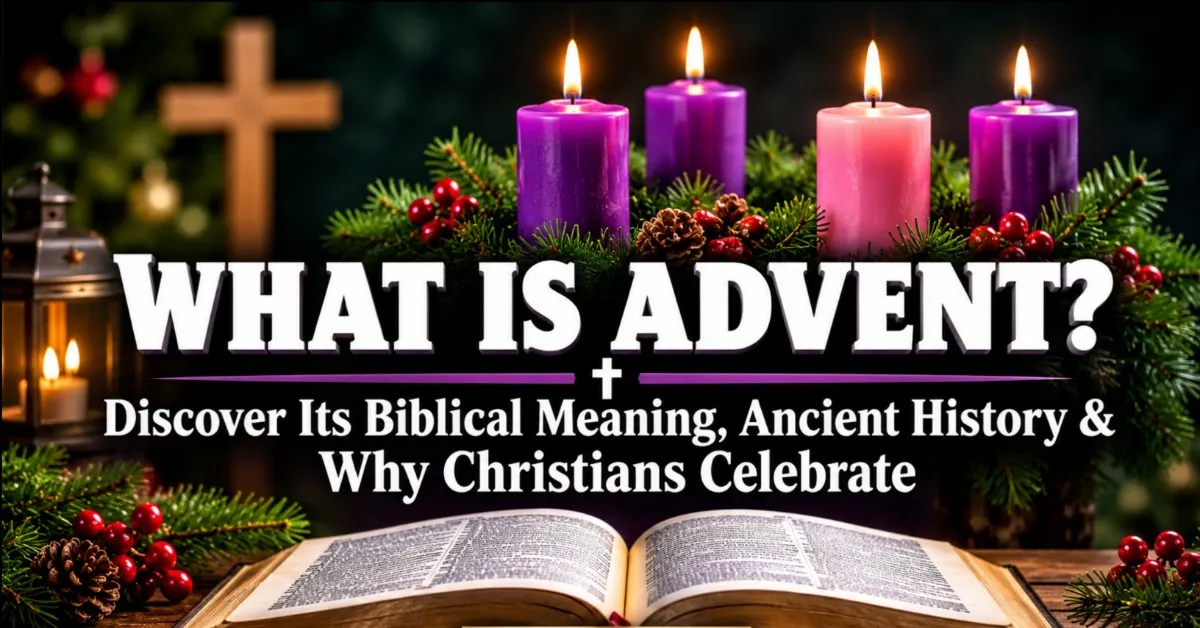
Why do many churches set aside several weeks before Christmas instead of moving straight to the celebration? This period is known as Advent, a season that helps Christians prepare to celebrate the birth of Jesus Christ.
Observed in many Western churches, Advent also points beyond the first Christmas. It connects the remembrance of Jesus’ birth with the Christian hope that He will come again.
Churches do not all observe Advent in the same way, and some do not keep it as a separate season. But understanding its purpose helps explain why it remains meaningful to many Christians and how it shapes the weeks leading up to Christmas.
What Is Advent?
Advent is a season of preparation and expectation observed by many Christian churches during the weeks before Christmas. In the Western Christian calendar, it marks the beginning of the liturgical year and prepares the church for the celebration of Jesus’ birth.
The season brings together two important themes of Christian hope. Believers remember the first coming of Jesus in Bethlehem, while also looking forward to His promised return. One points back to the birth of the Savior; the other reminds Christians that their hope is not limited to remembering the first Christmas.
In many Western churches, Advent includes four Sundays before Christmas. During these weeks, congregations may use special Bible readings, worship services, an Advent wreath, or other traditions to mark the season. Practices vary among churches, so the way Advent is observed can differ from one congregation to another.
Advent is a church tradition, not a requirement for being a Christian. The Bible does not command believers to observe a four-week season before Christmas. Many churches, however, find it a meaningful way to prepare for the celebration and reflect on the life, coming, and promises of Jesus.
What Does Advent Mean?
The Meaning and Origin of the Word Advent
The word Advent comes from the Latin word adventus, meaning “coming” or “arrival.” In Christian tradition, it refers to the coming of Jesus Christ.
This meaning explains the name of the season. Advent is not another word for Christmas; it describes the coming Christians remember as they celebrate Jesus’ birth and the hope of His promised return.
Why the Coming of Christ Matters to Christians
For Christians, the coming of Jesus is central because they believe God sent His Son to bring salvation to the world. His birth is not remembered only as the arrival of a child in Bethlehem. It marks the beginning of the earthly life and saving work of the One Christians confess as Savior.
That belief gives Advent its deeper significance. As Christmas approaches, the season invites believers to consider not only the events surrounding Jesus’ birth, but also why His coming matters to their faith.
Why Do Christians Celebrate Advent?
For churches that observe Advent, the season shapes the weeks leading up to Christmas in three main ways: remembering Jesus’ birth, looking ahead to His return, and making time for spiritual reflection.
To Remember the First Coming of Jesus Christ
The Christmas story explains why Christians place Jesus at the center of Advent. In Matthew’s Gospel, an angel tells Joseph that Mary will give birth to a son and that he must name Him Jesus, “for he shall save his people from their sins” (Matthew 1:21, KJV). Matthew also connects His birth with the name Emmanuel, meaning “God with us” (Matthew 1:22–23).
Luke records the angel’s announcement to the shepherds:
“For unto you is born this day in the city of David a Saviour, which is Christ the Lord.” — Luke 2:11 (KJV)
These passages show why the birth of Jesus is more than a familiar Christmas story for Christians. They understand it as the coming of the Savior God had promised. During Advent, churches return to these accounts through Scripture readings, worship, and prayer.
To Look Forward to Christ’s Second Coming
Advent also gives attention to the Christian hope that Jesus will return. Before His death, Jesus told His disciples that He would prepare a place for them and come again to receive them (John 14:2–3). Christians look to this promise as a source of hope as they await His return.
The final chapter of Revelation records this response: “Even so, come, Lord Jesus” (Revelation 22:20, KJV).
This expectation is not a reason to set dates or speculate about the future. It encourages believers to remain faithful and live in light of Christ’s promise. In this way, Advent looks beyond the celebration of His birth to the hope of His return.
To Reflect on Faith and Spiritual Readiness
Advent can also create space for reflection during a season that is often filled with shopping, travel, and family plans. For Christians who observe it, preparation for Christmas can include attention to their spiritual lives, not only the arrangements for the holiday.
Some believers set aside time for Scripture reading and prayer, attend additional worship services, follow an Advent devotional, or look for ways to help people in need. Practices differ, and no single activity is required of every Christian.
If you would like ideas for prayer during this season, explore our Advent prayers. You can also read how to prepare your heart for Christmas for practical ways to make spiritual preparation part of the season.
When Does Advent Begin?
In the Western Christian calendar, Advent begins on the First Sunday of Advent, which falls on the Sunday nearest November 30. Depending on the year, this Sunday can fall anywhere from November 27 to December 3.
Because the date is based on a Sunday rather than a fixed calendar date, Advent does not begin on the same date every year. The following details explain how the starting date is determined and when the season ends.
Why Does the Starting Date Change Every Year?
The First Sunday of Advent is determined by its relationship to November 30, the feast of Saint Andrew in the Western calendar. It is observed on the Sunday closest to that date.
This means the first Sunday can fall on November 27, 28, 29, 30, or December 1, 2, or 3. Although the starting date changes, the Western observance always includes four Sundays before Christmas.
In the Roman Catholic Church, Advent officially begins with First Vespers, also called Evening Prayer I, on the Saturday evening before the First Sunday of Advent. Other Western churches may describe the season as beginning on the Sunday itself.
How Long Does the Advent Season Last?
Advent is traditionally described as a four-week season because it includes four Sundays before Christmas. However, these are not always four complete seven-day weeks.
The total number of calendar days varies according to when the First Sunday falls. For example, an Advent season beginning on November 29 lasts longer than one beginning on December 3.
The season also has a closer focus on Christmas during its final days. In the Roman Catholic calendar, the weekdays from December 17 through December 24 are especially directed toward preparing for the celebration of Christ’s birth.
Other Christian traditions may follow different calendars or observe a different period of preparation before Christmas.
When Does Advent End?
In common Western observance, Advent continues through Christmas Eve, December 24. In the Roman Catholic calendar, however, the season ends before First Vespers, or Evening Prayer I, of Christmas.
Christmas then begins as the Church celebrates the Nativity of Jesus Christ. The distinction is important: Advent is the season of preparation, while Christmas is the celebration of Christ’s birth.
What Is the Biblical Meaning of Advent?
The Bible does not use the word Advent to describe an annual four-week church season. That observance developed later in Christian history. However, the themes behind Advent are rooted in Scripture, including God’s promises about the Messiah, the birth of Jesus, and the hope of His return.
Old Testament Promises About the Coming Messiah
Several Old Testament passages are important to the way Christians understand the coming of Jesus. Isaiah 7:14 speaks of a sign involving a child who would be called Emmanuel. In its original historical setting, this prophecy was given during a crisis involving King Ahaz and the kingdom of Judah. Matthew 1:22–23 later connects the passage with Jesus’ birth and explains the name Emmanuel as “God with us.”
Isaiah 9:6 describes a child who is born and a son who is given, using royal titles that Christians have traditionally understood as pointing to the Messiah. Micah 5:2 speaks of a ruler who would come from Bethlehem, the town associated with Jesus’ birth in Matthew 2:1–6.
Christians read these passages as part of the biblical hope for God’s promised King and Savior. Their original settings and interpretations are important, too. Jewish and Christian traditions do not interpret every passage in the same way, so it is more accurate to explain how Christians understand these texts rather than suggest that all readers share one interpretation.
The Fulfillment of God’s Promise in Jesus Christ
The Gospels of Matthew and Luke describe the events surrounding Jesus’ birth. Matthew 1:18–23 tells of Mary’s pregnancy and the angel’s message to Joseph. Luke 1:26–38 records the angel Gabriel’s announcement to Mary that she would give birth to Jesus.
Luke 2:1–20 then describes Jesus’ birth in Bethlehem and the angel’s announcement to the shepherds. Together, these passages tell the story Christians remember during the Christmas season.
For Christians, these events reveal God’s promise of a Savior fulfilled in Jesus Christ. You can read the biblical accounts together in our guide to the Christmas story in the Bible.
The Biblical Hope of Christ’s Return
The biblical message of hope also looks beyond the events of Jesus’ earthly life. Jesus told His disciples that He would come again (John 14:3). After His ascension, the angels told the disciples that Jesus would return in the same way they had seen Him go into heaven (Acts 1:11).
Revelation 22:20 records these words:
“Surely I come quickly. Amen. Even so, come, Lord Jesus.” — Revelation 22:20 (KJV)
This verse appears near the end of Revelation and expresses the expectation of Christ’s coming. For Christians, it is a reminder that the hope connected with Jesus is not limited to His birth in Bethlehem. His promised return is also part of the biblical foundation behind the Advent season.
How Did the Advent Season Begin?
Advent did not begin with one universally recognized founder or a single event. It developed gradually as Christian communities established periods of preparation before celebrating the birth of Jesus Christ.
The Early History of Advent in Christianity
Historical accounts trace Advent as a distinct church season to the late fourth century. Its early purpose and practices were not exactly the same as those followed by churches today.
According to a historical account from the United Methodist Church, early Advent was connected with fasting and preparation for baptism. Over time, its length and practices varied across Christian communities. By the eighth century, Advent was generally observed for six weeks in the East and seven weeks in the West. The Western observance was later shortened to four weeks by the twelfth century.
This history shows that the Advent season familiar to many Christians today took shape over several centuries. Its development was gradual, rather than the result of one decision or the work of one individual.
How Advent Became Part of the Christian Calendar
As the Western church calendar developed, Advent became the season that begins the liturgical year and leads into Christmas. Its place in the calendar gave churches a regular period to prepare for the celebration of Jesus’ birth and reflect on the hope of His return.
Over time, Advent readings, prayers, and worship services became established parts of many church traditions. Customs such as the Advent wreath and lighting candles also became familiar ways of marking the weeks before Christmas. These practices developed within Christian tradition and are not followed in exactly the same way by every church.
How Do Different Christians Observe Advent?
Advent is observed in many Christian communities, but it is not universal. Some churches follow a formal liturgical season, while others use personal or family devotions. The customs depend on a church’s calendar, worship tradition, and local practice.
Advent in Catholic and Liturgical Churches
The Roman Catholic Church observes Advent as part of its liturgical year. Special Scripture readings and prayers guide the season, with an emphasis on preparation, hope, and the coming of Christ.
Purple or violet is traditionally used for vestments and other liturgical decorations during much of Advent. On the Third Sunday, known as Gaudete Sunday, rose-colored vestments may be used to express joy as Christmas approaches.
Many Catholic churches and families also use an Advent wreath with four candles, lighting another candle on each Sunday. The wreath provides a visible reminder of the season as it progresses.
Other liturgical churches, including Anglican and Lutheran congregations, also have established Advent services and customs. Their practices may include special readings, hymns, prayers, and Advent wreaths, although details vary between denominations and individual churches.
Advent in Protestant and Evangelical Churches
Many Protestant churches observe Advent through seasonal Bible readings, hymns, prayers, and worship services. Anglican, Lutheran, and Methodist congregations commonly include Advent in their church calendars, while some Reformed churches also observe it.
In evangelical churches, Advent may be marked through family devotionals, sermon series, small-group studies, or personal Scripture reading. Some congregations follow a formal Advent calendar, while others celebrate Christmas without observing a separate Advent season.
These differences reflect the variety of Protestant worship traditions. A church does not have to follow a formal Advent calendar to celebrate Jesus’ birth or believe in His promised return.
Eastern Christian Traditions
Many Eastern Orthodox churches prepare for the celebration of Christ’s birth through a forty-day period known as the Nativity Fast. It is also sometimes called Philip’s Fast because it begins after the feast of the Apostle Philip.
Orthodox churches that follow the New Calendar generally observe the fast from November 15 through December 24. Churches following the older Julian calendar observe it from November 28 through January 6 on the civil calendar, with Christmas celebrated on January 7.
The Nativity Fast includes prayer, spiritual reflection, and fasting according to the practices of the church. Its observance can vary between communities and individuals.
Although the Nativity Fast shares the purpose of preparing for Christ’s birth with Western Advent, the two are not identical. The Nativity Fast has its own calendar, fasting practices, and liturgical traditions. Other Eastern Christian communities may follow different calendars and preparations for Christmas.
Is Advent Mentioned in the Bible?
No. The Bible does not name Advent as an annual church season or instruct Christians to observe four Sundays before Christmas. The observance developed later in Christian history as part of the church calendar.
However, the ideas behind Advent come from Scripture. The Old Testament contains promises Christians connect with the coming Messiah, the Gospels describe the birth of Jesus, and the New Testament speaks of His promised return.
This distinction is important: Advent itself is a church tradition, but the biblical teachings it highlights are central to Christian faith. Christians may observe the season or choose not to; observing Advent is not a requirement for salvation.
Frequently Asked Questions About Advent
Is Advent Only Celebrated by Catholics?
No. Advent is observed by Catholics as well as many Anglican, Lutheran, Methodist, and other Protestant churches. Some evangelical congregations also mark the season through sermons, Bible readings, or family devotionals, while others do not follow a separate Advent observance.
Is Advent the Same as Christmas?
No. Advent is the season of preparation leading up to Christmas, while Christmas celebrates the birth of Jesus Christ. In the Western Christian calendar, they are two distinct seasons that follow one another.
How Many Weeks Does Advent Last?
Advent includes four Sundays before Christmas in the Western Christian calendar. However, it does not always last four complete weeks because its starting date changes each year.
Do All Christians Celebrate Advent?
No. Many Christian churches observe Advent, but it is not universal. Some follow a formal liturgical calendar, others mark the season through personal or family devotions, and some celebrate Christmas without a separate Advent observance.
Conclusion
Advent is more than a countdown to Christmas. It is a Christian season that brings together the remembrance of Jesus’ birth and the hope of His promised return.
Although its customs and calendars differ among churches, its central message points believers toward Christ. For Christians who observe Advent, these weeks offer an opportunity to reflect on Scripture, renew their faith, and prepare to celebrate the birth of Jesus with a deeper understanding of its meaning.

Hi, I’m Prashanta Kumbhar, a Christian blogger, faith writer, and the founder of Light and Gospel (LightandGospel.com), based in Odisha, India.
I regularly write Bible devotionals, prayers, Scripture reflections, and faith-based messages to encourage people in their daily walk with Jesus Christ and help them grow in hope, faith, and spiritual strength.
Along with blogging, I also create Christian content on my YouTube channel “The God Helps” and share faith, prayer, Bible study, and motivational messages across social media platforms like Facebook & Instagram. My mission is to make God’s Word simple, practical, & meaningful for everyday life.