
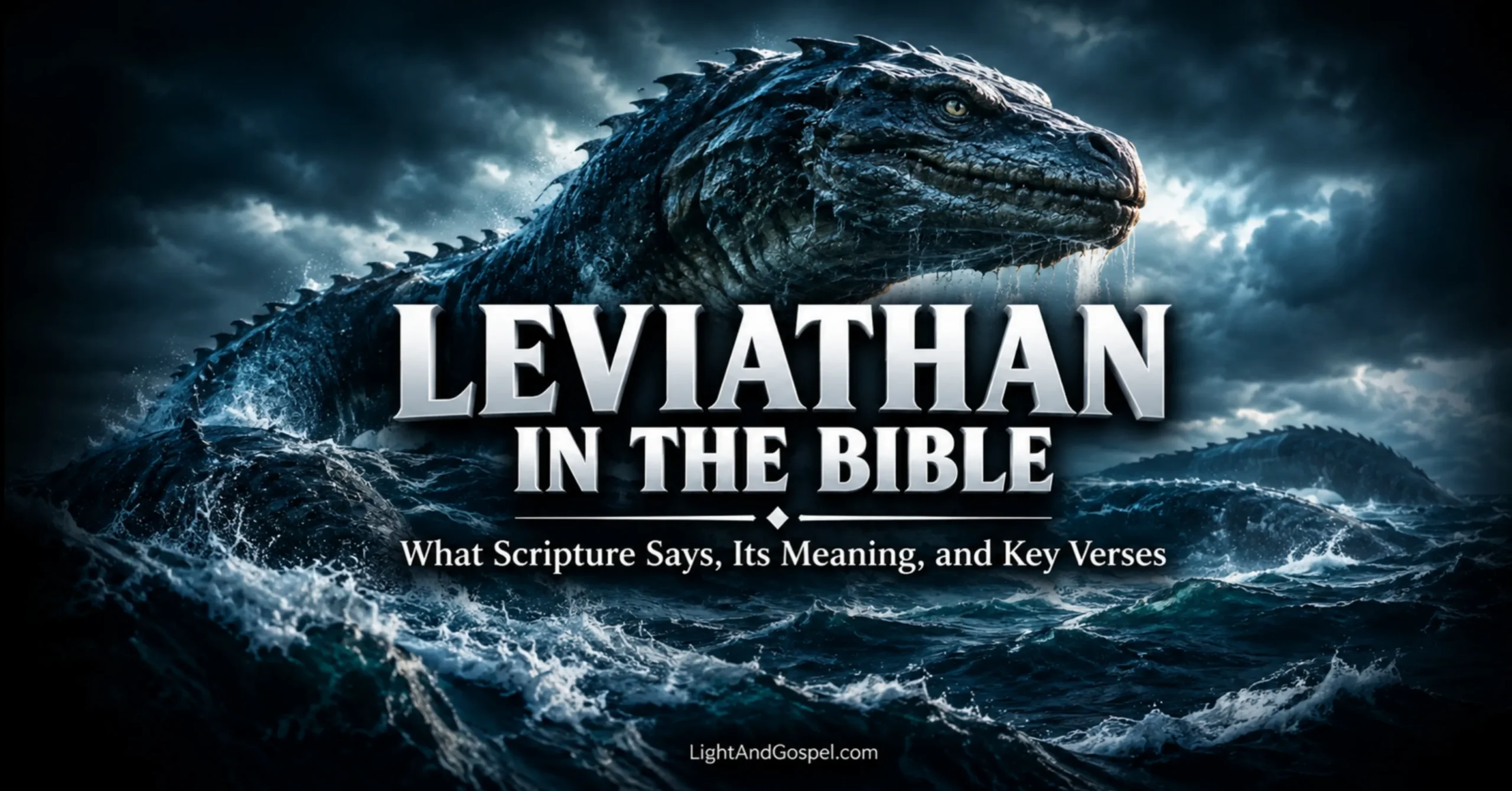
Leviathan is one of the most mysterious figures in the Old Testament. The Bible describes Leviathan in striking language, especially in Job 41, while the Psalms and Isaiah use the name in different contexts.
This raises several questions: Was Leviathan a real creature? Was it a sea monster, crocodile, dragon, or dinosaur? Does it represent Satan? Is it still alive?
Scripture gives us important clues, but it does not answer every modern question about Leviathan. The best approach is to examine each passage in its own context rather than forcing every reference into one explanation.
Job 41 presents Leviathan as a creature beyond human control. Psalm 74 uses Leviathan in imagery of God’s victory over the sea. Psalm 104 places Leviathan among God’s creatures, while Isaiah 27 uses serpent and sea-monster imagery in a prophecy of divine judgment.
What Is Leviathan in the Bible?
Leviathan is a powerful creature or sea-monster figure mentioned in Job 3:8, Job 41, Psalm 74:13–14, Psalm 104:25–26, and Isaiah 27:1.
These passages do not use the name in exactly the same way.
In Job 41, God describes Leviathan as something humans cannot capture or tame. Psalm 104 presents it as part of God’s created world. Psalm 74 uses Leviathan in imagery of God’s victory over threatening forces associated with the sea. Isaiah 27 uses Leviathan as a serpent-like sea monster in a prophecy of God’s judgment.
Because of these differences, it is safer to speak of Leviathan as a powerful biblical creature or sea-monster figure rather than assign it a modern scientific species.
Where Is Leviathan Mentioned in the Bible?
The main references are:
- Job 3:8 — Leviathan appears in Job’s lament.
- Job 41:1–34 — the Bible’s longest description of Leviathan.
- Psalm 74:13–14 — Leviathan appears in imagery of God’s victory over the sea.
- Psalm 104:25–26 — Leviathan is included among God’s creatures.
- Isaiah 27:1 — Leviathan appears as a serpent or sea monster in prophetic judgment.
These passages should not be combined into one continuous story. Each serves a different literary and theological purpose.
What Does Job 41 Say About Leviathan?
Job 41 contains Scripture’s fullest description of Leviathan. It comes near the end of God’s speeches to Job, following the description of Behemoth in Job 40.
The central issue is human limitation.
God Challenges Job’s Ability to Control Leviathan
God begins by asking:
“Can you draw out Leviathan with a hook?”
— Job 41:1
God asks whether Job can capture Leviathan, put a cord around its tongue, make it serve him, or tame it like an ordinary animal.
The questions emphasize that Job cannot control Leviathan.
This fits the larger message of Job. God has already shown Job the complexity of creation and the limits of human knowledge. Leviathan becomes another powerful example: there are parts of God’s creation that human beings cannot control.
If Job cannot master one creature, this highlights how limited his understanding of the Creator’s purposes is.
What Does Job 41 Describe?
The chapter portrays Leviathan as extraordinarily powerful and terrifying. It speaks of its strength, armor-like scales, powerful jaws, resistance to weapons, frightening appearance, and movement through the water.
Job 41:12 says:
“I will not fail to speak of Leviathan’s limbs,
its strength and its graceful form.”
The language is deliberately dramatic. Weapons such as swords, spears, arrows, clubs, and fishing equipment are portrayed as ineffective against it.
Job 41 is therefore not written like a modern wildlife field guide. Its vivid description serves a theological purpose: Leviathan’s overwhelming strength highlights the much greater wisdom and authority of God.
What About the Fire, Smoke, and Light?
Job 41:18–21 contains some of the most debated imagery in the passage. Leviathan is described with images of light, smoke, sparks, burning coals, and fire.
Some readers take these details as evidence that Leviathan literally breathed fire. But that conclusion is not required by the text.
Job is poetic literature, and the description uses highly dramatic imagery to communicate terror and power. It should therefore not be treated as a technical biological description.
This is also why Job 41 does not provide enough evidence to confidently identify Leviathan as a particular modern animal.
“King Over All the Children of Pride”
Job 41:34 concludes:
“He is king over all that are proud.”
This verse is sometimes used to argue that Leviathan is Satan or a demon connected with pride.
However, Job 41 does not explicitly make either identification. The statement fits the chapter’s portrait of an overwhelming creature before which human pride and strength are powerless.
The immediate point is God’s greatness compared with human limitations.
What Does Job 3:8 Mean?
Job 3:8 appears in a completely different setting.
After losing his children, possessions, and health, Job curses the day of his birth. He wishes that the day could disappear.
He says:
“May those who curse days curse that day,
those who are ready to rouse Leviathan.”
— Job 3:8
This is part of Job’s intense lament, not a physical description of Leviathan.
Job uses Leviathan as part of dark poetic imagery. The verse does not explain its size, species, habitat, or physical abilities.
Therefore, Job 3:8 should not be used to calculate Leviathan’s dimensions or prove that it was a particular animal. Its main purpose is to express the depth of Job’s grief.
Why Job 3:8 Is Different From Job 41
Job 3:8 and Job 41 mention the same name, but they serve different purposes.
In Job 3:8, Leviathan appears in Job’s lament and dark poetic imagery. In Job 41, God gives a detailed description of Leviathan while emphasizing its power and the limits of human control.
This difference is important when interpreting what the Bible says about Leviathan.
What Does Psalm 74:13–14 Mean?
Psalm 74 is a communal lament that remembers God’s mighty acts and asks Him to act for His people.
It says:
“It was you who split open the sea by your power;
you broke the heads of the monster in the waters.
It was you who crushed the heads of Leviathan…”
— Psalm 74:13–14
Here Leviathan appears within dramatic imagery of God’s victory over the sea and threatening forces.
The imagery emphasizes God’s overwhelming sovereignty rather than presenting Leviathan as a rival equal to God.
The Bible can use the sea as a picture of danger, disorder, and forces beyond human control. Psalm 74 declares that none of these things are beyond God’s authority.
Because Psalm 74 is poetry, it should not automatically be interpreted as a modern eyewitness report of a literal animal attack. Its purpose is to proclaim God’s power and faithfulness through powerful sea-monster imagery.
What Does Psalm 104:25–26 Mean?
Psalm 104 provides another important perspective because it celebrates God’s creation.
The psalm describes the sea and its many creatures and then says:
“There the ships go to and fro,
and Leviathan, which you formed to frolic there.”
— Psalm 104:26
Leviathan as Part of God’s Creation
This passage presents Leviathan as something God formed.
That matters because it shows a different side of the biblical picture. Leviathan is not simply presented as an evil power. In Psalm 104, it belongs within God’s created world.
The psalm celebrates God’s wisdom and sovereignty over creation, including creatures humans cannot control.
Psalm 104 does not provide a modern species classification. It connects Leviathan with the sea and God’s creation without identifying it as a crocodile, whale, dinosaur, or another specific animal.
What Does Isaiah 27:1 Mean?
Isaiah 27:1 says:
“In that day, the LORD will punish with his sword—
his fierce, great and powerful sword—
Leviathan the gliding serpent,
Leviathan the coiling serpent;
he will slay the monster of the sea.”
The language is clearly prophetic.
Isaiah describes Leviathan as a gliding serpent, a coiling serpent, and a sea monster. The imagery communicates a powerful force that cannot ultimately escape God’s judgment.
Isaiah 27:1 does not explicitly say that Leviathan is Satan. Some Christian interpreters connect the imagery with Satan or broader biblical themes of evil and opposition to God, but that is an interpretation rather than a direct identification in the verse.
Leviathan and Ancient Near Eastern Imagery
Leviathan also appears within a wider ancient Near Eastern world where serpent and sea-monster imagery was associated with danger, disorder, and powerful forces.
Ugaritic texts, for example, mention Lotan, a serpent-like sea figure connected with conflict involving the storm god Baal.
This background can help modern readers understand why biblical writers used sea-monster imagery. However, historical similarities do not mean that the Bible simply copies another religion’s theology.
The biblical writers use this imagery within Israel’s own understanding of the Lord as Creator and sovereign King.
What Was Leviathan? Major Interpretations
Scripture does not give Leviathan a modern species name, so several interpretations have been proposed.
Leviathan as a Real Sea Creature
Some interpreters understand Leviathan as a real creature known to people in the ancient world. This fits Psalm 104, where Leviathan is included among God’s creatures, and takes seriously the sea-related language throughout Scripture.
However, the dramatic imagery in Job 41 makes an exact identification difficult.
Leviathan as a Crocodile or Crocodile-Like Creature
Another interpretation connects Leviathan with a crocodile or crocodile-like animal.
Crocodiles have powerful jaws, armored scales, and great strength. Some details in Job 41 can sound compatible with such an animal.
Yet the entire description does not fit a modern crocodile neatly, particularly the extraordinary imagery in verses 18–21.
Therefore, the crocodile interpretation remains an interpretation rather than an established biblical fact.
Leviathan as a Sea Monster or Dragon Image
Some readers understand Leviathan primarily as a sea monster or dragon-like figure. This fits especially well with Psalm 74 and Isaiah 27, where Leviathan appears in dramatic sea-monster imagery.
The word “dragon” should also be handled carefully. Modern readers may imagine fantasy creatures with wings and magical powers, but ancient terms for serpents and monsters do not necessarily carry that modern meaning.
Leviathan as a Symbol of Chaos or Hostile Power
Another interpretation sees Leviathan as imagery representing chaos, disorder, or hostile forces.
This can help explain the defeat imagery in Psalm 74 and Isaiah 27. However, this meaning should not be applied identically to every reference. Psalm 104 presents Leviathan within creation, while Job 41 emphasizes its untamable strength.
Was Leviathan a Dinosaur?
The Bible does not identify Leviathan as a dinosaur.
Some Christians believe descriptions in Job 41 could fit an extinct creature, especially because of its strength, scales, and unusual imagery. But this remains an interpretation.
The Bible was not written using the modern scientific category “dinosaur,” and none of the Leviathan passages explicitly identifies a dinosaur species.
For a broader discussion of dinosaurs and Scripture, see Why Does the Bible Not Mention Dinosaurs?
Is Leviathan a Real Creature?
The biblical passages present Leviathan as a meaningful creature or sea-monster figure, but they do not provide enough information for a modern scientific identification.
The biblical passages present Leviathan as:
- mentioned in several Old Testament passages;
- associated with the sea;
- portrayed as extremely powerful;
- beyond normal human control;
- included within God’s creation in Psalm 104;
- used in sea-monster and judgment imagery in other passages.
What Scripture does not provide is an exact species, scientific classification, precise size, confirmed modern location, or current population.
The safest approach is therefore to distinguish what Scripture clearly says from later attempts to identify the creature.
How Big Was Leviathan?
The Bible does not give an exact measurement for Leviathan.
Job 41 emphasizes its extraordinary strength, scales, terrifying appearance, and resistance to human weapons, but it never gives a precise length or weight.
Therefore, claims that Leviathan was a specific number of feet long or weighed a certain number of tons should not be presented as biblical facts.
Job 41 is poetry, not a scientific measurement chart. Creating exact measurements by combining its imagery with assumptions about modern animals produces a level of precision that Scripture itself does not provide.
Did God Kill Leviathan?
The answer depends on the passage.
Psalm 74:14 speaks of God crushing the heads of Leviathan. Isaiah 27:1 describes the Lord striking and killing Leviathan in prophetic judgment imagery.
Job 41, however, does not describe God killing Leviathan. Its focus is God’s challenge to Job concerning his inability to control the creature.
These passages should therefore not be merged into one chronological story.
Psalm 74 emphasizes God’s victory, Isaiah 27 emphasizes prophetic judgment, and Job 41 emphasizes God’s greatness and human limitation.
Is Leviathan Still Alive?
The Bible does not tell us whether Leviathan is alive today.
Psalm 104 places Leviathan within God’s creation, while Job, Psalms, and Isaiah use the figure in different literary settings. None provides a modern scientific report about its present existence.
The Bible does not say that Leviathan currently lives in the ocean.
Stories of modern sea-monster sightings cannot establish the identity or meaning of the biblical Leviathan. Modern reports and biblical evidence should be kept separate.
Why Did God Create Leviathan?
Psalm 104 gives the clearest biblical context.
Leviathan is described as a creature God formed to move and play in the sea. The psalm places it within the larger order of creation and uses it to celebrate God’s wisdom and creative power.
Scripture does not provide a detailed explanation of every reason God created Leviathan.
What it does show is that even a creature humans may find terrifying belongs to the world God made and rules.
Leviathan and Behemoth: What Is the Difference?
Behemoth and Leviathan appear near the end of God’s speeches to Job.
Behemoth is described in Job 40:15–24. It is associated with land and vegetation and is presented as extraordinarily strong.
Leviathan follows in Job 41 and is associated with the sea. Its description emphasizes scales, strength, fear, and the inability of humans to tame it.
| Behemoth | Leviathan |
|---|---|
| Job 40 | Job 41 |
| Associated with land | Associated with the sea |
| Feeds on vegetation | Described with sea-related imagery |
| Emphasizes great strength | Emphasizes strength and untamability |
Neither passage explicitly identifies these creatures as dinosaurs. The larger purpose is to show Job the greatness of God’s creation and the limits of human power.
Is the “Leviathan Spirit” in the Bible?
The phrase “Leviathan spirit” appears in some modern Christian spiritual-warfare teaching, but the Bible does not explicitly teach about a demon called the “Leviathan spirit.”
Some teachers connect Leviathan with pride because Job 41:34 calls it “king over all that are proud.” Others associate the name with demonic activity.
These are later interpretations, not a direct biblical doctrine.
Job 41 does not say that Leviathan is a demon or that it controls people through pride. Scripture also does not authorize Christians to diagnose illnesses, emotional struggles, relationship problems, or sinful habits as evidence of a “Leviathan spirit.”
Christians can take spiritual warfare seriously while still distinguishing biblical teaching from later traditions.
What Does Leviathan Symbolize?
Leviathan does not have one identical symbolic meaning in every passage.
- Job 41: Leviathan highlights the limits of human strength and understanding.
- Psalm 74: it appears in imagery of God’s victory over threatening forces associated with the sea.
- Psalm 104: Leviathan belongs to God’s created order.
- Isaiah 27: it appears in prophetic judgment imagery.
Together, these passages point toward a consistent theological truth: what appears powerful, mysterious, or uncontrollable to humans remains under God’s authority.
What Does Leviathan Teach Us About God?
The most important lesson is not discovering an exact species. It is understanding what these passages reveal about God.
God Is Greater Than What Humans Cannot Control
Job cannot tame Leviathan, just as he cannot control every part of creation.
The lesson is humility. Human knowledge and power are limited, but God’s wisdom is not.
God Is the Creator
Psalm 104 reminds us that even Leviathan belongs to God’s creation.
The creature is not God’s equal. It is part of the world He made.
God Has Authority Over What Appears Threatening
Psalm 74 and Isaiah 27 use Leviathan to communicate God’s victory over threatening and chaotic forces.
The Bible never presents such forces as equal rivals to God.
Scripture Invites Humility
The Bible does not answer every question modern readers may ask about Leviathan.
We can study the text, examine its context, and consider responsible interpretations without pretending that every mystery has a definite answer.
Conclusion: What the Bible Actually Says About Leviathan
Leviathan is one of Scripture’s most striking and mysterious figures.
Job 41 gives the fullest description, presenting Leviathan as a creature beyond human control and using its overwhelming strength to highlight God’s greatness. Job 3:8 uses Leviathan within Job’s lament rather than providing a physical description.
Psalm 74 uses Leviathan in imagery of God’s victory over the sea, while Psalm 104 places Leviathan within God’s created world. Isaiah 27 uses serpent and sea-monster imagery in a prophecy of God’s judgment.
The Bible does not explicitly identify Leviathan as a dinosaur, Satan, or a demon. It does not establish a “Leviathan spirit,” give an exact scientific species, or tell us whether Leviathan is alive today.
What Scripture does make clear is more important: what humans cannot control is still under God’s authority.
Leviathan reminds us that God’s creation is greater than our experience, God’s wisdom is greater than our understanding, and God’s authority extends over everything that appears powerful or mysterious.
The right response is not to fill biblical gaps with speculation. It is to read each passage carefully, respect its context, distinguish Scripture from later interpretation, and worship the God who is greater than everything we can understand.

Hi, I’m Prashanta Kumbhar, a Christian blogger, faith writer, and the founder of Light and Gospel (LightandGospel.com), based in Odisha, India.
I regularly write Bible devotionals, prayers, Scripture reflections, and faith-based messages to encourage people in their daily walk with Jesus Christ and help them grow in hope, faith, and spiritual strength.
Along with blogging, I also create Christian content on my YouTube channel “The God Helps” and share faith, prayer, Bible study, and motivational messages across social media platforms like Facebook & Instagram. My mission is to make God’s Word simple, practical, & meaningful for everyday life.