
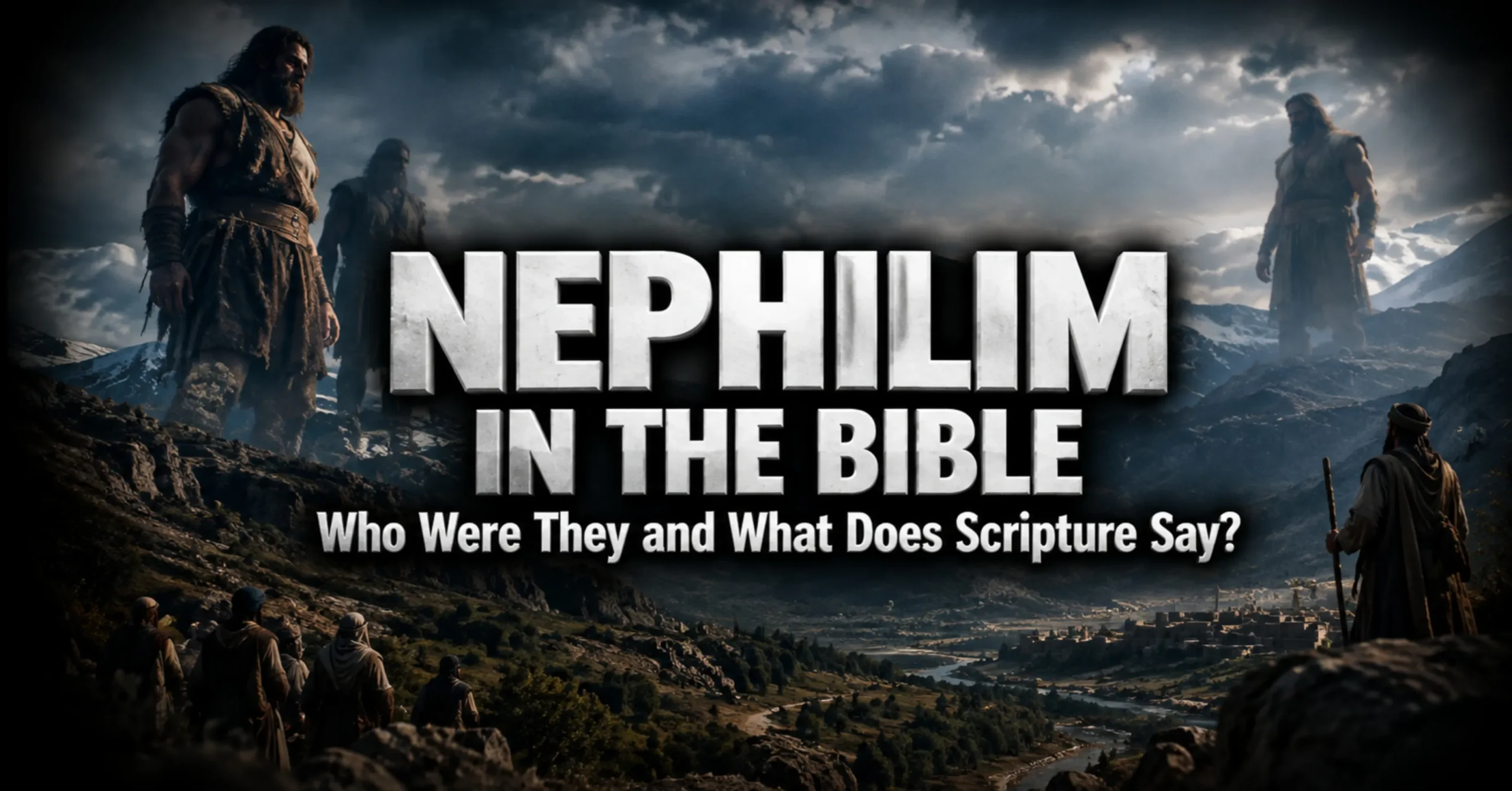
The Nephilim in the Bible are mentioned only briefly, yet Genesis 6:1–4 has raised many questions. Who were the Nephilim? Were they giants? Who were the “sons of God” who took the daughters of men as wives? Did the Nephilim survive the Flood? And was Goliath one of them?
The Bible gives us some clear answers, but it does not explain every detail. That matters because many ideas about the Nephilim come from later Jewish writings, theological interpretations, or modern speculation rather than from Scripture itself.
In this article, we will look closely at what the Bible says, where Christians differ in their interpretations, what the Book of Enoch adds, and what we should be careful not to claim. The goal is simple: to understand this difficult passage faithfully without filling its unanswered questions with speculation.
What Are the Nephilim in the Bible?
The Nephilim are first mentioned in Genesis 6:4. The verse describes a time before the Flood when the “sons of God” went in to the “daughters of men.” It then says:
“The Nephilim were on the earth in those days–and also afterward…” (Genesis 6:4, NIV)
The same verse also mentions the “mighty men” and “men of renown” associated with that time.
The Hebrew word Nephilim is unusual. It is not a word that can be translated with complete certainty into one English word. Some English translations have used “giants,” following the ancient Greek translation of the Old Testament, while many modern translations transliterate the Hebrew word as “Nephilim.” Bible Gateway’s Bible encyclopedia notes that the Hebrew term appears in the Old Testament only in Genesis 6:4 and Numbers 13:33, and that its exact etymology remains uncertain.
So, what can we say with confidence?
The Bible clearly tells us that the Nephilim were on the earth in the period described in Genesis 6 and that Numbers 13:33 uses the same name in the spies’ report about Canaan.
What the Bible does not give us is a complete description of their nature, physical appearance, or exact origin.
That distinction matters.
What Does Genesis 6 Say About the Nephilim?
Genesis 6:1–4 is the main biblical passage about the Nephilim. The passage begins by describing the growth of humanity:
“When human beings began to increase in number on the earth…” (Genesis 6:1, NIV)
Then Genesis introduces the “sons of God” and the “daughters of men.” The sons of God saw that the daughters were beautiful and took wives for themselves.
Genesis 6:4 then mentions the Nephilim and the mighty men of old.
But the story does not stop there. The next verses are important.
Genesis 6:5–7 describes the great wickedness of humanity. God sees that human evil has become widespread, and the passage moves toward the judgment of the Flood.
We should not reduce the Flood to a simple statement such as, “God destroyed the world because of the Nephilim.” Genesis gives a much broader reason for judgment: human wickedness, corruption, and the evil continually present in people’s hearts.
The Nephilim belong to this dark period of Genesis history, but Scripture does not say that they alone caused the Flood.
Who Were the “Sons of God” in Genesis 6?
This is one of the most debated questions in the passage.
There are several major interpretations.
The Sons of God Were Heavenly Beings
One major interpretation understands the “sons of God” as heavenly or angelic beings.
Part of the reason for this view is the expression itself. The Hebrew phrase bene ha’elohim appears in Job 1:6, 2:1, and 38:7, where it refers to heavenly beings. The NET Bible notes this connection while also explaining that Genesis 6 has been interpreted in more than one way.
Jude 6 and 2 Peter 2:4 are also commonly connected with this interpretation. Both passages speak about angels who sinned and came under God’s judgment. Some scholars understand these New Testament passages as reflecting the same tradition behind Genesis 6, although the connection remains debated.
Still, Genesis 6 itself does not give us a detailed explanation of how such a union would work. We should not add details that Scripture does not provide.
The Sons of God Were Connected With Seth’s Line
Another interpretation connects the “sons of God” with the line of Seth in Genesis 5.
In this view, Genesis 4 describes the development of Cain’s line, while Genesis 5 follows the family line of Seth. The “sons of God” are then understood as people from Seth’s line who began marrying women outside that faithful pattern.
This interpretation has been held by some Christian interpreters, although it faces questions of its own, especially concerning the wording of Genesis 6 and the identity of the Nephilim.
The Sons of God Were Powerful Human Rulers
A third interpretation understands the phrase as referring to powerful rulers or leaders who claimed special status.
This view focuses on the way ancient cultures sometimes used divine language for kings and rulers. It also considers the wider pattern of violence and abuse of power found in Genesis.
These interpretations should not be treated as though Scripture explicitly names one of them as the only possible answer.
What Scripture clearly establishes is that Genesis 6 describes a period of serious human wickedness before the Flood. The exact identity of the “sons of God” remains debated.
Does Nephilim Mean “Giants” or “Fallen Ones”?
You may have heard that the word Nephilim definitely means “fallen ones” or definitely means “giants.”
Neither statement should be made with absolute confidence.
The Hebrew word is nephilim. Its exact origin and meaning have been debated. The connection with the Hebrew root naphal, meaning “to fall,” has led some interpreters to suggest “fallen ones,” but the linguistic evidence does not make that meaning certain. Bible Gateway’s Bible encyclopedia notes that deriving the term from that root does not provide a satisfactory solution.
The word “giants” comes from ancient translation tradition and from the way the Nephilim are described in Numbers 13:33.
That gives us a useful conclusion:
The Nephilim may be associated with extraordinary size, but we should not pretend that one English translation completely settles their identity.
Were the Nephilim Giants?
There is biblical reason to associate the Nephilim with great size.
In Numbers 13:33, the Israelite spies say that they saw the Nephilim and describe themselves as grasshoppers compared with them. The same verse identifies them with the descendants of Anak.
But we need to read the verse in context.
The spies were giving a fearful report about the land. Their description emphasizes how overwhelming the people appeared to them. Caleb, however, responded differently and urged Israel to trust God (Numbers 13:30).
The Bible therefore gives us a connection between the Nephilim, the Anakim, and great physical stature in this passage. But that does not mean we should automatically treat every biblical giant as a Nephilim.
The Anakim, Rephaim, Goliath, and King Og should not simply be placed into one category without biblical evidence.
Were There Nephilim After the Flood?
This question comes from Genesis 6:4, which says the Nephilim were on the earth “and also afterward.”
Then Numbers 13:33 mentions the Nephilim when the spies describe Canaan.
At first glance, this may seem to prove that the Nephilim survived the Flood. But the passage is more complicated than that.
Some interpreters understand Genesis 6:4 as referring to another appearance of the Nephilim after the Flood. Others connect Numbers 13:33 with later giant traditions without concluding that the same pre-Flood people literally survived.
Numbers connects the spies’ report with the sons of Anak, while other passages discuss groups such as the Rephaim. Scripture does not give us a complete family line linking all these groups back to the Nephilim.
So we should be careful.
The Bible mentions Nephilim before the Flood and uses the name again in Numbers 13:33, but it does not give enough information to establish a definite surviving Nephilim bloodline.
Was Goliath a Nephilim?
No Bible verse explicitly says that Goliath was a Nephilim.
Goliath was a Philistine warrior from Gath, and 1 Samuel 17 describes his extraordinary size and military equipment. His height is given in the biblical text, although ancient textual traditions differ over the measurement.
But being a very large warrior does not automatically make Goliath a Nephilim.
The Bible never identifies him with that name.
There are connections between Goliath and other giant traditions in passages such as 2 Samuel 21:15–22 and 1 Chronicles 20:4–8. Yet these passages still do not provide a statement saying, “Goliath was one of the Nephilim.”
So the safest biblical conclusion is simple:
Goliath was an unusually large Philistine warrior, but Scripture does not explicitly call him a Nephilim.
How Tall Were the Nephilim?
The Bible does not give us a specific measurement for the height of the Nephilim.
That means we should not say that the Nephilim were 10 feet, 15 feet, 20 feet, or any other exact height.
Descriptions of Goliath or King Og cannot be used as direct measurements for the Nephilim.
For example, Deuteronomy 3:11 describes the enormous bed associated with King Og of Bashan. That passage is important when studying biblical giant traditions, but it does not give us a measurement for the Nephilim.
Likewise, Goliath’s height in 1 Samuel 17 tells us about Goliath, not about every giant mentioned in Scripture.
So if someone asks, “How tall were the Nephilim?” the most honest biblical answer is:
We do not know. Scripture does not give us their exact height.
What Does the Book of Enoch Say About the Nephilim?
The Book of 1 Enoch is often brought into discussions about the Nephilim.
It is an ancient Jewish work that expands the short Genesis 6 account into a much longer story involving heavenly beings known as the Watchers, their rebellion, their relationship with human women, and the giant offspring that followed.
The Watchers tradition became an important development of the brief Genesis 6 story in ancient Jewish literature.
This helps explain why modern discussions about the Nephilim often contain details that are not found in Genesis itself.
But there is an important distinction:
1 Enoch is not accepted as canonical Scripture by all Christian traditions.
Therefore, it can be useful when studying how ancient Jewish writers interpreted and expanded Genesis 6, but it should not be treated as though every detail in it comes directly from the Bible.
Jude’s reference to Enoch is also worth handling carefully. Jude 14–15 refers to a prophecy associated with Enoch, but that does not mean the entire Book of Enoch is therefore accepted as Scripture by every Christian tradition.
For a Bible study on the Nephilim, Genesis should remain the starting point.
Do Jude and 2 Peter Talk About the Nephilim?
Jude 6 says that angels did not keep their proper position but left their proper dwelling and were kept under judgment.
Similarly, 2 Peter 2:4 speaks about angels who sinned and were committed to gloomy darkness until judgment.
Some interpreters connect these passages with the events of Genesis 6. This connection is especially important because Jude 6 appears in a section where Jude describes examples of God’s judgment. Academic discussion continues to examine how closely these passages should be connected with the Watchers tradition.
What we should not do is turn that connection into a statement that the New Testament gives a complete explanation of the Nephilim.
The passages do not describe Nephilim biology, their height, or a supposed genetic bloodline.
They emphasize God’s judgment on rebellious beings, while Genesis 6 also describes the growing wickedness of humanity.
Are the Nephilim Evil?
The Bible does not give us a simple sentence saying, “The Nephilim were demons,” or “The Nephilim were fallen angels.”
Genesis 6 places them in a period marked by widespread human wickedness. Genesis 6:5 says that human wickedness had become great on the earth.
Later traditions, especially 1 Enoch, describe the giants in much greater detail and portray them as violent and destructive. Those traditions are important for understanding later interpretations, but they should not be confused with the shorter biblical account.
So it is better to say that the Nephilim are associated with the corrupt and violent world described around Genesis 6, while avoiding claims that go beyond what Scripture actually tells us.
Do Nephilim Exist Today?
The Bible does not teach that Nephilim bloodlines continue to exist today.
Modern claims about Nephilim DNA, secret bloodlines, giant skeletons, or half-human and half-angel descendants go far beyond what Scripture establishes.
There is also no biblical basis for claiming that modern people can be identified as Nephilim because of their height, appearance, ancestry, or genetics.
Christians should be especially careful here. A lack of biblical information does not give us permission to fill the gap with internet theories.
When Scripture is silent, faithful Bible study should be willing to say, “We do not know.”
That is not a weakness in biblical faith. It is an honest way of respecting God’s Word.
What Can We Actually Know About the Nephilim?
When we separate Scripture from later tradition and modern speculation, the picture becomes much clearer.
The Bible says:
- The Nephilim are mentioned in Genesis 6:4.
- They are mentioned again in Numbers 13:33.
- Genesis connects them with the mysterious “sons of God” and “daughters of men.”
- Genesis 6 places the account in the period leading to the Flood.
- Numbers 13 connects the Nephilim with the descendants of Anak in the spies’ report.
- Numbers 13 describes the Nephilim in a way that emphasizes their great stature, but the Bible does not give a precise Nephilim height.
Christians interpret:
- the identity of the sons of God
- the meaning of Nephilim
- the relationship between Genesis 6 and Numbers 13
- the connection between Genesis 6 and Jude 6 or 2 Peter 2:4
Later Jewish literature adds:
- the Watchers story
- expanded accounts of the giants
- details that are not given in Genesis
Modern speculation claims:
- Nephilim bloodlines
- Nephilim DNA
- secret giant discoveries
- modern Nephilim descendants
- half-human, half-angel genetics
Those modern claims should not be presented as biblical teaching.
FAQ About the Nephilim
Who were the Nephilim in the Bible?
The Nephilim are mysterious figures mentioned in Genesis 6:4 and Numbers 13:33. Scripture associates them with the period before the Flood and with the Israelite spies’ report in Canaan. Their exact identity remains debated.
What does Nephilim mean?
The exact meaning of the Hebrew word Nephilim is uncertain. Some translations use “giants,” while others retain “Nephilim.” The claim that the word definitely means “fallen angels” goes beyond what can be established from the Hebrew term alone.
Were the Nephilim half angel and half human?
The Bible does not use the phrase “half angel, half human.” That idea comes from later interpretations and traditions surrounding Genesis 6. Scripture itself does not explain the Nephilim in those biological terms.
Was Goliath a Nephilim?
The Bible never explicitly calls Goliath a Nephilim. He was a large Philistine warrior from Gath, but Scripture does not directly identify him with the Nephilim of Genesis 6.
Were there Nephilim after the Flood?
Numbers 13:33 mentions the Nephilim in the spies’ report, and Genesis 6:4 says “and also afterward.” These passages have been interpreted in different ways. Scripture does not provide enough detail to establish a definite surviving Nephilim bloodline.
Does the Book of Enoch mention the Nephilim?
Yes. 1 Enoch expands the Genesis 6 tradition and describes the Watchers and their giant offspring. It is useful for understanding ancient Jewish interpretation, but it should be kept distinct from the biblical text.
How tall were the Nephilim?
The Bible does not give an exact measurement for the Nephilim. Claims that they were a specific height are not established by Scripture.
Conclusion: What Scripture Really Tells Us
The Nephilim are one of the Bible’s more mysterious subjects, but mystery does not mean we need to create answers that Scripture never gives.
Genesis 6 tells us that the Nephilim were present in the world before the Flood and connects them with the difficult account of the sons of God and daughters of men. Numbers 13:33 mentions the Nephilim again in the spies’ report and connects them with the descendants of Anak. Beyond those passages, many details remain uncertain.
Christians may disagree about the identity of the sons of God, the exact meaning of Nephilim, and how Genesis 6 relates to later biblical passages. Ancient Jewish writings such as 1 Enoch add another layer of interpretation, but they should not be treated as though they were universally accepted Scripture.
The best approach is to stay close to God’s Word. We can study difficult passages carefully, consider different interpretations, and still be comfortable saying when the Bible does not give us a complete answer.
The Nephilim may raise many questions, but they also remind us of something important: our faith does not depend on knowing every hidden detail. It rests on the truth God has revealed.
When Scripture speaks, we should listen carefully. When Scripture leaves a question open, we can trust God without inventing an answer.

Hi, I’m Prashanta Kumbhar, a Christian blogger, faith writer, and the founder of Light and Gospel (LightandGospel.com), based in Odisha, India.
I regularly write Bible devotionals, prayers, Scripture reflections, and faith-based messages to encourage people in their daily walk with Jesus Christ and help them grow in hope, faith, and spiritual strength.
Along with blogging, I also create Christian content on my YouTube channel “The God Helps” and share faith, prayer, Bible study, and motivational messages across social media platforms like Facebook & Instagram. My mission is to make God’s Word simple, practical, & meaningful for everyday life.