
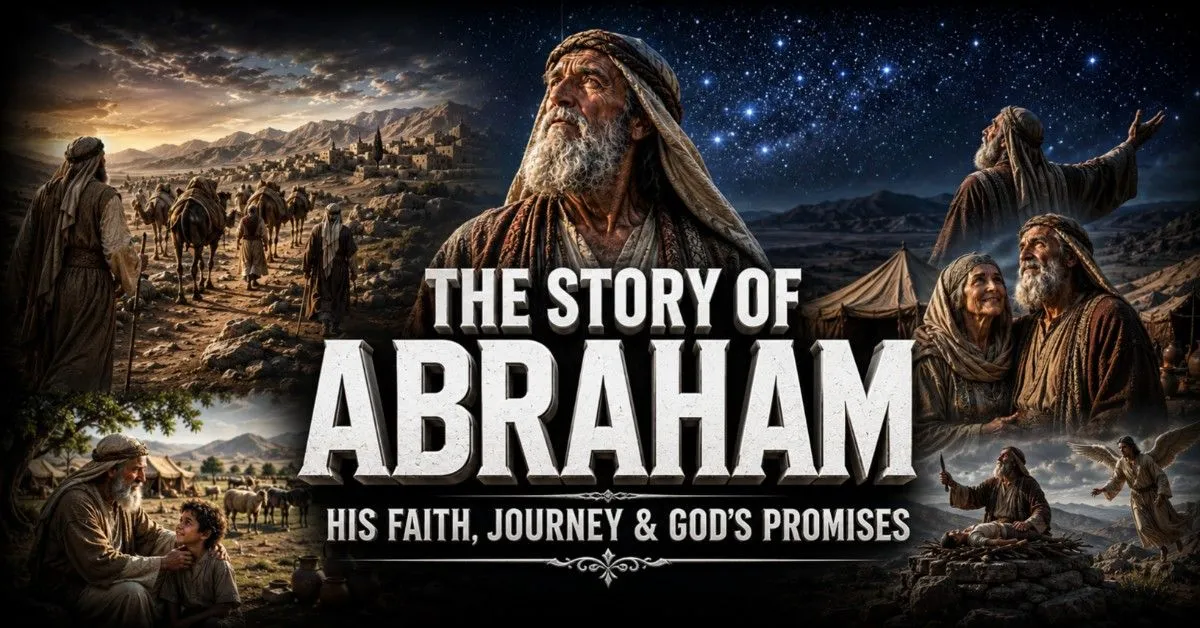
Where is the story of Abraham in the Bible? It runs from Genesis 11:26 to Genesis 25:11 fifteen chapters that follow one man from a family in ancient Mesopotamia to a burial cave in Canaan, and along the way reshape the entire biblical story.
Abraham (first named Abram) is the man God called to leave everything familiar and follow a promise he couldn’t yet see fulfilled. He became the father of Isaac and Ishmael, the recipient of God’s covenant, and centuries later the figure the New Testament points to again and again as the model of what it means to trust God. Abraham also holds an important place in Jewish, Christian, and Islamic tradition, but this account follows what Genesis itself actually records, chapter by chapter, distinguishing what the text says from what later tradition added to it.
This article covers the whole arc: Abraham’s early life in Ur, his covenant with God, his relationships with Sarah, Hagar, and Lot, the test of Genesis 22, and the closing chapters of his life that most summaries leave out.
The Story of Abraham in the Bible: A Brief Summary
Abraham’s family came from Ur of the Chaldeans and moved with his family to Haran. At 75, God called him to leave Haran for Canaan, promising to make him into a great nation. Abraham traveled through Canaan and Egypt, separated from his nephew Lot, and rescued Lot after a regional war. God made a covenant with Abraham twice – in Genesis 15 and Genesis 17 – promising land, descendants, and blessing, and giving circumcision as its sign.
Because Sarah remained childless, she gave her servant Hagar to Abraham, and Hagar bore Ishmael. Later, at 100 years old, Abraham had a son with Sarah named Isaac, exactly as God had promised. God then tested Abraham by commanding him to offer Isaac on Mount Moriah; Abraham obeyed, and God stopped him at the last moment, providing a ram instead. Sarah died at 127, Isaac married Rebekah, and Abraham died at 175, buried by both of his sons, Isaac and Ishmael, together.
Abraham’s Early Life – From Ur to God’s Call
Genesis introduces Abram’s family in chapter 11. His father, Terah, lived in Ur of the Chaldeans, and Abram was part of his household there, one of three sons alongside Nahor and Haran. Terah eventually took his household – Abram, his wife Sarai, and his grandson Lot – and set out toward Canaan, but they stopped and settled instead in a city called Haran (Genesis 11:26–32).
It’s in Haran that the story turns.
God spoke to Abram with a command and a promise: leave your country, your people, and your father’s household, and go to the land I will show you. Attached to that command was a promise almost too large to take in that God would make Abram into a great nation, bless him, make his name great, and that through him all the families of the earth would be blessed (Genesis 12:1–3).
Abram was 75 years old when he left Haran (Genesis 12:4). He took Sarai, Lot, and everything they had accumulated, and set out for a land he hadn’t yet seen.
That detail matters more than it might first appear the letter to the Hebrews later points to this exact moment as the clearest picture of faith in the Old Testament: Abraham “went out, not knowing where he was going” (Hebrews 11:8).
It’s worth being clear about what Genesis does and doesn’t say here. Later Jewish tradition tells vivid stories about Abraham’s early life that he smashed his father’s idols, or confronted a king named Nimrod over idolatry. Those stories don’t appear in Genesis at all. They come from much later Jewish writings and should be read as tradition, not as part of the biblical account.
Abraham’s Journey to Canaan and Egypt
Once in Canaan, Abram traveled through the land, building altars at Shechem and later near Bethel, marking each stop as a place where he worshiped God (Genesis 12:6–8). But almost immediately, a famine forced him south into Egypt.
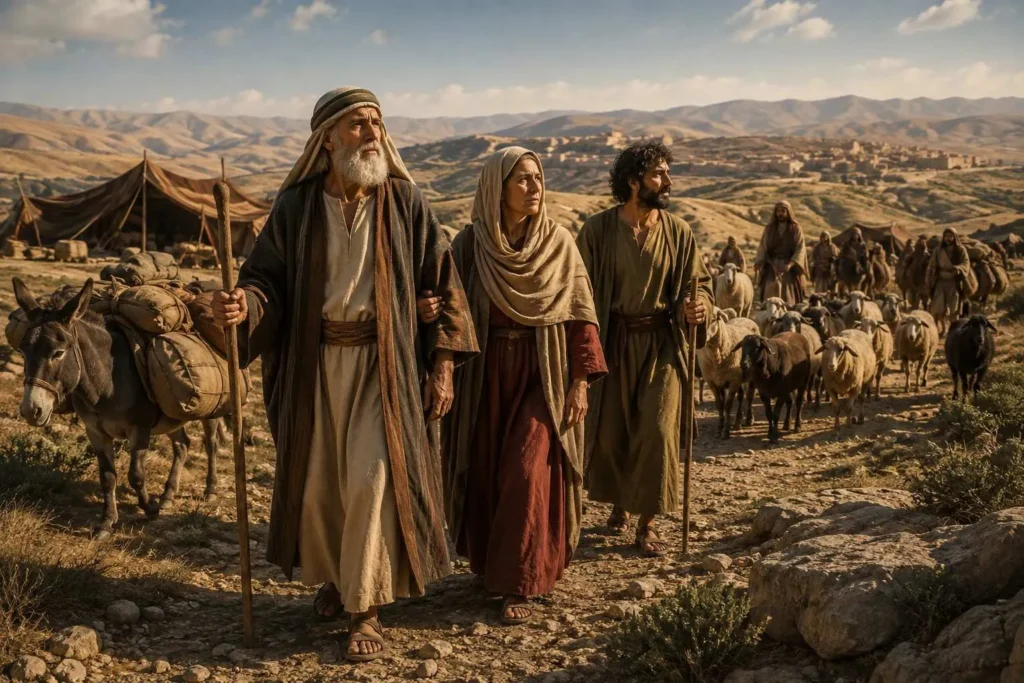
This is where Scripture shows a side of Abram that doesn’t fit a simplified hero narrative. Afraid that Sarai’s beauty would get him killed, Abram told her to say she was his sister rather than his wife. Pharaoh took Sarai into his household, and it took a plague from God – not Abram’s courage – to set things right and send them back out of Egypt (Genesis 12:10–20).
Genesis doesn’t soften this. Abram, the man who had just left everything on the strength of God’s word, responded to a real threat with fear and a half-truth. His faith in this story wasn’t a finished, flawless thing. It grew through failure as much as through obedience — and that’s part of why his story continues to resonate: it’s a story about a real person, not a stained-glass figure.
Abraham and Lot – Separation and Rescue
Back in Canaan, Abram’s household and Lot’s had both grown wealthy enough that the land couldn’t support their combined flocks. Their herdsmen began quarreling, and Abram – the elder – offered Lot the choice of land instead. Lot looked toward the Jordan Valley, saw how well-watered it was, and chose to settle near Sodom (Genesis 13:1–13).
After Lot moved on, God renewed his promise to Abram, telling him to look in every direction: all the land he could see would belong to his offspring, who would be as numerous as the dust of the earth (Genesis 13:14–17).
Not long after, a coalition of eastern kings invaded the region and took Lot captive along with the rest of Sodom’s people and possessions. When Abram heard, he armed 318 men from his own household, pursued the raiding kings, and rescued Lot (Genesis 14:1–16).
On his way back, Abram was met by Melchizedek, king of Salem, who brought out bread and wine. Genesis describes him plainly as “priest of God Most High” (Genesis 14:18). He blessed Abram, and Abram gave him a tenth of everything he had recovered. That’s the full extent of what Genesis records about Melchizedek’s role in this account.
Centuries later, the book of Hebrews draws a theological connection between Melchizedek’s priesthood and Christ’s (Hebrews 7). That’s a legitimate New Testament interpretation of the earlier text but it’s worth being precise: Genesis itself never identifies Melchizedek as Christ. That connection comes from Hebrews’ later theological interpretation of the passage, not from Genesis itself.
What Was God’s Covenant With Abraham?
Two separate scenes in Genesis record God formally establishing his covenant with Abraham, and they’re often blended together in retellings. They shouldn’t be each one adds something different.
Genesis 15 comes after the rescue of Lot, when Abram voices a real concern: he still has no heir. God responds by taking him outside to look at the stars, promising that his descendants would be just as uncountable. Genesis records Abram’s response in a single sentence that the New Testament will later quote four separate times: “And he believed the LORD, and he counted it to him as righteousness” (Genesis 15:6). God then confirms the promise through an ancient covenant ceremony, with the smoking fire pot and flaming torch passing between the divided animals a solemn sign of God’s commitment to the covenant promise.
Genesis 17 happens years later, when Abram is 99. Here God gives the covenant a permanent sign: circumcision, required of Abraham, Ishmael, and every male in the household (Genesis 17:9–14, 23–27). It’s also here that Abram’s name changes to Abraham – “father of a multitude” – and Sarai becomes Sarah. God tells Abraham plainly, for the first time, that the promised son will come through Sarah, not through any other arrangement (Genesis 17:15–19).
Taken together, the covenant God makes with Abraham has three consistent parts:
- Land – Canaan, promised to his descendants
- Descendants – a nation as numerous as the stars and the dust of the earth
- Blessing to the nations – that through Abraham’s offspring, all the families of the earth would be blessed
That third part is the one the New Testament leans on most heavily. Paul, writing to the Galatians, argues that the promise of blessing to “all nations” ultimately points to one specific offspring Christ and that everyone who has faith, not only Abraham’s physical descendants, shares in that blessing (Galatians 3:8, 16, 29). It’s the same covenant Genesis records, read forward into its fullest New Testament meaning.
Abraham, Sarah, and Hagar
Sarah’s inability to have children is mentioned as early as Genesis 11:30, and it shapes much of the story that follows. Roughly ten years after arriving in Canaan, with no child yet born, Sarah proposed a solution common in the ancient world: Abraham would have a child through her Egyptian servant, Hagar. Abraham agreed, and Hagar bore a son, Ishmael, when Abraham was 86 years old (Genesis 16:16).
It didn’t resolve the tension it was meant to solve. Hagar and Sarah’s relationship grew bitter, and Hagar fled into the wilderness where, notably, God met her directly, promised that her son would also become a great nation, and told her to return (Genesis 16:7–13). It’s an important detail: God’s care for Hagar and Ishmael is stated explicitly in the text, not implied or absent.
Thirteen years later, at the covenant renewal of Genesis 17, God confirmed that the promised son would come through Sarah after all and a year after that, at 100 years old, Abraham became a father again. Isaac was born, exactly as promised (Genesis 21:1–7).
Some time after Isaac was weaned, tension between the two households came to a head, and Sarah asked Abraham to send Hagar and Ishmael away. Abraham was genuinely distressed by this Genesis says the matter “was very displeasing to Abraham on account of his son” (Genesis 21:11) but God told him to listen to Sarah, reassuring him that Ishmael, too, would become a nation. Hagar and Ishmael were sent into the wilderness, and God provided for them there, opening Hagar’s eyes to a well of water and remaining with Ishmael as he grew (Genesis 21:14–21).
It’s worth stating the distinction clearly, because it’s easy to misread: Isaac is the son through whom God’s covenant promise continues. Ishmael is not abandoned or forgotten Genesis is explicit that God blessed him, was with him, and gave him descendants of his own. The two sons carry different roles in the story, not different levels of God’s care.
Abraham, the Three Visitors, and the Intercession for Sodom
Genesis 18 opens with three visitors arriving at Abraham’s tent near Mamre. Abraham welcomes them with real hospitality, and one of them – identified in the text as the LORD – repeats the promise that Sarah will have a son within the year. Sarah, listening from the tent, laughs quietly at the idea. The visitor’s response is one of the most quoted lines in the whole narrative: “Is anything too hard for the LORD?” (Genesis 18:14).
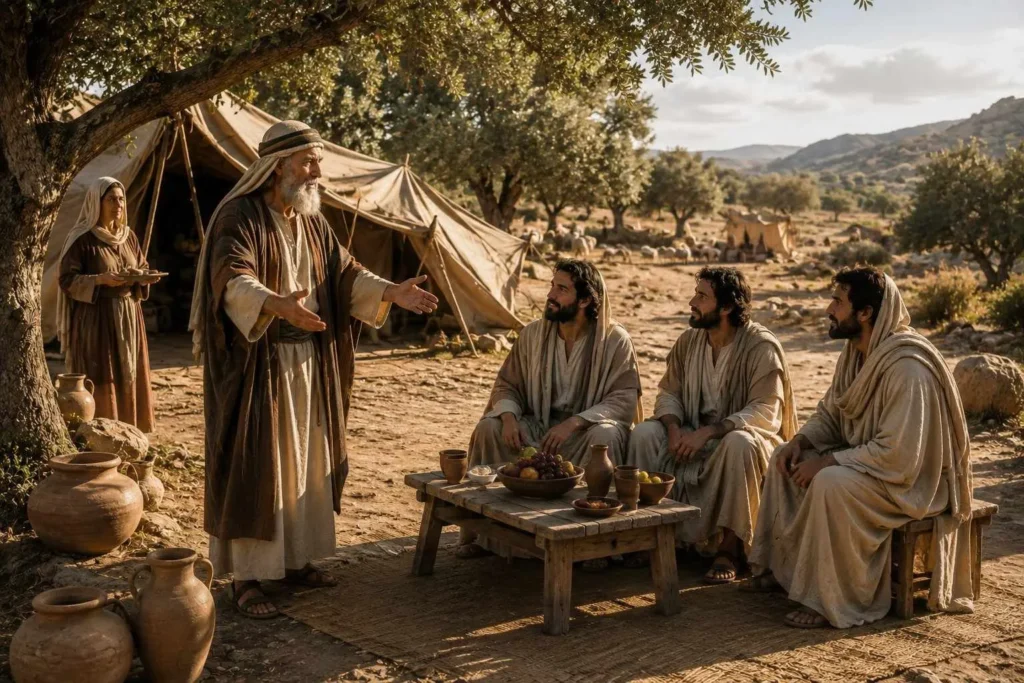
As the visitors prepare to leave, they reveal the coming judgment on Sodom and Gomorrah. What follows is one of the most striking scenes in Genesis: Abraham bargains with God, asking whether he would spare the city for fifty righteous people, then forty-five, then forty, thirty, twenty, and finally ten. Each time, God agrees (Genesis 18:22–33). It’s not full information about what happens next but it shows Abraham interceding on behalf of people who aren’t his own family, appealing directly to God’s justice and mercy.
Genesis 19 then narrates Sodom’s destruction. Lot and his family are rescued by two angels, though Lot’s wife, looking back as they fled, becomes a pillar of salt (Genesis 19:26). The text describes the destruction as coming from the LORD, “sulfur and fire… out of heaven” (Genesis 19:24) – it doesn’t give a location precise enough to map onto a modern archaeological site, and any claim to know Sodom’s exact geographic location today should be treated as debated among historians, not settled.
How Did Sarah Have a Baby at 90?
This is one of the most direct questions readers bring to Abraham’s story, and Genesis answers it without ambiguity: it presents her pregnancy as a miraculous fulfillment of God’s promise. Genesis frames Isaac’s birth as God’s deliberate, supernatural fulfillment of a promise made decades earlier.
Abraham was 100 and Sarah was 90 when Isaac was born (Genesis 17:17, 21:5). Genesis doesn’t try to explain this biologically – it simply states that “the LORD did to Sarah as he had promised” (Genesis 21:1). The name Isaac itself means “he laughs,” a quiet echo of both Sarah’s disbelieving laughter in Genesis 18 and, presumably, the joy that followed once the promise actually came true.
The Story of Abraham and Isaac – Genesis 22
This is the episode most people think of first when they hear “the story of Abraham,” and it deserves to be handled with care and precision.
Genesis 22 opens by telling the reader directly what’s happening: “God tested Abraham.” The command that follows is severe – take Isaac, “your only son, whom you love,” and offer him as a burnt offering on a mountain in the region of Moriah (Genesis 22:1–2).
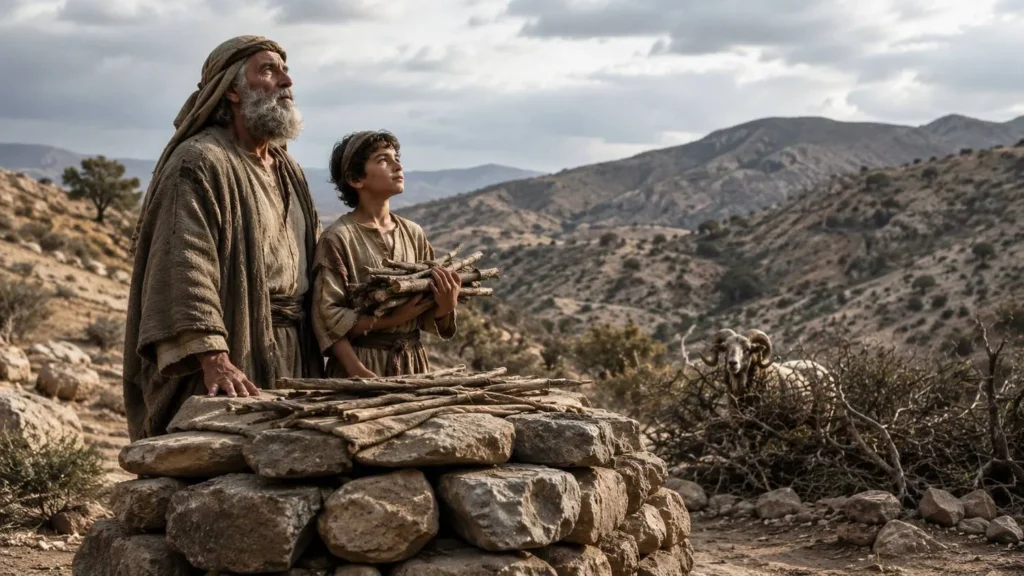
Abraham obeys without recorded hesitation. He rises early, and on the third day of travel, sees the place from a distance. Genesis includes a detail that carries real weight: Isaac is old enough to carry the wood for the offering himself (Genesis 22:6) – the text never states his exact age, and any specific number assigned to him is a guess, not a biblical fact.
As they climb, Isaac asks the obvious question: they have wood and fire, but where is the lamb for the offering? Abraham’s answer is one of the most quietly loaded lines in Genesis: “God will provide for himself the lamb” (Genesis 22:8).
At the altar, with Isaac bound and Abraham’s hand raised, an angel of the LORD stops him. Isaac was not sacrificed. God tested Abraham by commanding him to offer his son, but he intervened before the act was carried out, and Abraham found a ram caught by its horns in a nearby thicket, which he offered instead (Genesis 22:9–13). God then reaffirms the covenant promise in the strongest terms yet – blessing, descendants as numerous as the stars, and through Abraham’s offspring, blessing to all the nations of the earth (Genesis 22:15–18).
Genesis doesn’t spell out every reason behind the test. What it does show is a faith willing to trust God even when the command seemed to contradict everything God had already promised how could the covenant continue through Isaac if Isaac didn’t survive? Hebrews later reflects on exactly this tension, suggesting Abraham reasoned that God was able to raise Isaac even from death (Hebrews 11:19). James points to the same episode from a different angle, using it as proof that real faith shows itself in action (James 2:21–23). This connection between faith and obedience is also explored in our examples of obedience in the Bible.
Both are genuine theological reflections on the event worth including, but distinct from what Genesis 22 itself states outright.
Abraham’s Later Years – Sarah’s Death, Isaac’s Marriage, and Abraham’s Death
Most retellings of Abraham’s story end at Genesis 22. Genesis itself doesn’t – there are three more chapters, and they matter.
Sarah died at Kiriath-arba, at 127 years old (Genesis 23:1). Abraham, described in the text as mourning and weeping for her, negotiated with Ephron the Hittite to purchase the cave of Machpelah near Hebron as a permanent burial place the first piece of land in Canaan Abraham actually owned outright (Genesis 23). With Sarah gone, Abraham turned to securing Isaac’s future.
He sent his senior servant back to his own relatives to find a wife for Isaac rather than let him marry a Canaanite woman. That servant isn’t named in Genesis 24 tradition has long identified him with Eliezer of Damascus, mentioned earlier in Genesis 15:2, but that’s an identification made by later readers, not something Genesis 24 states directly. The servant’s prayer for guidance is answered when he meets Rebekah at a well, and she returns with him to marry Isaac (Genesis 24).
Genesis 25 closes out Abraham’s life.
He took another wife, Keturah, who bore him several more sons (Genesis 25:1–4). Abraham died at 175 years old, and Genesis records a detail that’s frequently left out of shorter summaries but is genuinely moving: “Isaac and Ishmael his sons buried him” – together – in the cave of Machpelah, beside Sarah (Genesis 25:7–10). The two brothers, separated for most of the narrative, stand side by side at their father’s grave.
Abraham’s Story: A Timeline at a Glance
| Event | Genesis | Abraham’s Age | Why It Matters |
|---|---|---|---|
| Terah’s family leaves Ur, settles in Haran | 11:26–32 | Not stated | Sets the stage for God’s call |
| God calls Abram; departs Haran for Canaan | 12:1–4 | 75 | Beginning of the covenant story |
| Famine; journey to Egypt; Sarai and Pharaoh | 12:10–20 | Not stated | Shows Abram’s fear alongside his faith |
| Separation from Lot | 13:1–18 | Not stated | Abram’s generosity; land promise renewed |
| Rescue of Lot; meeting with Melchizedek | 14:1–24 | Not stated | Abram’s courage; tithe to God’s priest |
| Covenant ceremony; faith credited as righteousness | 15:1–21 | Not stated | Foundational faith text, quoted in the New Testament |
| Ishmael is born to Hagar | 16:1–16 | 86 | Human attempt to fulfill God’s promise |
| Covenant of circumcision; name changed to Abraham | 17:1–27 | 99 | Sign of the covenant; Isaac’s birth promised |
| Three visitors; intercession for Sodom | 18:1–33 | Not stated | Abraham’s role as intercessor |
| Sodom and Gomorrah destroyed | 19:1–29 | Not stated | Judgment; Lot spared |
| Isaac is born | 21:1–7 | 100 | The promise fulfilled |
| Hagar and Ishmael sent away | 21:8–21 | Not stated | God’s continued care for Ishmael |
| The test – Genesis 22 | 22:1–19 | Not stated | Abraham’s faith tested; God provides a substitute |
| Sarah dies; Machpelah purchased | 23:1–20 | Not stated (Sarah was 127) | First land Abraham owned in Canaan |
| Isaac marries Rebekah | 24:1–67 | Not stated | Covenant line secured |
| Abraham dies; buried by Isaac and Ishmael | 25:7–11 | 175 | Both sons reunited at their father’s grave |
Why Is Abraham Important in the New Testament?
The New Testament returns to Abraham constantly, and for a reason that’s easy to miss if you only read Genesis on its own: writers across the New Testament treat Abraham’s story as the clearest early picture of what faith actually looks like.
Matthew opens his entire Gospel by tracing Jesus’s genealogy back to Abraham (Matthew 1:1–2), placing him at the very root of the story that leads to Christ. John records Jesus making a striking claim about his own relationship to Abraham – “before Abraham was, I am” (John 8:56–58) – asserting something far beyond ordinary human history.
Paul builds an entire argument in Romans 4 around Genesis 15:6 – that Abraham was counted righteous through faith, before he was circumcised and before the law existed. For Paul, that timing matters: it means Abraham’s righteousness came by trusting God, not by any prior religious performance. Galatians extends the same point, arguing that the promise of blessing to “all nations” is ultimately fulfilled in Christ, and that anyone who has faith not only Abraham’s physical descendants is counted among his spiritual offspring (Galatians 3, 4).
James 2 looks at the same man from a different direction, using the Genesis 22 episode specifically to argue that real faith always shows itself through action faith and obedience aren’t presented as competing ideas, but as two sides of the same reality. Hebrews 11 gathers both threads together, calling Abraham’s willingness to leave Haran and his willingness to offer Isaac two expressions of the same trust in God’s character.
This is why Abraham is often described as a model of faith not a claim that his faith was flawless (Genesis itself records his failures honestly), but a recognition that his life became the pattern the rest of Scripture points back to whenever it wants to describe what trusting God actually looks like.
What We Can Learn From Abraham’s Story
- Faith often means obeying before the outcome is visible. Abraham left Haran without knowing where he was going (Hebrews 11:8). The step came before the certainty, not after it.
- Abraham’s story includes real failure, not just faith. The deception in Egypt, and a nearly identical episode later with a king named Abimelech (Genesis 20), show a man whose trust in God grew unevenly, under pressure, over time – not a man who had it all figured out from the start.
- God’s promises aren’t fulfilled through human shortcuts. The plan to have a child through Hagar came from understandable impatience, not from God’s instruction and it created lasting family pain. God’s promise to Sarah and Abraham was fulfilled on God’s timing, not theirs.
- Faith that doesn’t act isn’t the kind of faith Scripture is describing. James points to Genesis 22 specifically because Abraham’s trust in God wasn’t just a private belief it moved him to obey, even when obedience was costly.
- God remained faithful to Abraham even in his weakest moments. The Egypt episode didn’t disqualify Abraham from the covenant. God’s commitment to the promise didn’t depend on Abraham’s performance being perfect.
- The covenant was never only about one man. From the beginning, the promise pointed outward to a nation, and ultimately, in the New Testament’s reading, to “all the families of the earth” (Genesis 12:3; Galatians 3:8). Abraham’s story was always bigger than Abraham.
Common Questions and Misconceptions About Abraham
Abraham did not actually sacrifice Isaac. God tested him by commanding it, but stopped him before the act, and provided a ram instead (Genesis 22:12–13).
Ishmael wasn’t cast out immediately after he was born. He lived in Abraham’s household for roughly fourteen years before being sent away with Hagar, sometime after Isaac was weaned (Genesis 16:16, 21:5, 21:8).
Isaac’s exact age at Moriah isn’t given. Genesis only indicates he was old enough to carry wood for the offering (Genesis 22:6) – no specific number is stated.
Genesis 15 and Genesis 17 are two distinct covenant scenes, separated by years, each adding something different the covenant ceremony and the promise of descendants in chapter 15; the sign of circumcision and the name changes in chapter 17.
Abraham’s faith wasn’t flawless. The Egypt deception, repeated later with Abimelech, is recorded honestly, without being softened.
Melchizedek shouldn’t automatically be identified as Christ within Genesis itself. Genesis calls him king of Salem and priest of God Most High (Genesis 14:18); the connection to Christ’s priesthood comes from Hebrews 7, a later theological reading of the passage.
The story of Abraham smashing his father’s idols isn’t in Genesis. It comes from later Jewish tradition, not from the biblical text.
FAQ
Where is the story of Abraham in the Bible?
Genesis 11:26–25:11. That’s the full narrative from his family’s origins in Ur through his death and burial in Canaan.
How long did Abraham live?
175 years (Genesis 25:7).
Who were Abraham’s sons?
Ishmael, through Hagar; Isaac, through Sarah; and several more sons through Keturah, whom Abraham married after Sarah’s death (Genesis 16, 21, 25:1–4).
What are some important facts about Abraham?
He was born in Ur, called by God at 75, made a covenant with God confirmed by circumcision, became father to Isaac at 100, was tested regarding Isaac in Genesis 22, and was buried by both Isaac and Ishmael together at 175.

Hi, I’m Prashanta Kumbhar, a Christian blogger, faith writer, and the founder of Light and Gospel (LightandGospel.com), based in Odisha, India.
I regularly write Bible devotionals, prayers, Scripture reflections, and faith-based messages to encourage people in their daily walk with Jesus Christ and help them grow in hope, faith, and spiritual strength.
Along with blogging, I also create Christian content on my YouTube channel “The God Helps” and share faith, prayer, Bible study, and motivational messages across social media platforms like Facebook & Instagram. My mission is to make God’s Word simple, practical, & meaningful for everyday life.