

If someone asked what is the story of Joseph in the Bible, you could answer in one sentence a favored son becomes a slave, a slave becomes a prisoner, a prisoner becomes a prince. But that sentence won’t tell you what it felt like to live it.
This is the full story of Joseph in the Bible, found in Genesis 37 through 50, told the way it unfolded slowly, painfully, and then, finally, beautifully.
The Story of Joseph in the Bible
Canaan smelled like woodsmoke and warm earth. Sheep bleated beyond the tents, and the sun sat heavy over hills where Jacob’s family had lived for two generations, never quite settling, always a little like guests in someone else’s land.
Jacob had twelve sons. He loved one of them differently.
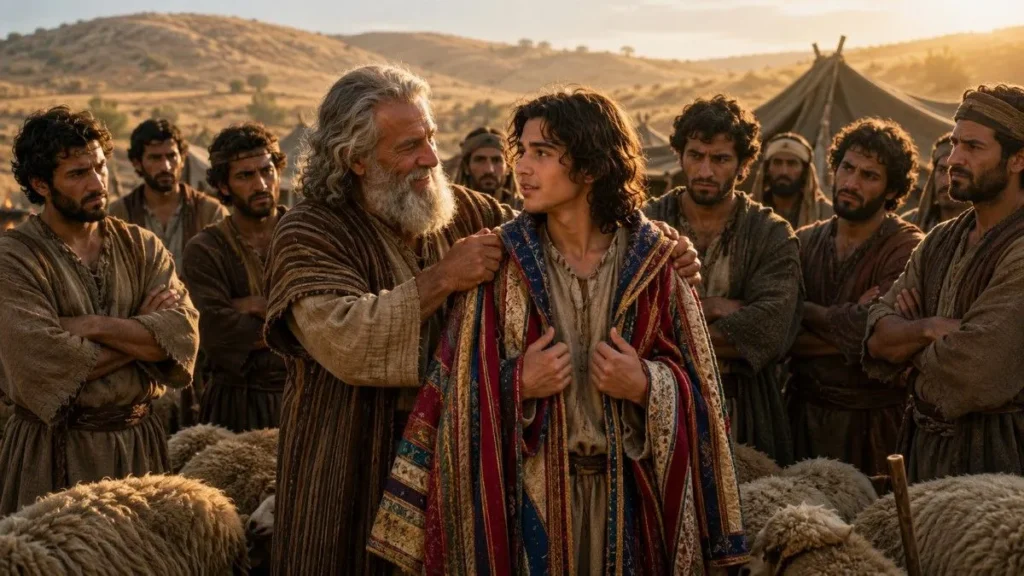
Joseph was Rachel’s firstborn, the son Jacob wanted most, and everyone in camp knew it. So when Jacob draped a rich, colorful robe over Joseph’s shoulders not plain wool like his brothers wore, but something fine enough to turn heads nobody had to explain what it meant (Genesis 37:3). Ten grown men watched their father dress their youngest brother like royalty, and something in them went cold.
Genesis doesn’t soften what came next. His brothers could not speak a kind word to him (Genesis 37:4). Sitting at the same fire every night, never once hearing warmth in your own family’s voice.
One night, Joseph had a dream. His brothers’ bundles of wheat bowed low to his own, standing tall in the field. He told them maybe with excitement, maybe without thinking it through the way a seventeen-year-old rarely does and it only made things worse. A second dream followed, the sun and moon and eleven stars bowing to him, and even Jacob pulled back at hearing it. Shall your mother and I and your brothers really come and bow down before you? he asked (Genesis 37:10). Yet Jacob kept turning it over in his mind (Genesis 37:11). His sons kept something too not the dream, but the resentment underneath it, sharpening by the day.
Jacob sent Joseph to check on his brothers, away with the flocks. Joseph walked for miles under a hard sun, dust rising with every step, taking directions from a stranger when he couldn’t find them where expected with no idea the road was carrying him toward danger (Genesis 37:15–17).
They saw him coming from a distance, that same robe catching the light. Here comes that dreamer, someone muttered. Let’s kill him and throw him in a pit. We’ll say a wild animal got him. Then we’ll see what becomes of his dreams (Genesis 37:19–20). Reuben talked them back from murder, but only partly he suggested a pit instead, quietly planning to return later and pull Joseph out himself (Genesis 37:21–22).
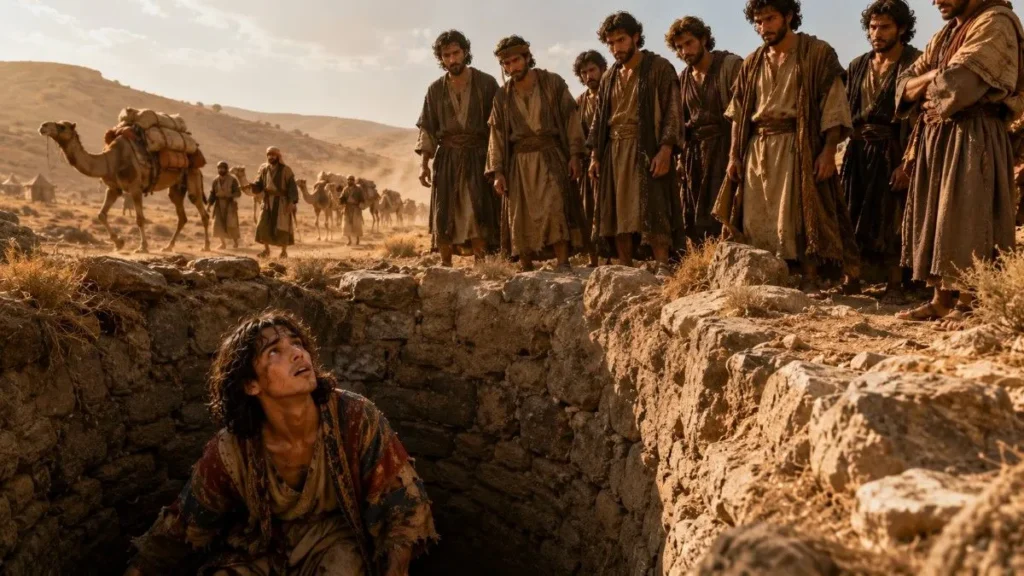
What happened next must have hit Joseph before he understood it. He was walking toward brothers he hoped to see when rough hands tore that beloved robe from his shoulders and the ground disappeared beneath him a dry cistern, cut deep into rock, walls close enough to touch, a strip of sky shrinking above him. He would have known those hands. That was what cut deepest. Not strangers. Brothers.
His brothers sat down and ate a meal while he sat alone in that hole, the silence broken only by his own breathing against stone (Genesis 37:25). Years later, not yet recognizing the powerful Egyptian official in front of them, those same brothers would admit to each other in words they thought Joseph couldn’t understand that they had seen his anguish and heard him beg for his life, and ignored him anyway (Genesis 42:21).
A caravan happened by while they ate, headed for Egypt. Judah looked at it and suggested something that sounded, to him, almost like mercy: sell Joseph instead of killing him (Genesis 37:26–27). Hands pulled him up into daylight he thought he’d never see again only to hand him straight to strangers. Twenty pieces of silver changed hands, and the road he was walking now belonged to someone else. Behind him, his brothers dipped his robe in goat’s blood and carried it home, letting the evidence tell a lie none of them had the nerve to speak.
Jacob didn’t need convincing. One look at that robe and grief swallowed him whole. A ferocious animal has devoured him, he said, tearing his clothes, refusing every comfort his children offered (Genesis 37:33–35). Rachel had died giving him this son, on the road to Bethlehem, and Joseph had carried her face ever since the last living piece of her Jacob had left. He mourned long after everyone expected him to stop twenty-two years of it, with no one brave enough to tell him why his grief never had to last that long.
The caravan carried Joseph into Egypt rivers, monuments, gods he’d never known and sold him to a palace official named Potiphar. No family. No language of his own. No robe to mark him as anyone’s favorite. Yet Scripture drops a quiet line that changes everything about what follows: the Lord was with Joseph (Genesis 39:2). His circumstances hadn’t changed. Something underneath them had. Whatever he touched seemed to flourish, and Potiphar noticed, eventually placing his whole household in the hands of a foreign slave who had every reason by now to give up on trustworthiness.
He hadn’t given up. But trouble found him anyway. Potiphar’s wife pursued him day after day, and day after day he refused her: How then could I do such a wicked thing and sin against God? (Genesis 39:9). One day, with the house empty, she grabbed his cloak. He ran, leaving it in her hand and turned that cloak into a weapon, accusing him falsely. Potiphar believed his wife over his most faithful servant. Joseph, guilty of nothing but doing right, was thrown into prison (Genesis 39:13–20). Integrity hadn’t protected him. It had nearly ended him.
Prison in ancient Egypt wasn’t clean walls and set release dates. It was stone, shadow, and silence, broken only by other men’s despair. Yet that same quiet sentence returns even here the Lord was with him too (Genesis 39:21–23). Two of Pharaoh’s officials, a cupbearer and a baker, landed in that same darkness, both troubled by dreams on the same night. Joseph, noticing their downcast faces, offered to interpret, crediting God rather than himself: Do not interpretations belong to God? Tell me your dreams (Genesis 40:8). Everything he told them came true. Before the cupbearer walked free, Joseph asked one small thing remember me, and mention me to Pharaoh (Genesis 40:14).
He didn’t. Genesis says plainly the cupbearer walked out of that prison and never thought of Joseph again (Genesis 40:23). So Joseph waited. A week. A month. Long enough to stop counting the days, maybe, just to survive them. Two more full years passed like that waking each morning to the same darkness, doing the same faithful work no one applauded, listening for footsteps that weren’t coming. Faithfulness rarely gets applause while it’s happening.
Without warning, everything shifted. Pharaoh had two disturbing dreams in a single night starving cows devouring healthy ones, withered grain swallowing full grain and no wise man in Egypt could explain them. Genesis says his spirit was troubled (Genesis 41:8), which is a quiet way of saying the most powerful man alive couldn’t sleep. It was the cupbearer, of all people, who finally remembered the Hebrew prisoner who had once read his dream perfectly. Pharaoh’s concern turned to curiosity fast enough to send men running Joseph was pulled from his cell, shaved, dressed, and standing in a palace corridor before he’d had time to catch his breath.
He didn’t reach for credit. It is not I, he told Pharaoh. God will give Pharaoh the answer he desires (Genesis 41:16). As Joseph explained the dreams seven years of plenty, then seven of famine and laid out a plan to prepare, you can watch curiosity turn into something steadier. Respect first, for a slave who spoke with more clarity than every magician in the court.
Then trust, complete and immediate. Can we find anyone like this man, one in whom is the spirit of God? Pharaoh asked his officials (Genesis 41:38), answering his own question before anyone could. That same day, he placed his own ring on Joseph’s hand, dressed him in fine linen, and set him over all of Egypt. Joseph was thirty thirteen years after a pit in Canaan. Like Moses, Joseph’s life shows how God can prepare a person through years of hardship before giving them greater responsibility. Read the Story of Moses in the Bible to see another biblical example of how God prepares His servants through difficult seasons.
The famine came exactly as he’d said, reaching all the way to his father’s tents. Jacob sent his sons to Egypt for grain, and there they stood, bowing before the official in charge fulfilling, without knowing it, the very dream that had made them hate him decades earlier (Genesis 42:6). Joseph knew them instantly. They had no idea who stood in front of them.
He tested them, holding one brother back, demanding they return with Benjamin. When they finally brought him, something in Joseph nearly broke. Twenty-two years since he’d last seen his mother’s only other son the same mother, maybe the same eyes, the same way of standing. Rachel had died bringing this boy into the world, and here he was now, grown, alive, close enough to touch. Joseph left the room and wept alone before he could face them again (Genesis 43:29–31). Still, the test wasn’t finished. He hid his silver cup in Benjamin’s sack and accused them all of theft, watching for one thing only would they abandon this brother, the way they’d once abandoned him?
Judah stepped forward. The same man who once said let’s sell him now offered himself as a slave in Benjamin’s place, so his father wouldn’t lose another son (Genesis 44:33–34). Whatever Joseph had been holding back through every test and every private moment of weeping alone gave way all at once.
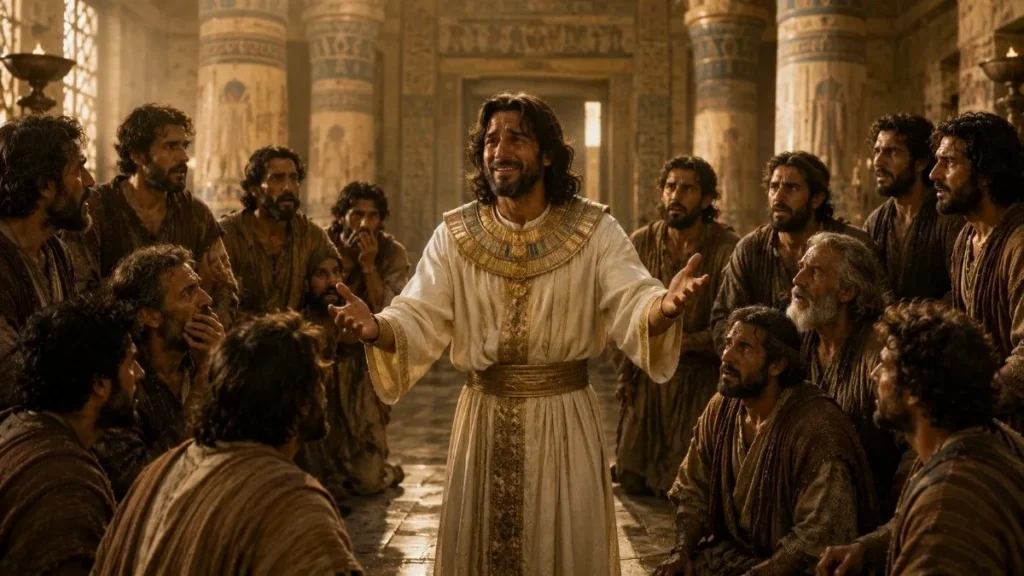
Have everyone leave my presence, he cried out, and the room emptied until it was just brothers, facing each other for the first time in over two decades. He wept so loudly the Egyptians outside heard him through the walls. Finally, the words he’d carried since he was seventeen:
I am Joseph! Is my father still alive? (Genesis 45:3).
Nobody answered. His brothers stood frozen the boy they’d thrown into a pit was standing before them wearing a crown, and none of them could tell if they were about to be forgiven or destroyed.
Joseph reached for them, not for revenge. Come near to me, he said, gently now. I am Joseph your brother, whom you sold into Egypt. And now do not be distressed or angry with yourselves, for God sent me before you to preserve life (Genesis 45:4–5).
Word reached Jacob that his son was alive, and at first the old man’s heart went numb too much to take in after twenty-two years of believing otherwise. Then he saw the wagons Joseph had sent, and something in him woke back up (Genesis 45:26–28). When father and son finally stood face to face, Joseph fell on his neck and wept there a long while not the sharp tears of the pit this time, but the slower kind, the kind that comes with relief (Genesis 46:29).
Joseph spent his remaining years caring for the family who had once tried to erase him. When Jacob died, his brothers feared his kindness had only been for their father’s sake that the reckoning would finally come. Joseph wept at their fear and told them plainly: Am I in the place of God? You meant evil against me, but God meant it for good, to save many lives (Genesis 50:19–20). He said it again, years later, with no one left to make sure he kept his word.
He lived to be a hundred and ten. His last request wasn’t for himself he asked his family to carry his bones out of Egypt one day, back to the land God had promised, a promise he’d never live to see fulfilled but trusted anyway (Genesis 50:24–25). Centuries later, it was.
Story of Joseph in the Bible Summary
Joseph was Jacob’s favored son, given a colorful robe and two prophetic dreams that stirred jealousy in his brothers. That jealousy led to betrayal a pit, slavery, a father deceived into believing his son was dead. In Egypt, Joseph rose in Potiphar’s household, then was falsely accused and imprisoned. Years passed before his gift for interpreting dreams reached Pharaoh, who raised him to rule Egypt. When famine struck, his brothers came seeking grain, unaware of who stood before them. After testing their hearts, Joseph revealed himself, forgave them completely, and brought his whole family including Jacob to live safely in Egypt for the rest of his life.
Key Story of Joseph in the Bible Verses
A few verses carry the weight of the whole story of Joseph and his brothers in the Bible. The Lord was with Joseph, and he was a prosperous man (Genesis 39:2, KJV) marks him even in slavery. How then can I do this great wickedness, and sin against God? (Genesis 39:9, KJV) shows the integrity that cost him his freedom. And the words he finally speaks to his brothers ye thought evil against me; but God meant it unto good (Genesis 50:20, KJV) carry the meaning of all that came before.
What Can We Learn from Joseph’s Story?
There’s no single lesson tidy enough to sum up fourteen chapters of a life. But something emerges the longer you sit with it. Joseph never controlled what happened to him not the pit, the false accusation, or the years he spent forgotten. All of it was done to him. None of it got the final word. He worked with integrity in a house that wasn’t his. He trusted God through years of silence no one else could hear. Elijah also experienced seasons of fear, waiting, and dependence on God, as seen in the Story of Elijah in the Bible.
And when he finally held all the power over the people who wronged him, he chose to forgive rather than punish naming the harm honestly, then letting it go. If you’re in a season that feels like a pit right now, this old story is still quietly true: the darkness has an end, even if you can’t see it from here.
FAQ
What is the story of Joseph in the Bible?
Jacob’s favored son, betrayed by his brothers and sold into slavery, rises through suffering to rule Egypt and forgives the family who wronged him.
Where is the story of Joseph in the Bible?
In the Book of Genesis, chapters 37 through 50 the longest continuous narrative about one person in the book.
Why did God favor Joseph?
Not because he was flawless, but because he stayed faithful in a stranger’s house, a prison cell, and before a king when nothing suggested it would matter.
What are the five qualities of Joseph?
Integrity, wisdom, faith, humility, and forgiveness visible in what he did when no one was watching, and later, when everyone was.
What was Joseph’s dream in the Bible?
Joseph had two dreams from God. In one dream, his brothers’ bundles of grain bowed down to his bundle. In the other, the sun, moon, and eleven stars bowed before him. Years later, these dreams came true when his family came to Egypt and honored him.
What is the main lesson from Joseph’s story?
Joseph’s story teaches us to trust God even during difficult seasons. Though he faced betrayal, slavery, and prison, he remained faithful. In the end, God used every hardship for a greater purpose and blessing.

Hi, I’m Prashanta Kumbhar, a Christian blogger, faith writer, and the founder of Light and Gospel (LightandGospel.com), based in Odisha, India.
I regularly write Bible devotionals, prayers, Scripture reflections, and faith-based messages to encourage people in their daily walk with Jesus Christ and help them grow in hope, faith, and spiritual strength.
Along with blogging, I also create Christian content on my YouTube channel “The God Helps” and share faith, prayer, Bible study, and motivational messages across social media platforms like Facebook & Instagram. My mission is to make God’s Word simple, practical, & meaningful for everyday life.