
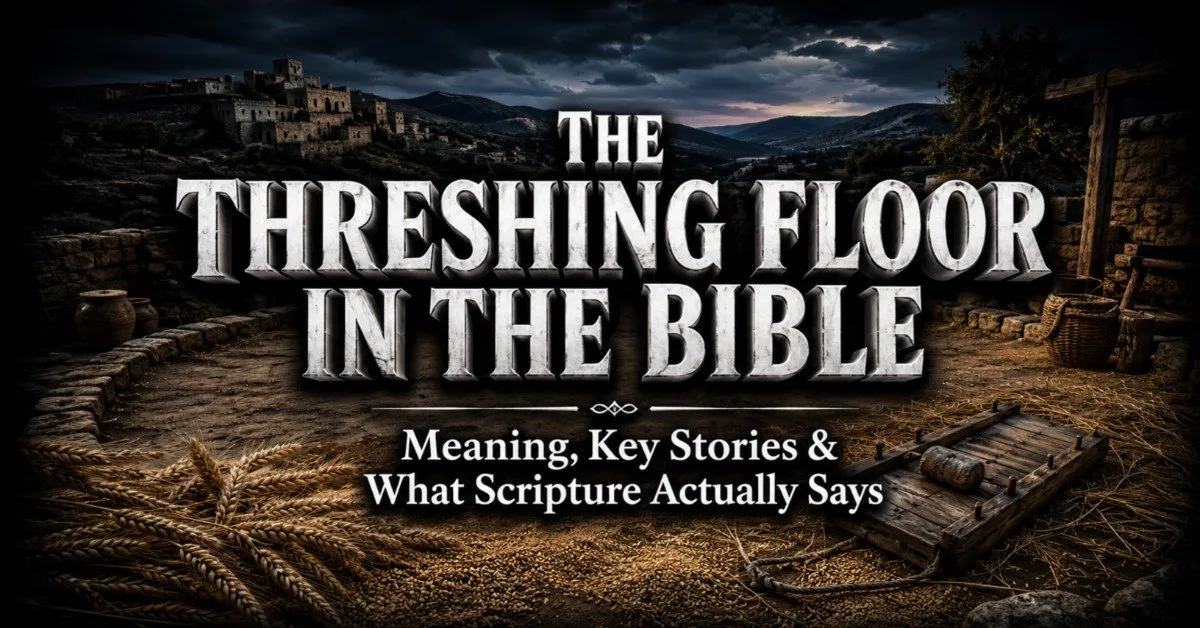
A threshing floor was an open area where Israelite farmers processed harvested grain, loosening the kernels from the stalks and chaff before winnowing them. It was not inherently a religious site. It was simply a place where an important part of the harvest took place. But in Scripture, this ordinary place keeps turning up at extraordinary moments. Ruth came to Boaz there, at a turning point in her life.
David built an altar there, and the plague was stopped. Later, the site became associated with the place where Solomon’s Temple was built. John the Baptist used the imagery of a threshing floor to describe the Messiah’s work of judgment and separation. This article explains what a threshing floor was and what it means in the Bible.
What Is a Threshing Floor?
Picture a wide, flat patch of hard-packed ground, open to the wind. After harvest, farmers used the floor to loosen the grain from the stalks, then winnowed it to separate the grain from the chaff before storing it.
It was simple generally an open, cleared area rather than an enclosed building. The surface needed to be firm enough for threshing, while the open setting allowed the wind to help with winnowing.
What Does Threshing Mean?
Threshing and winnowing get lumped together, but they’re two different jobs.
Threshing comes first. It is the process of loosening grain from the stalks, using methods such as trampling by oxen, a threshing sledge, or a hand-held flail. The goal was to loosen the grain from the stalks and other plant material.
Winnowing comes second. Once the grain was loosened, workers tossed the mixture into the air using a winnowing fork or another suitable tool. The wind carried away the lighter chaff and straw, while the heavier grain fell back to the threshing floor. After repeated winnowing, the grain could be separated from the lighter material.
That is why an open setting was important: the wind helped with winnowing, and some threshing floors were placed on slightly raised ground.
What Was a Threshing Floor Like in Bible Times?
Because threshing floors appear in several important passages of Scripture, it helps to have a clear picture of what they were like.
Threshing floors were open-air workspaces, usually chosen for a firm surface and exposure to the wind. Farmers spread harvested grain across the floor and used methods such as trampling by oxen or a threshing sledge to loosen the kernels. The grain was then winnowed to separate it from the lighter chaff.
Ruth 3 shows that Boaz stayed overnight at the threshing floor, apparently keeping watch over the grain. It was physical work, done outdoors and shaped by the weather.
Threshing Floors in the Bible
The threshing floor appears in several important Old Testament passages the threshing floor of Atad in Genesis 50, Gideon’s fleece in Judges 6, the royal gathering described in 1 Kings 22, and the place where Uzzah reached out to the Ark when the oxen stumbled in 2 Samuel 6. Grain from the threshing floor also appears in Israel’s laws concerning offerings and tithes.
Two accounts are especially important for understanding the biblical significance of the threshing floor: Ruth and David. One belongs to Ruth. The other belongs to David. Both are worth slowing down for.
Ruth and Boaz at the Threshing Floor
Ruth is a Moabite widow who has come to Bethlehem with her mother-in-law, Naomi. She has been gleaning in the fields of Boaz, a relative of Naomi’s late husband, who has treated her with kindness. By Ruth 3, Naomi sees a way to seek security for Ruth.
She tells Ruth to wash, put on her best clothes, and go down to the threshing floor that night, where Boaz will be winnowing barley. Afterward, Boaz lies down at the end of the grain pile. Naomi’s instructions are specific: wait until Boaz has eaten and lain down, then uncover his feet and lie down there. Ruth does exactly that.
When Boaz wakes startled in the middle of the night, Ruth identifies herself and asks him to spread the corner of his garment over her, appealing to his role as a family redeemer. Her request is about protection, family responsibility, and the possibility of marriage. Boaz is not the closest relative, but he is willing to act if the nearer redeemer declines.
His response is worth noticing. He responds with restraint and integrity. He commends Ruth for her kindness, tells her that the people of the town know her as a woman of noble character, and explains that a closer relative must be given the first opportunity to act. He sends her away before daylight, concerned that people might know a woman had been at the threshing floor. By the next chapter, he takes the matter to the city gate and settles it publicly with the nearer relative.
The scene has also led to discussion among interpreters because of the wording about uncovering Boaz’s feet and lying down beside him. But the text itself does not describe sexual wrongdoing, and both Ruth and Boaz are portrayed as acting honorably. At its heart, the story is about redemption: Ruth’s future is secured, Boaz acts as a redeemer, and their marriage becomes part of the family line that leads to King David.
You can also read Ruth and Naomi’s story of faith, loyalty, and redemption
David and Araunah’s Threshing Floor
David’s story is very different. In 2 Samuel 24, he orders a census of Israel’s fighting men. Scripture presents the act as sinful, although the passage does not fully explain David’s motive. Through the prophet Gad, David is told that judgment is coming and is given a choice of three consequences: famine, fleeing before enemies, or plague. He chooses to fall into God’s hands rather than an enemy’s, and a plague spreads across Israel.
As the plague reaches Jerusalem, the Lord commands the angel to stop. David sees the angel of the Lord standing at the threshing floor of Araunah. Gad tells David to build an altar there, so David goes to Araunah to acquire the threshing floor. Araunah offers to give David the threshing floor, the oxen, and the wood for the sacrifice. David refuses. “I will not sacrifice to the LORD my God burnt offerings that cost me nothing,” he says, and pays for the threshing floor and the oxen. He builds the altar, offers the sacrifice, and the plague ends.
First Chronicles 21 retells the story with several differences worth noting. It says that Satan incited David to take the census, while 2 Samuel describes the Lord’s anger as the cause, and some of the numbers differ between the accounts. These differences have been discussed by readers and scholars for a long time, while the central events of the story remain the same.
The central lesson is sobering: David’s sin brought real judgment, but he responded with repentance and costly obedience, and God showed mercy. Chronicles later connects this site with Mount Moriah, where Solomon would build the Temple the place where Israel’s sacrificial worship would be centered for generations. The significance of the location comes from what God did there, not from anything special about the dirt itself.
The Threshing Floor, Wheat, and Chaff
When John the Baptist begins preaching, he uses the familiar work of a threshing floor to describe the Messiah’s coming judgment. He tells the crowd that the one coming after him will use a winnowing tool to clear his threshing floor, gathering the wheat into the barn and burning the chaff “with unquenchable fire” (Matthew 3:12; Luke 3:17).
It is a vivid image drawn from an everyday part of the harvest. Chaff is the light material separated from the grain, easily carried away by the wind and commonly discarded or burned. The grain, by contrast, was the valuable part of the harvest. John uses that contrast to picture the Messiah’s coming judgment and the separation it will bring.
It’s worth being clear about one thing here: this isn’t the same image as Jesus’ parable of the wheat and the weeds in Matthew 13. That parable takes place in a field, where weeds and wheat are allowed to grow together until harvest; it is not a picture of threshing and winnowing. Both passages deal with judgment and separation, but they use two different pictures.
What Is the Spiritual Meaning of the Threshing Floor?
This is often the question people are really asking, and it deserves an honest answer rather than a tidy one.
Scripture uses the threshing floor as an image of separation, judgment, provision, and redemption. John’s image makes the judgment side especially clear: the Messiah separates the wheat from the chaff. Joel 3:13, in a passage about God’s judgment and restoration, uses full threshing floors as an image of abundant harvest. And Ruth’s story brings her to the threshing floor at a decisive moment, where she asks Boaz to act as her family redeemer.
Many Christians through history have also seen Boaz’s willingness to redeem Ruth as a picture of Christ’s willingness to redeem his people. That is a longstanding Christian interpretation of the story, but the book of Ruth does not explicitly say that Boaz represents Christ.
You’ll also come across books and sermons built around phrases like “the power of the threshing floor” or “the secrets of the threshing floor,” usually describing a season of personal testing or an intense time of prayer. Christians may use the image devotionally, but it is worth saying plainly: nothing in Scripture suggests that a physical threshing floor carries spiritual power, or that visiting one, literally or as a metaphor, guarantees some kind of breakthrough.
Whatever weight the image carries comes from what God did in these stories, not from the ground itself.
What Can Christians Learn From the Biblical Threshing Floor?
Pull these stories together, and a few honest, grounded lessons emerge.
God brings separation and judgment. John’s threshing-floor image shows the Messiah separating wheat from chaff, reminding us that God’s judgment is not something Scripture treats lightly. The image points to a real distinction between what is gathered and what is discarded.
Repentance and mercy belong together. David’s story shows the seriousness of sin, the importance of taking responsibility, and God’s mercy. David confesses his sin, builds an altar, and offers sacrifices and the plague comes to an end.
Obedience may require sacrifice. David refuses to offer God something that costs him nothing. His response shows that he was not looking for the cheapest way to fulfill his obligation, but was willing to give something of real value. (examples of obedience in the Bible)
God can bring redemption out of hard circumstances. Ruth’s story begins in loss and ends in restoration, and the threshing floor becomes a decisive moment in the story as Boaz agrees to act as her family redeemer.
None of this requires turning the threshing floor into a formula. It simply asks us to pay attention to what’s already there in the text.
Frequently Asked Questions
What is a threshing floor in the Bible?
A threshing floor was an open area where harvested grain was processed. Threshing loosened the grain from the stalks, and winnowing then separated the grain from lighter chaff. In Scripture, threshing floors also appear in several significant stories and images.
What is the spiritual meaning of the threshing floor?
There is no single spiritual meaning assigned to every threshing floor in Scripture. In John’s preaching, the threshing floor becomes an image of the Messiah’s judgment and the separation of wheat from chaff. Other biblical passages connect threshing floors with harvest, provision, redemption, or significant events. Later Christian teaching has also used the image to talk about testing and spiritual growth, but those applications should not be treated as explicit biblical definitions.
Why did Ruth go to the threshing floor?
Ruth went to Boaz at the threshing floor to ask him to act as her family redeemer. She asked him to spread the corner of his garment over her, appealing to his responsibility toward Naomi’s family and expressing her desire for marriage. Boaz agreed to act, provided the nearer family redeemer first declined.
Why did David want Araunah’s threshing floor?
David did not originally seek out the threshing floor on his own. After the plague, he saw the angel of the LORD standing at Araunah’s threshing floor, and the prophet Gad instructed him to build an altar there. David therefore went to Araunah to acquire the site for worship and sacrifice.
What is the difference between threshing and winnowing?
Threshing loosens grain from the stalks and other plant material, using methods such as trampling, a threshing sledge, or beating. Winnowing comes afterward: the loosened mixture is tossed into the air so the wind carries away the lighter chaff while the heavier grain falls back to the floor.
What do wheat and chaff mean in the Bible?
In Matthew 3:12, John the Baptist uses wheat and chaff to describe the Messiah’s coming judgment. The wheat is gathered into the barn, while the chaff is burned. The image emphasizes separation and judgment rather than providing a universal symbolic meaning for every mention of wheat and chaff in Scripture.
How many times is the threshing floor mentioned in the Bible?
The threshing floor appears many times throughout the Old Testament and is also used as an image in the New Testament. The exact number depends on the translation and on whether you count English phrases or the underlying Hebrew and Greek terms, so it is better not to give a single number without specifying the method of counting.
Conclusion
Take away everything else, and a threshing floor was simply where people processed harvested grain, separating the valuable grain from the stalks and chaff. Scripture does not present it as something mystical. It simply keeps returning to that ordinary setting for some of its most important moments a widow’s future taking a decisive turn, a king responding to judgment with repentance and sacrifice, and the coming Messiah described through the familiar work of threshing and winnowing.
The ground itself was not spiritually powerful. What happened there mattered because God was at work through those events. And that may be the most helpful way to understand the biblical threshing floor: not as a place with special power, but as an ordinary place where Scripture shows us God’s judgment, mercy, provision, and redemption.

Hi, I’m Prashanta Kumbhar, a Christian blogger, faith writer, and the founder of Light and Gospel (LightandGospel.com), based in Odisha, India.
I regularly write Bible devotionals, prayers, Scripture reflections, and faith-based messages to encourage people in their daily walk with Jesus Christ and help them grow in hope, faith, and spiritual strength.
Along with blogging, I also create Christian content on my YouTube channel “The God Helps” and share faith, prayer, Bible study, and motivational messages across social media platforms like Facebook & Instagram. My mission is to make God’s Word simple, practical, & meaningful for everyday life.