
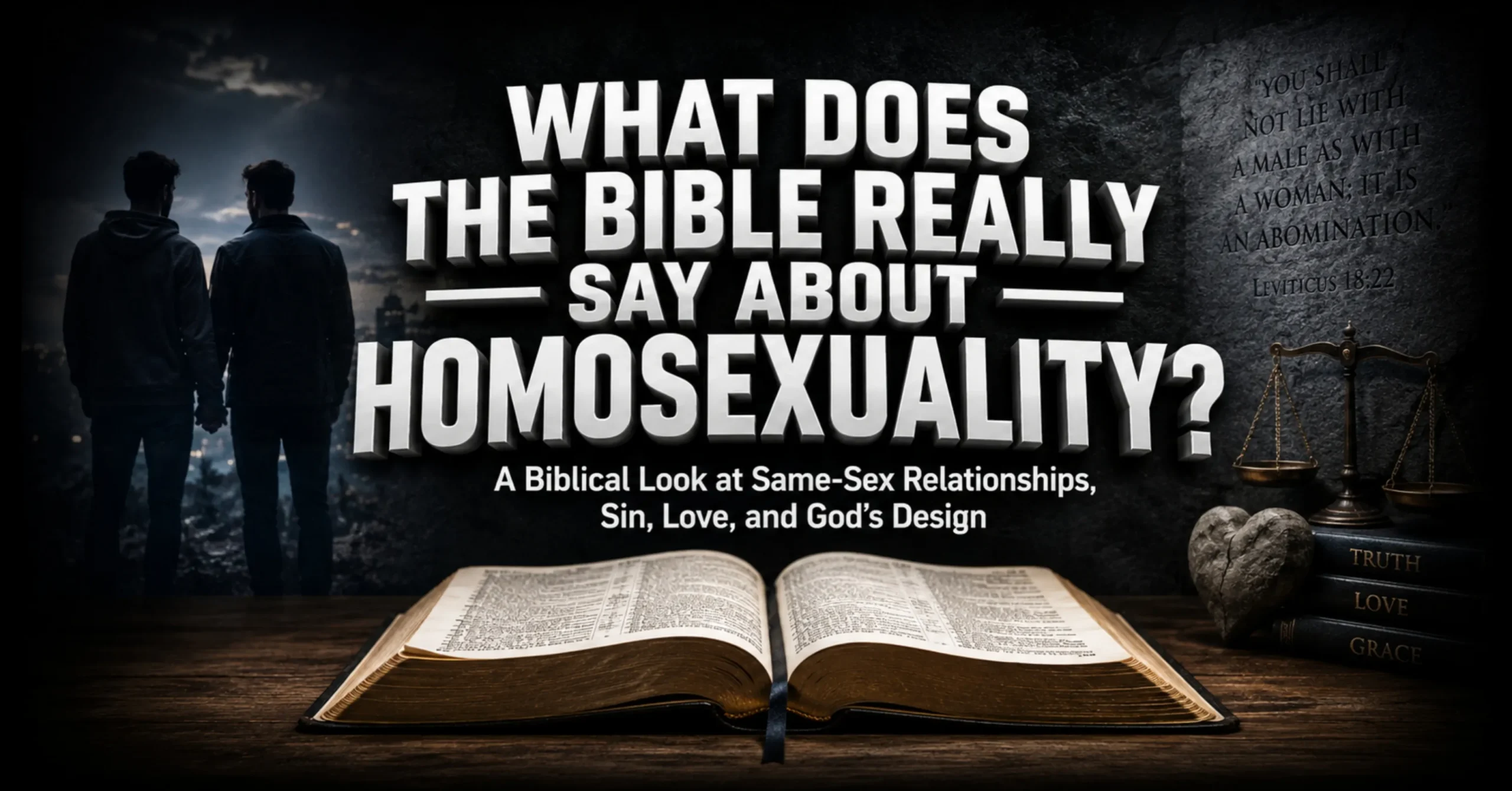
Maybe someone you love just came out to you, and you don’t know what to say back. Maybe it’s you who has carried this question quietly for years, afraid of what the answer means for your faith. Maybe you’re a parent lying awake tonight, wondering if you did something wrong. If you’re searching for what does the Bible say about homosexuality, you’re not looking for a fight. You’re looking for the truth, delivered with kindness.
The Short Answer
The Bible teaches that sexual intimacy is designed for marriage between a man and a woman, and consistently identifies homosexual behavior as outside that design. This is the traditional Christian understanding of Scripture, held across many centuries and denominations, and we won’t hide from it.
But that’s not the whole answer, and if we stop there, we’ve missed the point of the Bible entirely. It also teaches that every single person, no matter what they’ve done or felt, is deeply loved by God and can be forgiven, restored, and welcomed into His family. Both are true at once. The rest of this article walks through why.
What Does the Bible Say About Homosexuality?
Five passages traditionally form the core of this discussion. Leviticus 18:22 and 20:13, part of Israel’s holiness code, name same-sex intercourse as forbidden. Romans 1:26–27 describes men and women turning from God’s design toward “shameful lusts.” First Corinthians 6:9–11 and 1 Timothy 1:10 both list homosexual behavior among sins that separate people from God’s kingdom.
Genesis 19 is often mentioned alongside these, and belongs in the conversation, but works differently. It describes the destruction of Sodom, where the men of the city tried to assault two visitors attempted sexual violence, not a portrait of a consensual relationship. It’s a related narrative about judgment, not a direct teaching passage the way the others are.
That list can feel cold on its own, so let’s look closer.
The Original Words – What Hebrew and Greek Actually Say
The Hebrew word translated “abomination” in Leviticus is to’evah, sometimes rendered “detestable thing.” It’s strong, but its force depends on context the same term describes dishonest scales and idol worship elsewhere. It doesn’t mark this as Scripture’s single worst sin; within Leviticus 18 and 20, it marks a violation of Israel’s holiness code. Paul’s Greek word in 1 Corinthians 6:9, arsenokoitai, is one many scholars connect to the wording of Leviticus 18:22 and 20:13, though its precise meaning is debated. Reasonably clear: Paul wasn’t inventing a new judgment – he was building on something already written.
The 1946 Translation Debate
You may have heard “homosexual” only appeared in an English Bible for the first time in 1946, in the Revised Standard Version. True but the word is young, and earlier translations simply used other terms for the same Hebrew and Greek words. A 1946 translation choice doesn’t mean the text suddenly appeared that year; the real question isn’t when the English word showed up, but how the ancient terms are best translated. Caution runs both directions: “sexual orientation” as an identity category is modern and shouldn’t be read backward into ancient texts but that doesn’t mean those texts have nothing to say about the behavior itself.
What About Sodom and Gomorrah?
A common question is whether Sodom was destroyed simply because of homosexuality. It’s not that simple. Genesis 19 centers on attempted sexual violence against Lot’s guests. But Ezekiel 16:49–50, looking back generations later, points to pride, excess, and a failure to care for the vulnerable, and Jude 7 also connects Sodom with sexual immorality. Together, the picture is broader than one word cruelty and arrogance alongside sexual violence, not one cause alone.
What About Leviticus?
Christians don’t treat every Old Testament law as binding today nobody argues for a modern civil penalty from Leviticus 20:13. Jesus fulfilled the law rather than simply repeating it. So why does Leviticus 18:22 still matter? Because the New Testament doesn’t quietly drop this teaching it keeps affirming the same sexual ethic, rooted in creation and holiness, that Leviticus first pointed to.
What Did Jesus Say About Homosexuality?
Jesus never used the word. Some take His silence to mean He didn’t care, or quietly disagreed with Scripture. Neither is accurate.
When religious leaders asked Jesus about marriage in Matthew 19, He pointed straight back to Genesis: “at the beginning the Creator made them male and female,” and a man and woman become “one flesh.” Jesus treated that pattern as the standard, not one option among many. Mark 10:6–9 records Him saying nearly the same thing.
That pattern goes back to the start of the Bible. Genesis 1:27 describes humanity made “male and female,” and Genesis 2:24 describes a man joined to his wife as “one flesh.” It’s not one verse standing alone it’s the foundation Scripture builds on, from creation into marriage, into what Jesus later taught.
Jesus also said He didn’t come to throw out the Law, but to fulfill it (Matthew 5:17). He raised the bar on sexual sin, not lowered it even looking at someone with lust was serious to Him (Matthew 5:28). When Jesus had the chance to redefine marriage and sexuality for His followers, He reached for Genesis and affirmed it instead.
What Did Paul Say About Homosexuality?
Paul’s words get quoted often and understood rarely. In Romans 1, Paul isn’t listing sins to condemn one group. He’s describing all of humanity turning from God idolatry, greed, gossip, pride, and same-sex behavior all show up as symptoms of the same deeper problem. In Romans 2, he confronts the religious people who felt superior while judging everyone else. By Romans 3, he brings both groups to the same conclusion: “All have sinned,” he writes, “and fall short of the glory of God” (Romans 3:23). Paul was building a case for why every person needs grace, not a case against one kind of sinner.
First Corinthians 6:9–11 works the same way. Paul lists several sins, homosexual behavior among them but doesn’t stop there. He finishes: “such were some of you. But you were washed, you were sanctified, you were justified.” Paul doesn’t end with the warning; he moves from the seriousness of sin into the transforming grace of Christ, telling people who once lived this way they were changed not by trying harder, but by what Jesus did.
Is Being Gay a Sin?
This question deserves care, because two very different things get lumped together when people ask it.
Attraction is what you feel, without choosing it. Identity is the label a person uses. Behavior is what a person does. The Bible speaks most directly to behavior it calls sexual activity outside marriage sinful, homosexual behavior included, along with plenty of heterosexual sin, like adultery.
Feeling an attraction you didn’t choose is not automatically the same as acting on it. James 1:14–15 describes the general progression from desire and temptation toward sinful action James is speaking broadly about temptation, not addressing modern questions about orientation directly. Still, the principle applies: every human being deals with desires that don’t line up with God’s design, and Scripture often distinguishes temptation from sinful action. Being tempted is not the same as sinning. It’s being human.
It’s also worth being precise about language. The Bible doesn’t use modern categories like “gay,” “straight,” or “sexual orientation” – those developed long after Scripture was written. The biblical texts address sexual desire, behavior, marriage, and holiness directly. That’s not a reason to think the Bible has nothing to say here – it clearly does – but it’s a reason not to force ancient language into a modern box.
So the honest answer: the Bible teaches homosexual behavior is sin, the same way it teaches sex outside of marriage in general is sin. It does not teach that having an attraction makes someone more broken, more sinful, or less loved than anyone else struggling with anything at all.
Is This the Unforgivable Sin? Can Gay People Go to Heaven?
If you’re wondering whether you’re beyond hope, hear this clearly: no sin listed here is the unforgivable sin.
Jesus named only one sin as unforgivable blaspheming the Holy Spirit, meaning permanently and knowingly rejecting God’s work in your life (Mark 3:28–29). Homosexuality isn’t singled out anywhere in Scripture as a special, unforgivable category. It’s treated like every other sin: serious, real, and fully covered by what Jesus did on the cross.
Getting into heaven was never about being sinless. Ephesians 2:8–9 says salvation comes “by grace… through faith,” not by earning it. A person who has struggled with same-sex attraction their whole life, and a person who has struggled with pride, greed, or lying, stand in exactly the same place before God in need of grace, and able to receive it.
Can You Be Gay and Christian?
This question usually isn’t about labels. It’s about whether someone still belongs.
If it means, “can someone who experiences same-sex attraction follow Jesus and grow in faith?” yes, without hesitation. Attraction alone doesn’t disqualify anyone from God’s family. Many faithful Christians carry this struggle quietly for years, the same way others carry other temptations.
If it means, “can a person build their identity and life around acting on that attraction and call it fully in line with the Bible?” that’s a harder yes to give honestly, since it runs against what Scripture says about sexual behavior. But the answer still isn’t rejection. It’s an invitation to keep walking with Jesus, one step at a time (Galatians 5:16), the same invitation extended to anyone still working through areas of life that don’t yet match what God asks.
Common Objections, Answered
What About Gay Marriage?
The Bible doesn’t use the phrase “gay marriage,” but it describes what marriage is, consistently, from Genesis to the Gospels. Genesis 2:24 describes a man leaving his parents and being joined to his wife a pattern Jesus repeated Himself in Matthew 19:5. Because the Bible only ever describes marriage as between a man and a woman, it doesn’t offer same-sex marriage as an alternate version of the same thing.
Isn’t This Just Cultural Bias?
Some wonder if Paul was simply reflecting the limits of his own time, the way people once assumed the earth didn’t move. It’s a fair question. But Paul’s argument in Romans 1 isn’t built on Roman-era customs he roots it in creation itself, long before his own culture existed. And this teaching runs consistently from the Old Testament through the New, across centuries and cultures different from a single, time-bound opinion.
What the Bible Does Not Teach About Gay People
It’s worth being just as clear about what the Bible does not say. It does not teach that gay people are less valuable as human beings, or tell Christians to hate or mistreat anyone. It does not say same-sex attraction places a person beyond God’s grace, and it does not name homosexuality as some special, unforgivable category of sin. It gives no one permission to be cruel, and it doesn’t assume everyone who experiences same-sex attraction consciously chose to feel that way.
Those ideas should not be confused with what Scripture explicitly teaches.
Hope, Grace, and Where to Go From Here
Scripture doesn’t shy away from naming sin, and it calls every person toward repentance but never to leave anyone in despair. Every warning points somewhere: toward grace and reconciliation with God.
Paul told the Corinthian church, people who had lived every kind of life imaginable, “such were some of you… you were washed” (1 Corinthians 6:11). That’s the real ending to every hard passage here not condemnation, but a fresh start based on what Jesus already did. Second Corinthians 5:17 calls anyone in Christ “a new creation,” and Romans 8:1 promises “no condemnation” for those who belong to Him. That’s the whole point of the gospel.
If you’re walking through this personally, find a pastor or trusted Christian counselor who will listen without judging you. If you’re a parent, start with love, not a lecture the relationship has to survive the conversation. And if you simply came here asking what does the Bible say about homosexuality, we hope you found it, delivered the way Jesus always delivered hard truths: without flinching, and without letting go of love.
Frequently Asked Questions
How many times is homosexuality mentioned in the Bible?
Several passages address same-sex sexual behavior directly – Leviticus 18:22, Leviticus 20:13, Romans 1:26–27, 1 Corinthians 6:9–11, and 1 Timothy 1:10. Genesis 19 is a related narrative often discussed alongside them, though it centers on attempted sexual violence, not a direct teaching statement.
Is it a sin to feel same-sex attraction, or only to act on it?
Scripture addresses behavior far more directly than modern categories of orientation, and it generally distinguishes temptation from acting on it.
What does 1 Corinthians 6:9 actually mean?
Paul lists behaviors, including homosexual behavior, that reflect a life turned away from – God then immediately follows with hope: people who once lived that way were “washed” and made new through Christ.
Did Jesus ever use the word “homosexual”?
No. The word didn’t exist in His language, but He did affirm marriage as between a man and a woman when asked directly about it.
What does the Bible say about lesbian relationships specifically?
Romans 1:26 mentions women as well as men, describing both turning from God’s design for sexuality. The teaching applies regardless of which sex is involved.
Is being gay a choice, according to the Bible?
The Bible doesn’t explain where attraction comes from. It focuses on how a person responds to what they feel, not on assigning blame for the feeling.
What does the Bible say about gay people?
The same thing it says about every person that they are made in God’s image, loved by Him, and offered grace through Jesus.
Can someone change their sexual orientation?
The Bible doesn’t promise attractions will disappear. It focuses more on faithfulness and identity in Christ than on explaining how attractions form promising that hope can be found in Christ either way.

Hi, I’m Prashanta Kumbhar, a Christian blogger, faith writer, and the founder of Light and Gospel (LightandGospel.com), based in Odisha, India.
I regularly write Bible devotionals, prayers, Scripture reflections, and faith-based messages to encourage people in their daily walk with Jesus Christ and help them grow in hope, faith, and spiritual strength.
Along with blogging, I also create Christian content on my YouTube channel “The God Helps” and share faith, prayer, Bible study, and motivational messages across social media platforms like Facebook & Instagram. My mission is to make God’s Word simple, practical, & meaningful for everyday life.