
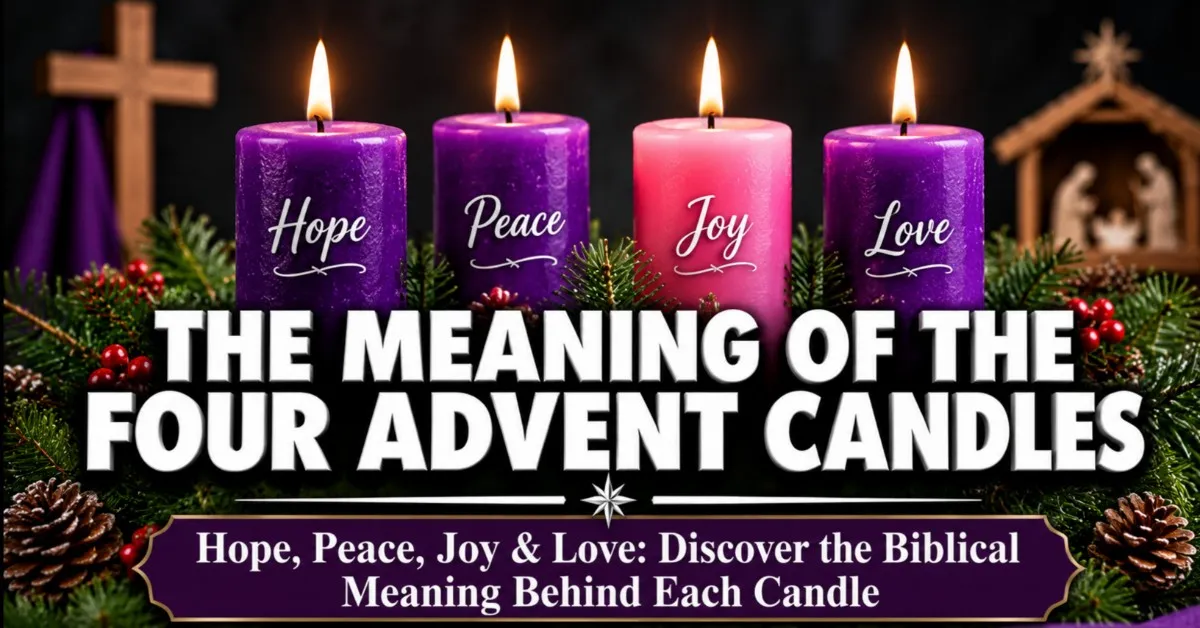
The Advent candles meaning goes beyond lighting a candle each Sunday before Christmas. For many Christians, these candles mark the weeks of preparation for Jesus’ birth and point to the hope found in Him. In one widely used tradition, the four candles represent hope, peace, joy, and love. An additional candle is lit on each Sunday as Advent progresses.
But why do some Advent wreaths have purple and pink candles while others use blue, red, or white? The answer lies in the different traditions followed by Christian churches. Although the colors and weekly themes can vary, the purpose remains much the same: to help believers prepare their hearts for Christ.
What Is an Advent Wreath?
An Advent wreath is a seasonal arrangement of candles used by many Christian churches and families during Advent. Its familiar design features four candles placed around a circle of evergreen branches. The first candle is lit on the first Sunday of Advent, and another is lit on each following Sunday.
Some wreaths also have a fifth candle in the center. This white candle, often called the Christ Candle, is usually lit on Christmas Eve or Christmas Day, depending on the church’s custom.
What Does an Advent Wreath Look Like?
A familiar church Advent wreath has four candles arranged around a circle of greenery. Many use three purple candles and one pink or rose candle, while other churches choose different colors. The arrangement may be simple or decorative. A family might place a small wreath on the dining table, while a church may display a larger one near the altar or pulpit. A fifth candle in the center is optional.
Why Do Christians Use an Advent Wreath?
The Advent wreath meaning is closely connected to the weeks of preparation before Christmas. Lighting another candle each Sunday gives families and congregations a visible way to mark the passing weeks and remember that Christmas is approaching.
The growing light can also point believers to Jesus. In John 8:12 (KJV), Jesus says, “I am the light of the world: he that followeth me shall not walk in darkness, but shall have the light of life.”
The custom developed from home devotional practices in Germany and Scandinavia, according to the United Methodist Church. Families used candles to mark the weeks of Advent and the growing light. Early arrangements did not always form a circle, and candle colors were not fixed.
Churches adapted the wreath for public worship in the late nineteenth century. More uniform arrangements and candle-lighting ceremonies developed over time. Weekly themes came later, helping explain why churches may use different candle names and colors. These differences also help explain why there is no single order or set of colors followed by every Christian tradition.
What Is the Meaning of the Advent Wreath?
The Advent wreath meaning is often found in three features: its circular shape, evergreen branches, and growing candlelight. These symbols help many Christians reflect on God’s faithfulness and the hope of Christ’s coming. They are traditional interpretations, not biblical instructions.
The Meaning of the Circular Wreath
A circle has no visible beginning or end, so it is often used to represent eternity. The wreath’s shape can remind Christians of God’s unending faithfulness and love. This is a devotional interpretation, not a biblical command to use a circular wreath during Advent.
The Meaning of Evergreen Branches
Evergreen branches stay green through winter, even when many other plants lose their leaves. In some Advent traditions, this greenery symbolizes enduring life and hope. Churches may explain it differently; it is not a fixed biblical meaning. The branches can remind believers of the hope they find in Jesus, even during difficult seasons.
The Meaning of the Growing Candlelight
Another candle is lit each Sunday, making the wreath brighter as Christmas approaches. This growing light can symbolize the anticipation of Christ’s coming and point believers to Jesus as the source of spiritual light.
John 1:4–5 (KJV) says of Jesus, “In him was life; and the life was the light of men. And the light shineth in darkness; and the darkness comprehended it not.”
The candles are not the source of the light Christians trust. They are visible reminders of Jesus, who gives life and light.
What Do the Four Advent Candles Mean?
The meaning of the four Advent candles is often explained through four themes: Hope, Peace, Joy, and Love. In one widely used tradition, each candle represents a theme for reflection during a week of Advent.
Not every church follows this same order. Some traditions use different weekly themes or connect the Sundays with particular people and events from the Bible.
First Advent Candle – Hope
The first candle is often called the Hope Candle. It represents trust in God’s promises and the expectation of the Messiah.
Isaiah 9:2 (KJV) describes people walking in darkness who see a great light. Christians understand this prophecy in connection with Jesus, the promised Savior.
Romans 15:13 describes God as the source of hope and expresses a prayer that believers will be filled with joy and peace as they trust in Him. Although the verse does not refer to Advent, its message fits the hope represented by this candle.
For families who follow this tradition, the first Sunday of Advent is an opportunity to reflect on God’s faithfulness, even when circumstances are uncertain.
Second Advent Candle – Peace
The second candle is often associated with Peace. Isaiah 9:6 (KJV) calls the promised Messiah the “Prince of Peace.”
Christians believe that Jesus brings reconciliation between God and humanity through His saving work. He also offers His followers peace during fear, grief, and uncertainty. This promise does not mean that believers will never face hardship.
In John 14:27 (KJV), Jesus tells His disciples, “Peace I leave with you, my peace I give unto you.” His words point to a peace that does not depend on everything around us going well.
The second candle offers a moment to reflect on the peace Christ gives and the importance of showing peace to others.
Third Advent Candle – Joy
The third candle is commonly called the Joy Candle. In the traditional arrangement of three purple candles and one rose candle, it is the pink or rose candle.
It is lit on the Third Sunday of Advent, known as Gaudete Sunday. Gaudete is Latin for “rejoice.” The day emphasizes joy as Christmas draws near. In Catholic worship, rose vestments may also be worn. The United States Conference of Catholic Bishops explains the connection between the rose candle and Gaudete Sunday.
In Luke 2:10–11, an angel announces “good tidings of great joy” to the shepherds: the Savior, Christ the Lord, has been born.
The Joy Candle points to the joy Christians find in Jesus. That joy is not limited to Christmas celebrations, gifts, or favorable circumstances.
Fourth Advent Candle – Love
The fourth candle is often associated with Love. It represents God’s love revealed through the gift of Jesus Christ.
John 3:16 (KJV) begins, “For God so loved the world, that he gave his only begotten Son.” The verse connects God’s love with the gift of His Son.
First John 4:9 (KJV) also explains that God’s love was revealed when He sent His only begotten Son into the world so that we might live through Him.
As Christmas approaches, the fourth candle invites believers to reflect on God’s love and the love Jesus demonstrated through His life and ministry.
What Are the Advent Candle Colors and Their Meanings?
Advent candle colors vary among Christian traditions. Purple and rose are familiar in many Western liturgical churches, while some churches use blue, red, or white. The colors may reflect the season or a particular Sunday, but they do not follow one universal rule.
Purple Advent Candles
Purple is used in many Western liturgical traditions during Advent. In Catholic practice, it is associated with prayer, penance, and preparation for Christmas.
In the familiar purple-and-rose arrangement, three purple candles are lit on the First, Second, and Fourth Sundays of Advent. The United States Conference of Catholic Bishops (USCCB) identifies purple as the traditional color for these three candles.
Pink or Rose Advent Candle
The pink or rose candle is usually lit on the Third Sunday of Advent, known as Gaudete Sunday. Its color marks a Sunday of rejoicing as Christmas approaches.
Not every church uses a rose candle. Some wreaths have four candles of the same color, while others follow a different arrangement.
Blue Advent Candles
Some churches use blue candles instead of purple. The Church of England’s Common Worship guidance allows four red or blue candles around a white or gold central candle. It also describes an alternative arrangement of three purple candles and one pink candle.
This is a recognized option in that guidance, not a universal color requirement for all Anglican or Protestant churches. You can read the details in the Church of England’s Advent wreath guidance.
White Advent Candles
Some traditions use white candles for the four weekly Advent candles. The USCCB also recognizes white as an option.
White is also commonly used for a separate candle placed in the center of the wreath. Known as the Christ Candle, it represents Christ and is usually lit on Christmas Eve or Christmas Day, depending on the church’s custom. It is not one of the four weekly candles.
What Is the Order of Lighting Advent Candles?
The order of lighting Advent candles follows the four Sundays of Advent. Start with the first candle on the First Sunday, then light one additional candle each week. In most traditions, candles lit on earlier Sundays are lit again.
- First Sunday of Advent: Light the first candle. In the Hope, Peace, Joy, and Love tradition, this is the Hope Candle.
- Second Sunday of Advent: Relight the first candle and light the second. Two weekly candles are now burning.
- Third Sunday of Advent: Relight the first two candles and light the third. In the purple-and-rose tradition, the third candle is pink or rose and marks Gaudete Sunday.
- Fourth Sunday of Advent: Relight the first three candles and light the fourth. All four weekly candles are now burning.
| Advent Sunday | Candles to Light |
|---|---|
| First Sunday | First candle |
| Second Sunday | First and second candles |
| Third Sunday | First, second, and third candles |
| Fourth Sunday | All four candles |
Families may light the candles during a meal, family prayer, or a short Scripture reading. Churches often include the lighting in a Sunday service. Candle placement can vary, and there is no universal requirement to light the candles clockwise or counterclockwise.
Families who would like to include prayer in this tradition can also read these Advent prayers together during the season.
What Is the Fifth Advent Candle?
Some Advent wreaths include a fifth candle in the center, called the Christ Candle. It is optional and separate from the four candles lit during Advent.
The Meaning of the White Christ Candle
The Christ Candle draws attention to Jesus Christ and the celebration of His birth. In the Church of England’s Common Worship guidance, the central candle may be white or gold and is lit on Christmas Day. Other churches and families may light it on Christmas Eve or Christmas Day, according to local custom.
John 1:9 (KJV) describes Jesus as “the true Light, which lighteth every man that cometh into the world.” The candle serves as a reminder of Christ, the Light Christians celebrate at Christmas.
A wreath with four candles and no Christ Candle is also a complete Advent wreath.
Do All Christians Use the Same Advent Candle Traditions?
No. Christian communities do not all follow the same Advent wreath customs. Candle colors, weekly themes, and lighting practices can vary between churches and families.
Catholic Advent Candle Traditions
Many Catholic churches and families use three purple candles and one rose candle. The rose candle is lit on the Third Sunday of Advent, known as Gaudete Sunday.
The United States Conference of Catholic Bishops (USCCB) describes this as the traditional arrangement and also recognizes white candles as an option. These details reflect Catholic guidance, not rules followed by every Christian denomination.
Protestant and Evangelical Advent Candle Traditions
Protestant and Evangelical churches may use different candle colors and weekly themes. Some follow the familiar purple-and-rose arrangement, while others use blue, red, or white candles.
Some congregations use Hope, Peace, Joy, and Love as their weekly themes. Others connect each Sunday with particular people or events from Scripture. There is no single arrangement followed by all Protestant or Evangelical churches; local church practices often determine how the wreath is used.
Why Do Advent Candle Meanings Differ?
Advent wreath customs developed over time, and churches adopted different ways of explaining the candles. Weekly themes were added as the tradition became part of church worship.
The United Methodist Church’s historical explanation describes how church-supply resources helped popularize weekly candle themes during the twentieth century. One sequence was Hope, Love, Joy, and Peace, while other churches use Hope, Peace, Joy, and Love.
The Church of England’s Common Worship guidance offers another approach. It connects the four Sundays with the Patriarchs, Prophets, John the Baptist, and the Virgin Mary. Its guidance also includes a central candle representing Christ.
These differences show why Hope, Peace, Joy, and Love should be understood as one common arrangement, not the official meaning of the four Advent candles for every Christian tradition.
What Does the Bible Say About Advent Candles?
The Bible does not command Christians to use an Advent wreath or follow a four-candle lighting ceremony. These are church and family traditions that developed to help believers reflect during the weeks before Christmas.
However, the themes often associated with Advent candles have biblical foundations. Scripture speaks about hope, peace, joy, and love, and it describes Jesus as the Light of the World.
John 1:4–5 and John 8:12 point to the light and life found in Christ. Luke 2:10–11 records the angel’s announcement of the Savior’s birth, while John 3:16 reveals God’s love through the gift of His Son.
Lighting Advent candles can give families an opportunity to reflect on these biblical truths. However, using an Advent wreath is not a biblical requirement. Christians can faithfully celebrate Jesus’ birth without following this particular tradition.
To read more about the events Christians remember at Christmas, see the Christmas story in the Bible.
Frequently Asked Questions About Advent Candles
What Are the Four Advent Candles Called?
In one common Christian tradition, the four Advent candles represent Hope, Peace, Joy, and Love. Other churches use different weekly themes, so these names are not universal.
Why Is the Third Advent Candle Pink?
The third candle is often pink or rose because it is lit on Gaudete Sunday, a traditional Sunday of rejoicing during Advent. Its color marks a change from the purple used in many Western liturgical traditions.
Do You Light All Four Advent Candles at Once?
No. One candle is added each Sunday, and previously lit candles are usually relit. By the Fourth Sunday of Advent, all four weekly candles are burning.
Which Advent Candle Do You Light First?
The first candle is lit on the First Sunday of Advent. In the Hope, Peace, Joy, and Love tradition, it is commonly called the Hope Candle.
Does the Advent Wreath Need a Fifth Candle?
No. A fifth candle is optional. When included, it is usually a white Christ Candle placed in the center and lit on Christmas Eve or Christmas Day, depending on the church’s custom.
Can Advent Candles Be Blue Instead of Purple?
Yes. Some churches use blue candles instead of purple. The Church of England’s Common Worship guidance, for example, allows four blue or red candles around a white or gold central candle. Other churches follow different arrangements.
Conclusion
Advent candles offer Christians a simple way to mark the Sundays before Christmas and reflect on the hope found in Jesus Christ. Although candle colors and weekly themes vary among churches, the purpose of the wreath is to turn attention toward Christ.
As you light each candle, take time to remember Jesus’ first coming and look forward with hope to His promised return. You can also use this season to prepare your heart for Christmas through prayer, Scripture, and time spent with others.

Hi, I’m Prashanta Kumbhar, a Christian blogger, faith writer, and the founder of Light and Gospel (LightandGospel.com), based in Odisha, India.
I regularly write Bible devotionals, prayers, Scripture reflections, and faith-based messages to encourage people in their daily walk with Jesus Christ and help them grow in hope, faith, and spiritual strength.
Along with blogging, I also create Christian content on my YouTube channel “The God Helps” and share faith, prayer, Bible study, and motivational messages across social media platforms like Facebook & Instagram. My mission is to make God’s Word simple, practical, & meaningful for everyday life.