
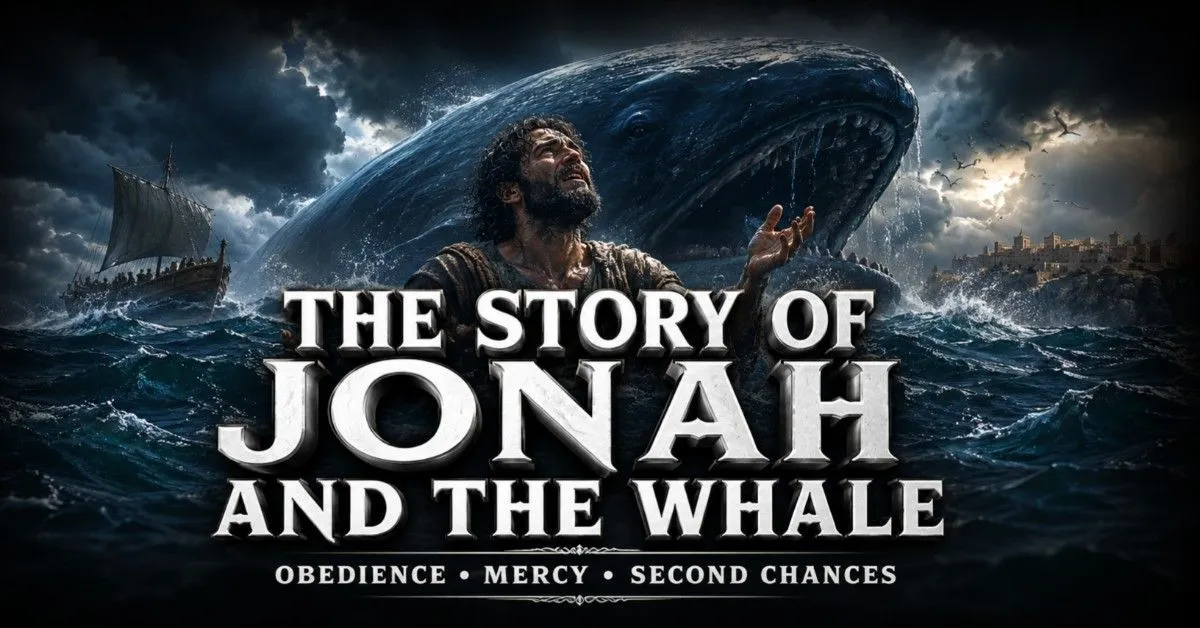
Jonah knew what God wanted. God had spoken to him before, and Jonah had always known his voice. This time was no different. God told Jonah to go to Nineveh, a great city, and warn its people that he had seen their wickedness.
Jonah did not go.
Instead, he packed what he needed and walked toward Joppa, in the opposite direction. A ship was waiting there. He thought he could sail away from what God had asked him to do. He did not yet know what was waiting for him on the sea.
This is the story of Jonah and the whale, and it does not begin with Jonah being brave.
God’s Call to Jonah
Jonah was a prophet, the son of Amittai. God had used him before to carry messages to Israel, and people had listened. Jonah knew what it sounded like when God spoke, and he knew what it meant to obey. This was not new to him.
So when the word of the Lord came to him, he understood it clearly. Go to Nineveh, God said. It was a great city, and its wickedness had come up before him.
Jonah had heard of Nineveh. Everyone had. It was the capital of Assyria, and Assyria had brought years of suffering to Israel, war after war, city after city. If any place in the world deserved to be warned and then destroyed, in Jonah’s mind, it was this one.
God did not explain further. He simply told Jonah to go and cry out against it.
Jonah said nothing back. He did not argue with God or ask to be excused. He did not fall to his knees and beg for a different task. He simply stood there for a moment, turned around, and began walking the other way.
It was not confusion that made him leave. Jonah understood the command perfectly well. He understood it well enough to know exactly where he did not want it to lead.
Jonah Runs Away
Jonah went down to Joppa. It did not take him long to find what he was looking for: a ship, ready to sail, heading to Tarshish.
Tarshish was far. It was about as far from Nineveh as a man could travel by sea. God had said go east. Jonah was going west, as far in the other direction as a ship could carry him.
He paid the fare and climbed aboard. No one on the ship knew who he was or what he was running from. To them, he was simply another passenger, one more traveler heading somewhere across the water.
There was no argument on the dock, no wrestling with the decision in front of anyone. Jonah simply did what he had already decided to do. He walked up the plank, found his place among the crates and ropes, and went below deck.
Down there, away from the sailors and the wind, he found a quiet corner and lay down.
The ship pulled away from the shore. The sea was calm. Jonah closed his eyes.
He fell asleep, and the ship carried him further from Nineveh with every passing hour.
The Storm at Sea
Not long after the ship left land, the wind began to change.
It grew stronger, then stronger still, until it was no longer wind but something closer to a wall pressing against the ship. The sea rose in waves taller than the sailors had ever seen. The ship groaned and pitched, and water began to break over the sides, soaking the deck, filling the ropes with spray.
The sailors had crossed this sea many times. They knew what an ordinary storm felt like, the kind that passed after an hour or two. This did not feel ordinary. It kept building, wave after wave, as though the sea itself had a reason to be angry.
Each man began to cry out to his own god, hoping someone would answer. They ran along the deck, throwing cargo into the sea, trying to make the ship lighter, trying to keep it from breaking apart.
Below deck, none of it reached Jonah. He was still asleep.
The captain found him there and shook him awake. How can you sleep at a time like this, he said. Every man up there is calling out to his god. Get up. Call out to yours. Maybe your god will notice us and we will not die.
Jonah went up onto the deck, but the storm did not stop.
The sailors turned to each other. Someone on this ship has brought this trouble, they said. Let us find out who. They cast lots, a way sailors had of asking a question they could not answer themselves.
The lot fell on Jonah.
They surrounded him. Tell us, they said. Why has this happened to us? What do you do? Where do you come from? What is your country? Who are your people?
Jonah answered them plainly. I am a Hebrew, he said. I worship the Lord, the God of heaven, who made the sea and the dry land.
The sailors grew even more afraid when they heard this. What have you done, they said, because they already knew he was running from this God.
The sea was growing wilder by the moment. What should we do to you, they asked him, so that the sea will calm down for us?
Pick me up, Jonah said, and throw me into the sea. Then it will become calm. I know this storm has come because of me.
The sailors did not want to do it. These men had spent the whole storm trying to save the ship, and now they did not want to save it by taking a man’s life. Instead, they rowed harder, trying to get the ship back to land. But the sea only grew rougher, the waves rising higher against them no matter how hard they pulled at the oars, no matter how many hands gripped each one.
Finally, they turned toward Jonah’s God themselves, the God of a passenger they had never met before that morning. Please, Lord, they prayed, do not let us die for taking this man’s life, and do not hold us responsible for killing an innocent man. You, Lord, have done as you pleased.
Then they picked Jonah up and threw him into the sea.
The moment he hit the water, the storm stopped. The wind died completely. The waves grew still, as if a hand had simply reached down and smoothed them flat.
The sailors stood on the deck in silence, staring at the sea around them, at the sky that had been screaming moments before and was now calm and quiet. Then, filled with a fear they had not expected, greater than the fear of the storm itself, they offered a sacrifice to the Lord and made vows to him, right there on the ship.
Jonah and the Great Fish
Jonah sank into the sea.
He went down through the water, past where light could reach, deeper than he had ever been. There was nothing to hold onto, nothing to swim toward. The water pressed in around him from every side, cold and heavy, and he sank further with each passing moment. There seemed to be no way this would end any other way than in his death.
But God had not finished with Jonah.
He sent a great fish, and it swallowed Jonah whole.
The Bible calls it a great fish. Over the years, people have often told the story as Jonah and the whale, but the words God’s people used for it simply meant something enormous, living in the sea, sent to save him rather than destroy him.
Inside the fish, there was no light at all. No sound but the slow movement of water somewhere outside him, and his own breathing. Jonah could not stand, could not see his own hands in front of him. He was alive. He did not understand fully how. He had been sinking toward death only moments before, and now he was here instead, in the dark, alone, with nothing to do but wait.
He stayed there for three days and three nights.
Jonah Prays in the Deep
Inside the fish, Jonah prayed.
He remembered the sea closing over him, the waves and the water pulling him down, seaweed wrapping around his head, the roots of the mountains seeming to rise up around him like a door that would never open again. He remembered thinking he had been driven away from God completely, that he would never again look toward anything holy.
But even there, at the bottom of everything, he had cried out. And God had heard him.
You brought my life up from the pit, Jonah prayed. When I had nothing left, when my life was slipping away from me, I remembered the Lord, and my prayer came to you, into your holy temple.
There was nowhere left for Jonah to run to. No ship, no road, no city to hide in. There was only the dark, and God, and Jonah’s own voice reaching out through it. It was the quietest, most honest place Jonah had been in the whole story so far. He had spent his strength running. Now, with nothing left to run with, he simply prayed.
I will give thanks to you, he said. What I have promised, I will do. Salvation belongs to the Lord.
Then God spoke to the fish, and it carried Jonah toward the shore. It opened its mouth, and Jonah was thrown out onto dry land.
He lay there for a moment, soaked through, the sand solid and still beneath him, sunlight touching his face for the first time in three days. He was alive. And the same command God had given him before was still waiting for him, exactly where he had left it.
Jonah Goes to Nineveh
God spoke to Jonah a second time. Go to Nineveh, he said again, and give the city the message I give you.
This time, Jonah went.
Nineveh was enormous, so large it took three days to walk across. Jonah began walking into it, and after just one day’s journey inside the city, he started to speak. Forty more days, he called out, and Nineveh will be overthrown.
He said nothing else. He did not explain himself or soften the words. He simply delivered the warning and kept walking, calling it out again in the next street and the next.
Something happened that Jonah had not expected.
The people who heard him believed God. One person told another. A merchant heard it in the marketplace and told his neighbor. A neighbor told his family. The message spread through the streets faster than Jonah could have carried it himself, faster than anyone could have planned. People stopped what they were doing. They put on rough clothing as a sign of sorrow, and they stopped eating, from the most important people in the city down to the least.
Word reached the king. When he heard it, he rose from his throne, took off his royal robes, and put on the same rough clothing everyone else was wearing. He sat down in ashes, a king with no crown, sitting in the dust like the poorest person in his own city.
Then he sent out an order across the whole city. No person and no animal was to eat or drink anything. Everyone was to call out to God with everything they had, and turn away from the wrong they had done and the violence that had filled their hands. Who knows, the king said. God may yet change his mind and spare us.
God saw what they did. He saw that they had turned from their evil ways, every one of them, from the throne down to the streets.
And God relented. The disaster he had warned them about did not come.
Jonah Is Angry
Jonah did not celebrate.
He was displeased, and angry, and he said so directly to God. Isn’t this exactly what I said would happen back home, he said. This is why I ran to Tarshish in the first place. I knew you were a gracious God, merciful, slow to anger, and full of love, the kind of God who would change his mind about destroying people. Now, Lord, take my life. I would rather die than see this.
There it was, finally spoken out loud. The reason for the ship, the sleeping below deck, all of it. Jonah had not run because he doubted God. He had run because he knew exactly what God was like, and he had not wanted Nineveh to receive it.
God asked him a simple question. Is it right for you to be angry?
Jonah did not answer.
He walked out of the city instead, found a place east of it, and built himself a small shelter. Then he sat down to wait and see what would happen to Nineveh, as if some part of him was still hoping for the worst, still waiting for the forty days to somehow come true after all.
The Plant and God’s Question
While Jonah sat there in the heat, God caused a plant to grow up over him. Its leaves spread out wide and gave him shade, cooling him from the sun that had been beating down on his shelter all day. Jonah was very happy about the plant. It was a small comfort, but it was the first thing that had made him glad in a long while.
But the next morning, at dawn, God sent a worm, and it chewed at the plant’s stem until the leaves curled and the whole thing withered and died.
When the sun rose fully, God sent a hot east wind to blow across the hillside, and the sun beat down on Jonah’s bare head until he grew faint and dizzy in the heat. He asked to die again. It would be better for me to die than to live, he said.
God spoke to him. Is it right for you to be angry about the plant?
It is, Jonah said. Angry enough to die.
Then God said, You have been concerned about this plant, even though you did not plant it or make it grow. It sprang up in a single night, and it died in a single night.
Should I not be concerned about Nineveh, that great city, where more than a hundred and twenty thousand people live who cannot tell their right hand from their left, and many animals as well?
Jonah did not answer.
The story ends there, with God’s question still hanging in the air, and Jonah sitting outside the city in silence.
FAQ About The Story of Jonah and the Whale
1. Is the story of Jonah and the Whale a true story?
Some readers understand it as a historical account, while others read it as a parable meant to carry a deeper truth. The debate centers on genre, not on whether the moral message is meaningful either way.
2. Was it really a whale, or a great fish?
The original text uses the words “great fish,” not “whale.” The word whale became attached to the story later, through translation and popular retelling, though the Bible itself never names the species.
3. Where is the story of Jonah and the Whale found in the Bible?
It’s told in the Book of Jonah, in the Old Testament, across four short chapters.
4. How long was Jonah inside the fish?
Three days and three nights, a phrase that in that time often meant “until the third day,” not necessarily a full seventy-two hours.
5. What is the moral of the story of Jonah and the Whale?
That God’s mercy reaches further than we expect, even to people we think don’t deserve it and it leaves the reader with the same question Jonah faced: can we accept that mercy when it isn’t aimed at us?

Hi, I’m Prashanta Kumbhar, a Christian blogger, faith writer, and the founder of Light and Gospel (LightandGospel.com), based in Odisha, India.
I regularly write Bible devotionals, prayers, Scripture reflections, and faith-based messages to encourage people in their daily walk with Jesus Christ and help them grow in hope, faith, and spiritual strength.
Along with blogging, I also create Christian content on my YouTube channel “The God Helps” and share faith, prayer, Bible study, and motivational messages across social media platforms like Facebook & Instagram. My mission is to make God’s Word simple, practical, & meaningful for everyday life.